The $200 Coffee Maker I Regret, and the Analog Life Experiment It Accidentally Started


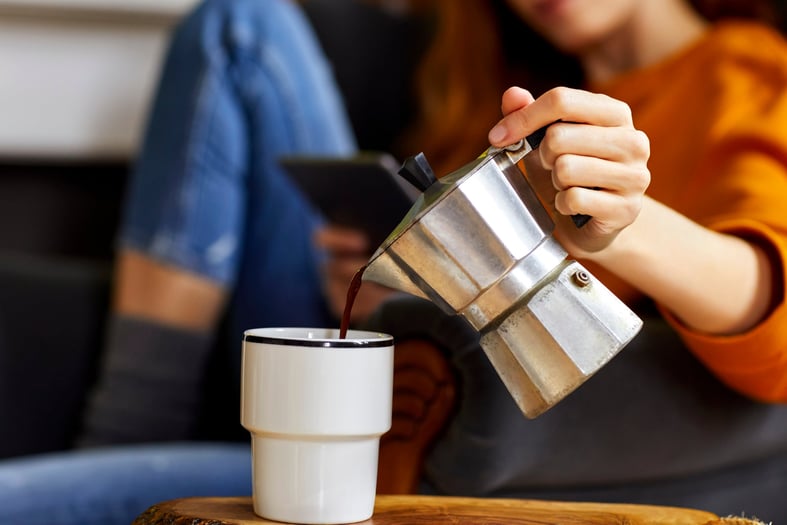
It all started with the world’s most overengineered coffee maker.
It boasted customized brew sizes, hot and cold brew, and the feature that ultimately sold me: a hot water dispenser (a must in our house since herbal tea is part of our daily bedtime routine).
At almost $200, it was a lot of money for something that wasn’t an imported espresso machine, in my humble opinion, but I went for it.
It was a disaster.
No less than eight knobs and buttons were involved no matter what you were trying to do. Fail to turn the dial from “half pot” to “12 ounce” when brewing evening tea, and I’d be mopping a lake of water off the counter at 10 pm.
(I documented all the gory details in a very long Amazon review.)
 Image courtesy of Beth Buczynski
Less than two years after shelling out for this behemoth, we found ourselves having a conversation about buying a new coffee maker. Ugh.
And then I had an idea. What if — instead of buying yet another modern machine destined to disappoint us — we went old school?
Like, all-the-way-back-to-the-19th-century, old school.
We bought a $43 stovetop percolator.
The basic design dates back to the 19th century (that’s how you know it’s good): a stainless steel body, a wooden handle that stays cool, and a real glass porthole on top that lets me watch the coffee brewing.
 Image courtesy of Beth Buczynski
Yes, the whole process of making my morning cup now takes longer.
Yes, cleanup is a bit more involved.
But there are no electronic bits to fail and no cleaning cycle that wastes gallons of water.
I half expected to resent the extra effort. Instead, I started to like it. The ritual of grinding the beans, filling the pot and waiting for that first gurgle has become my favourite part of the morning.
I wanted more. Turns out, I’m not alone.
Friction is having a moment
In early 2026, writer and sociologist Kathryn Jezer-Morton used the term friction-maxxing to describe the practice of intentionally making one’s life harder, often by choosing analog alternatives. In an essay for The Cut, she examined the extreme convenience of what she called “digital padded rooms of predictive algorithms and single-tap commands” and argued that this convenience saps our resilience and creativity. Friction-maxxing (a friendly poke at the internet’s tendency to “-maxx” everything) is Jezer-Morton’s counterpoint to what she calledto this “forced escapism.” It’s the deliberate choice to embrace small inconveniences in a world built to remove every obstacle. It’s purposefully resisting technology-driven ease. And in doing so, feeling more alive again. It’s not “simply a matter of reducing your screen time, or whatever,” she writes. “It’s the process of building up tolerance for ‘inconvenience’ (which is usually not inconvenience at all but just the vagaries of being a person living with other people in spaces that are impossible to completely control) — and then reaching even toward enjoyment.”
Low-key loving the analog
Without really knowing it, the coffee maker experiment thrust me into the world of friction-maxxing.
For me, it was part rebellion against a culture that offered an easy button at every turn, but also part exhaustion at feeling swindled.
All these fancy gadgets and subscription-based miracle cures and nothing delivered. I was left feeling disappointed and disconnected by experiences that were supposed to do the opposite.
I wanted off the costly conveyor belt.
Rejecting the coffee maker went so well, I decided to look for other areas where I could solve dissatisfaction with difficulty.
3 more swaps I've made so far
Streaming → CDs
Instead of renting access to millions of songs, I’ve started buying entire albums directly from the artists I love. I enjoy the tangible nostalgia of crinkly jewel cases and colourful liner notes (full lyrics without Googling!). And I feel good because the artist likely gets a more meaningful cut of the proceeds.
The friction: Sure, one CD costs roughly the same as a month of premium music streaming ($12-19 dollars), so this swap isn’t automatically a money-saver. But I just pay once and then own — really own — the album forever.
No CD player? No problem. Some of my Nerdy colleagues opt for vinyl records instead of streaming services. Record collecting can be a more expensive hobby, but there are plenty of ways for vinyl addicts to save some cash on their next LP.
Fast fashion → slow thrifting
I still shop from my couch, but now it's through online thrift stores like ThredUp, Depop and People’s Thrift (here’s a list of other options). Before a recent business trip, I scored a like-new Banana Republic blazer for $25 (it retails for $119).
The friction: Online consignment platforms have limited, dynamic inventory (i.e. you can't always find what you want) and delivery can take several weeks, depending on the seller and destination.
New books → the library
Glorious, physical books, free from the library. Need I say more? I’ve also rediscovered the pleasure of browsing without an algorithm telling me what I’d like.
The friction: When my tiny rural library doesn’t have a book (or it’s checked out), I have to join an online queue or wait for it to be brought in from another branch. But honestly, that just makes pick up day more exciting.
» MORE: Tight on cash? The Library Is Your New BFF
Is friction-maxxing worth it?
Ultimately, friction-maxxing (or whatever you want to call it) is a pushback. I am realizing (remembering?) that a little effort can make some things more satisfying.
And there’s a money angle. Friction can slow you down at exactly the moment spending feels too easy. It gives you a chance to ask: Do I really need this? Right now? Could I delay gratification for something even more meaningful?
For me, the trade-offs have totally been worth it. But my swaps might not be right for your life.
If you want to try friction-maxxing, start small. Pick one convenient thing that’s not really serving you and ask: what would a simpler alternative cost me in money — and pay me in joy?
You might be surprised by the answer.
Sources
NerdWallet writers are subject matter authorities who use primary, trustworthy sources to inform their work, including peer-reviewed studies, government websites, academic research and interviews with industry experts. All content is fact-checked for accuracy, timeliness and relevance. You can learn more about NerdWallet's high standards for journalism by reading our editorial guidelines.
- The Cut. In 2026, We Are Friction-Maxxing. Accessed Oct 20, 2026.
DIVE EVEN DEEPER


