As The Earth Quakes, The Bank of Canada Stands Its Ground


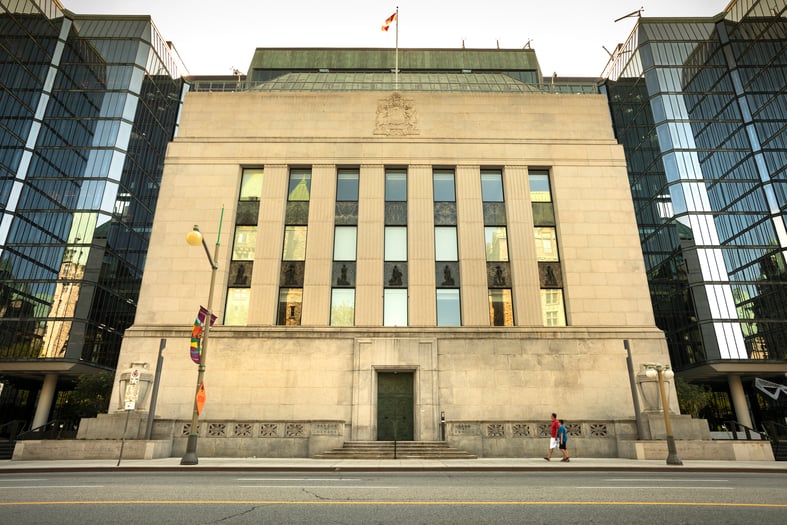
In the nearly three weeks since the Iran war started, oil prices have been jolted to more than $97 USD a barrel, government bond yields have spiked, and inflation fears have come roaring back.
If the conflict drags on, the Bank of Canada may be forced to act. But not yet.
On March 18, the Bank maintained its overnight rate at 2.25%, its third consecutive rate hold. The restraint wasn’t a surprise. The Bank, like any entity watching the conflict closely, is having its vision blurred by the fog of war. While the impact on oil prices has been swift, the war’s overall effect on the Canadian economy remains a mystery.
It’s simply too soon for an institution as risk-averse as the BOC to jump to any conclusions. Though employment weakened in February, inflation is hovering around the Bank’s 2% target. Dropping the overnight rate could fuel inflation at a time when actual fuel seems poised to do the same thing.
A rate hold won’t be cheered by consumers carrying variable-rate debt. Nothing changes for them. For someone considering a home purchase or facing a mortgage renewal, variable rates remain affordable, and may soon be the only viable option left.
But that doesn’t necessarily simplify things.
How war bleeds into the housing market
Of all the considerations that go into getting a mortgage, the removal of a theocratic regime 10,000 km away probably doesn’t top the list for most home buyers. However, it might move up a few spots for the next several weeks.
Government bond yields, specifically the yields on three- and five-year bonds, are used by lenders to price their three- and five-year fixed mortgage rates. These yields were blown through the roof during the first two weeks of the war— rising by 54 and 42 basis points, respectively — before moderating this week, as investors reacted to increased oil prices and their potential impact on future Bank of Canada decisions.
Several lenders and brokerages have already responded to the higher yields by increasing their fixed mortgage rates. Outside of a few exceptions, three- and five-year fixed rate offers are generally 3.85% or more at national brokerages, and far higher at Canada’s Big Six banks.
The increases haven’t been massive, but they might not be over. Another 10- or 20-basis point jump and sub-4% fixed rates will be the war’s next casualty. If we reach that point, home buyers, especially those dependent on a low rate to qualify, will really only have one choice: Go variable.
Variable mortgage rates can be found for around 3.4% and provide far more flexibility than fixed rates, a major selling point in times of economic uncertainty.
But as anyone who took on a variable-rate mortgage during the pandemic will tell you, they can be hell if inflation flares up and the Bank of Canada needs to hike the overnight rate to tamp it down.
That could happen. If the Iran war delivers a lasting inflationary shock to the economy, it might force the Bank’s hand. Sharon Kozicki, deputy governor of the Bank of Canada, recently made headlines by telling an audience in Oslo that “at times, monetary policy needs to be tightened even when the economy is weak.”
This all puts home buyers in an awkward position. Fixed rates provide predictability but could soon be prohibitively expensive. Variable rates are affordable, but carry the risk of increasing sooner than many buyers might be comfortable with.
With household budgets stretched thin as it is, increased rate uncertainty could become one more obstacle standing in the way of Canada’s housing rebound.
What comes next for the housing market?
Here are three possibilities.
Let’s say hostilities in the Middle East drag on until the next Bank of Canada decision, which is scheduled for April 29. Fixed rates, oil prices and inflation all increase while the Canadian economy falters.
In this bleak scenario, the Bank of Canada raises the overnight rate. Variable mortgage rates climb to at least 3.65%. Home buyers, worried about further rate hikes, reject variables but can't afford fixed rates that have risen above 4%.
Or maybe the war ends in a few days, the Strait of Hormuz is unblocked, and our oil-addicted economy gets its much needed fix. Lower bond yields, more affordable mortgages and a general sense of relief co-mingle to spark a mild bump in sales that lifts the spring housing market.
A third possibility is that buyers with sufficient buying power ignore the conflict completely and buy homes according to their own desires — a pleasant thought, but how many of these confident buyers are out there?
Whatever happens to the Canadian housing market in the coming weeks is somewhat beyond our control. It’ll depend at least a little, but still far too much, on the actions of men dropping bombs in the Middle East.


DIVE EVEN DEEPER


