The Best No-Fee Credit Cards in Canada


Summary: Best no annual fee credit cards in Canada
BACK TO TOP| Card | NerdWallet rating | Our pick for: | Apply Now |
|---|---|---|---|
| Scotiabank American Express® card | APPLY NOW on Scotiabank's website | ||
 APPLY NOW on Scotiabank's website | 5.0/5 | Best overall | |
| Tangerine® Money-Back World Mastercard®* | APPLY NOW on Tangerine's website | ||
 APPLY NOW on Tangerine's website | 4.9/5 | Custom bonus categories | |
| BMO CashBack® Mastercard®* | APPLY NOW on BMO's website | ||
 APPLY NOW on BMO's website | 4.5/5 | Grocery cash back | |
| BMO eclipse rise Visa Card* | APPLY NOW on BMO's website | ||
 APPLY NOW on BMO's website | 4.0/5 | Rewards on bills | |
| CIBC Adapta™ Mastercard® | APPLY NOW on CIBC's website | ||
 APPLY NOW on CIBC's website | 5.0/5 | Auto-optimized rewards | |
| Home Trust No Fee Preferred Visa card | APPLY NOW on Home Trust's website | ||
 APPLY NOW on Home Trust's website | 4.1/5 | No FX fees | |
Best No-Fee Credit Cards in Canada
BACK TO TOPScotiabank American Express Card

View details
Points on every $1 you spend at Sobeys, Safeway, Freshco and more.
Points for every $1 you spend on restaurants, fast food, drinking establishments. Includes popular food delivery and food subscriptions.
Points for every $1 you spend on eligible grocery stores.
Points for every $1 you spend on eligible entertainment purchases. Includes movies, theatre and ticket agencies stores.
Points for every $1 you spend on eligible gas.
Points for every $1 you spend eligible daily transit. Includes rideshares, buses, subway, taxis and more.
Points for every $1 you spend on eligible select streaming services.
Point for every $1 spent on all other eligible everyday purchases.
The Scotiabank American Express Card offers solid Scene+ point rewards on everyday purchases like groceries and dining — all with no annual fee and a few built-in perks.
Pros
- Great earn rates on everyday purchases.
- Includes mobile device insurance.
- Enjoy special offers, experiences and more with American Express Invites.
Cons
- Limited insurance — only includes mobile device coverage, purchase security, and extended warranty.
- No Amex Membership Rewards — only earns Scene+ points, which have limited redemption options and can’t be transferred to airline or hotel programs.
- Earn up to 10,000 bonus Scene+ points within your first 3 months (that’s up to $100 towards travel).¹
- Earn 3x Scene+ points¹ on every $1 you spend at Sobeys, Safeway, Freshco and more
- Earn 2x Scene+ points¹ for every $1 you spend on restaurants, fast food, drinking establishments and other eligible grocery stores. Includes popular food delivery and food subscriptions.
- Earn 2x Scene+ points¹ for every $1 you spend on eligible entertainment purchases. Includes movies, theatre and ticket agencies stores.
- Earn 2x Scene+ points¹ for every $1 you spend on eligible gas and daily transit. Includes rideshares, buses, subway, taxis and more
- Earn 2x Scene+ points¹ for every $1 you spend on eligible select streaming services
- Plus earn 1 Scene+ point for every $1 spent on all other eligible everyday purchases
- Earn additional benefits + up to 4X Scene+ points for every dollar you spend on hotel bookings, car rentals, and things to do with Scene+ Travel, Powered by Expedia.
- Mobile Device Insurance coverage
- American Express Invites®
- Rates, fees and other information are effective as of May 1, 2026. Subject to change.
- *See Card Provider's website and Card Application for complete card details, terms and current offers. Reasonable efforts are made to maintain accuracy of information.
The Scotiabank American Express Card is our pick for the best no-fee credit card in Canada because it combines strong everyday rewards with perks that are uncommon at the no-fee level. It earns up to 3x Scene+ points in select categories and adds value through features like mobile device protection, fuel discounts and Amex Offers, making it one of the most well-rounded cards you can carry without paying an annual fee.
What helps this card stand out on a no-fee page is that it doesn’t feel stripped down. Mobile device protection, car rental discounts and access to Amex Offers and Experiences give it a more premium feel than many free-to-carry cards.
The main trade-off is acceptance. American Express is not as widely accepted in Canada as Visa or Mastercard, so this card works best if your regular spending includes merchants that take Amex — or if you’re willing to pair it with a backup card.
Tangerine Money-Back World Mastercard

View details
Cash back in two 2% categories of your choice.
Cash back on all your other everyday purchases.
The Tangerine Money-Back World Mastercard has the same flexible 2% cash-back structure as Tangerine’s regular Money-Back card, but adds mobile device and rental car coverage at no annual fee. It also includes a Mastercard Travel Pass membership and an annual FlexiRoam data benefit, though lounge visits cost extra and the card does not include comprehensive travel insurance. Its 0.5% base rate means it works best when your chosen categories cover a meaningful share of your spending. Best for: People who qualify and want flexible no-fee cash back with practical insurance perks.
Pros
- No annual fee.
- Choose up to three 2% cash-back categories.
- Mobile device and rental car coverage.
- Mastercard Travel Pass membership and FlexiRoam data benefit.
Cons
- Just 0.5% cash back outside chosen categories.
- Must have a Tangerine Savings Account to unlock a third 2% category.
- No comprehensive travel insurance.
- Get $120 with a Money-Back World Mastercard®* Spend $1,500 in your first 3 months to enjoy this Bonus. It’s the no annual fee Credit Card with the most cash back categories to choose from ††. Offer Expires November 30, 2026.
- Two Categories – 2% Money-Back Rewards on purchases in two categories of your choice. OR Three categories Deposit your Rewards into a Tangerine Savings Account and get a third 2% Money-Back category. 13 Categories to explore – Groceries, gas, and beyond, choose from 13 categories to suit your spending. And change them up every 90 days to match your purchases.◊
- 0.5% on everything else.
- With Mastercard Travel Rewards, you can unlock cashback offers and get a rebate applied directly to your statement, by using your Tangerine® Money-Back World Mastercard®* at select merchants that accept Mastercard while travelling outside of Canada.
- Save on the things you love with your Tangerine® Money-Back World Mastercard®*. Enjoy special benefits and offers from a growing lineup of on-demand apps and subscription services made available to you as a Tangerine® Money-Back World Mastercard®* cardholder.
- Make the most of your travel with Mastercard® Travel Pass Provided by DragonPass. Your complimentary membership gives you exclusive dining, retail and spa offers in over 650 airports worldwide, along with access to over 1,300 airport lounges at $32 USD per visit. Learn more at Mastercard® Travel Pass.
- Rental Car Collision/Loss Damage Insurance**: Damage and theft protection for your car rental when you rent for up to 31 consecutive days and charge the full cost of your rental to your Card.
- Mobile Device Insurance**: Protection on new cell phones, smartphones or tablets when you charge the full cost to your Card, or when you purchase it through a plan and charge all of your wireless bill payments to your Card. Covers up to $1,000 if your mobile device is lost, stolen, accidentally damaged or experiences mechanical failure.
- Preferred rates: 20.95% for purchases, 22.95% for cash advances (including balance transfers).
- To be eligible, a $50,000 (individual) annual income is required. Also, you must have a Canadian credit file and be a Canadian resident of the age of majority in the province or territory where you live.
The Tangerine Money-Back World Mastercard is one of the more flexible no-fee cards in Canada because it lets you choose your own bonus categories. That makes it useful for people whose spending patterns do not map neatly onto a fixed grocery-or-dining card.
Its value comes from customization. Rather than adapting your spending to the card, you can shape the card around how you already spend. For someone who wants control without stepping up to an annual-fee product, that flexibility is a real advantage. It’s worth noting that unlike the CIBC Adapta Mastercard, you’ll have to do the work and plan ahead to maximize your spending categories.
BMO CashBack Mastercard

View details
Cash back on grocery purchases.
Cash back on recurring bill payments.
Cash back on all other purchases.
Snagging 3% cash back on groceries will help you rack up the rewards. That said, monthly spending caps on boosted earn rates could hamper your cash-back accumulation if you’re a bigger spender. Best for: Food shoppers who want easy access to their cash-back rewards.
Pros
- No annual fee.
- Redeem cash-back rewards of as little as $1 whenever you want.
Cons
- Highest cash back rate only applies to the first $500 spent per billing cycle.
- Low 0.5% baseline rate.
- Welcome offer: Get 5% cash back in your first 3 months.*
- Then get 3% cash back on grocery purchases, 1% cash back on recurring bill payments and 0.5% unlimited cash back on all other purchases!*
- Now earn the highest cash back on groceries in Canada without paying an annual fee!†
- Get a 0.99% introductory interest rate on Balance Transfers for 9 months, 2% fee applies to balance amounts transferred.*
- No Annual fee.*
- Want to get your cash back ASAP? Now you can redeem your cash back anytime through direct deposit, as a credit on your statement or into your BMO InvestorLine account.*
- Extended Warranty.*
- Purchase Protection.*
- Receive a discount on car rentals.*
- Enjoy three months of Instacart+ and a $5 monthly Instacart credit when you enroll your eligible BMO Credit Card.*
- *Terms and conditions apply.
- BMO is not responsible for maintaining the content on this site. Please click on the Apply now link for the most up to date information.
If groceries are one of your biggest recurring expenses, the BMO CashBack Mastercard is an easy card to justify. Its elevated grocery earn rate gives it a clear lane, and because there’s no annual fee to offset, the rewards you earn start delivering net value right away.
It also adds some utility outside the grocery aisle with rewards on recurring bills and a base earn rate on all other purchases. This is a good fit for someone who wants a familiar, straightforward cash-back card tied to one of the most reliable household spending categories.
BMO eclipse rise Visa

View details
Points for every $2 spent on recurring bills.
Points for every $2 spent on groceries.
Points for every $2 spent on dining and takeout.
Points
Point for every $2 spent on everything else.
The no-fee BMO eclipse rise Visa offers up to 5x BMO Rewards points across a handful of popular spending categories, including groceries, takeout and recurring bill payments. But the top earn rate is misleading — you only earn 5 points per $2 spent, which means this card’s top rate is actually 2.5x for every $1 spent on eligible purchases. Best for: Everyday shoppers interested in exploring BMO’s in-house rewards program.
Pros
- No annual fee.
- Up to 5,000 bonus points annually.
- Mobile device coverage.
Cons
- No travel insurance.
- Low base earn rate of 0.5x per $1 spent.
- Get up to 25,000 bonus points for your first anniversary.
- Get 20,000 points when you spend $1,500 in the first 3 months - that's a $133 value!* Plus, earn up to 5,000 bonus points every year. 2,500 bonus points for redeeming at least 12,000 points annually towards your statement balance with Pay with points - that's just 1,000 points per month! 2,500 bonus points for paying your full credit card balance on time for 12 consecutive months.
- Get a 0.99% introductory interest rate on Balance Transfers for 9 months, 2% fee applies to balance amounts transferred.*
- Earn 5 points for every $2 spent on recurring bills, groceries, dining, and takeout. Get 1 point for every $2 spent on everything else!
- Mobile Device Insurance that covers you for up to $1,000.*
- Pay with Points by browsing your recent transactions & redeem your points for as little as $1.
- Purchase Protection.*
- Extended Warranty.*
- Enjoy three months of Instacart+ and a $5 monthly Instacart credit when you enroll your eligible BMO Credit Card.*
- *Terms and conditions apply.
- BMO is not responsible for maintaining the content on this site. Please click on the Apply now link for the most up to date information.
For rewards on the purchases you make most with no annual fee, look to the BMO eclipse rise Visa Card. This card offers accelerated earnings on recurring bill payments, groceries, restaurants, as well as takeout and food delivery. It also pays an annual bonus of up to 5,000 points which you can use for travel, other purchases or even a contribution to your savings account.
The thing to watch out for with this card is that BMO Rewards points are only worth 0.67 cents each. While you’ll earn up to 5 points per $2 spent, other cards with lower earn rates may get you to your next vacation faster.
CIBC Adapta Mastercard

View details
With no annual fee and an intuitive rewards program, the CIBC Adapta Mastercard is a practical choice for cardholders with fluctuating spending habits. Adapta points can be redeemed for cashback, but when compared to other no-fee cash-back options, this card’s 1% cash-back rate isn’t hugely competitive. Best for: Those who want a no-fee, set-and-forget earn structure with straightforward, cash-style redemptions.
Pros
- No annual fee.
- Flexible earn rates that are automatically applied to your top spending categories monthly.
Cons
- Less competitive earn rates than other no-fee cashback cards.
- Welcome Offer: Join and get up to $200 in value† with no annual fee.† Here’s how it adds up–
- Receive a Welcome Bonus of 3,000 Adapta points after your first purchase (up to $25 value)†
- Get 3,000 Adapta points when you spend $1,000 in the first 4 monthly statement periods (up to $25 value)†
- As an eligible CIBC Cardholder, take advantage of a free Skip+ membership (first year value of $110)†
- Includes membership to Roadside Assistance† after you make your first purchase. Services include battery boosting, gas delivery, towing and more, offered by Dominion Automobile Association ($50 value)†
- How do Adapta points work? Each month, you’ll automatically earn–
- 1.5 Adapta points for every dollar you spend in your top 3 spend categories.†
- 2 Adapta points for every dollar you spend on eligible travel purchases made through CIBC by Expedia†; or
- 1 Adapta point for every dollar you spend on all other purchases.†
- What are Adapta points worth? 1,500 Adapta points are worth $10 when redeemed towards your credit card balance or a recent purchase.† 1,200 Adapta points are worth $10 when redeemed towards select CIBC financial products.†
- Get a free Skip+ membership when you link your eligible CIBC credit card. Plus, enjoy $0 delivery fees and earn a $10 monthly voucher.†
- Fuel up for less - Link your card with Journie Rewards to save up to 10 cents per litre at participating Pioneer, Fas Gas, Ultramar and Chevron gas stations.†
- Get 50% off Disney+ for 6 months - Use an eligible CIBC credit card to pay for your Disney+ Standard with Ads subscription, and automatically receive $4.50 each month in statement credits.†
- CIBC may approve your application, but you are not eligible to receive this Offer if you have opened, transferred or cancelled another Adapta card within the last 12 months.†
If you don’t want to worry about which spending categories you should choose, the CIBC Adapta Mastercard has you covered. Rather than offering fixed rewards, this card automatically rewards your top three spending categories each month. You can also earn bonus points on travel, which is rare in the no-annual-fee category.
This card also offers excellent benefits for drivers including free roadside assistance and savings of up to ten cents per litre at select gas stations with Journie Rewards.
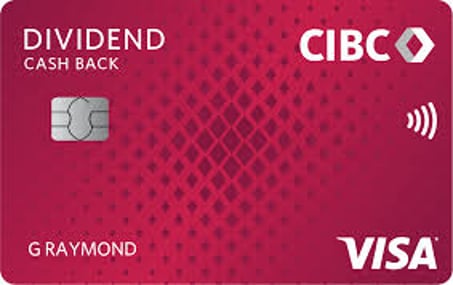
CIBC Dividend Visa Card
View details
Cash back for the first 4 statements on net purchases of up to $2,000 (up to $100 cash back).†
Cash back on eligible grocery purchases!†.
Cash back on eligible gas, EV charging, transportation, dining purchases and recurring payments†.
Cash back on all other purchases†.
The CIBC Dividend Visa Card is a solid option for budget-savvy households that frequently spend at the grocery store. With no annual fee, no-fuss redemption options and bonus savings on gas, this card offers reliable everyday savings.
Pros
- No annual fee.
- Redeem cash-back rewards any time.
- Gas discounts of up to 10 cents per litre.
Cons
- Limited insurance coverage.
- 0.5% base earn rate.
- Welcome Offer: Get 5% cash back for the first 4 statements on net purchases of up to $2,000 (up to $100 cash back).†
- Plus, get 2% cash back on eligible grocery purchases!†
- 1% cash back on eligible gas, EV charging, transportation, dining purchases and recurring payments†
- 0.5% cash back on all other purchases†
- Get cash back on demand - redeem your cash back at any time when you have a minimum of $10 through CIBC Online and Mobile Banking®
- Get a free Skip+ membership when you link your eligible CIBC credit card. Plus, enjoy $0 delivery fees and earn a $10 monthly voucher.†
- Fuel up for less - Link your card with Journie Rewards to save up to 10 cents per litre at participating Pioneer, Fas Gas, Ultramar and Chevron gas stations.†
- Get 50% off Disney+ for 6 months - Use an eligible CIBC credit card to pay for your Disney+ Standard with Ads subscription, and automatically receive $4.50 each month in statement credits.†
- This is a digital-exclusive offer.† To be eligible for this offer: 1) this offer must have been directly communicated to you from CIBC or from a partner/affiliate; and 2) you must apply for the eligible card through the link provided in the CIBC or partner/affiliate communication to you.† This offer is reserved for you. Please do not forward it to anyone else.
- CIBC may approve your application, but you are not eligible to receive this Offer if you have opened, transferred or cancelled another Dividend card within the last 12 months.†
If you want a no-fee cash-back card that feels simple and familiar, the CIBC Dividend Visa Card is an easy option to understand. It offers straightforward everyday value without asking you to learn a more complex rewards system or commit to a niche use case.
It may not be the highest-earning option in every category, but it makes sense for cardholders who want a mainstream no-fee card from a major bank with uncomplicated cash-back appeal.
Home Trust No Fee Preferred Visa Card

View details
Cash back on all eligible purchases
With 1% cash back on purchases, no foreign exchange fees and no annual fee, this rewards card offers travellers simplicity over luxury perks. Best for: Budget-conscious travellers who spend big abroad.
Pros
- No annual fee.
- No foreign exchange fees.
- No caps on cash back.
Cons
- No travel insurance.
- Not available in Quebec.
- Receive 1% cash back¹ on every eligible purchase made with your Home Trust Preferred Visa*.
- CashBack Rewards earned are displayed every month on your statement, and the total amount earned for the previous year will be provided to you as a credit in January.
- No annual fee.
- Use your Home Trust Preferred Visa on purchases made in foreign currencies without added foreign exchange fees², whether you’re spending while abroad or shopping online at home.
- Worldwide access from anywhere you are, for hotel and travel reservations or shopping in-store and online. Access cash at over 2.5 million ATMs in more than 200 countries and territories worldwide.
- Manage your Visa account easily and securely — at any time, and from anywhere. Get your balance and view your transactions at Home Trust Visa Online.
- Purchase Security³: insures eligible items against theft or damage for 90 days from the date of purchase.
- Manage your Home Trust Visa account easily and securely — at anytime from anywhere in the world. View the card’s balance, transactions and pay bills online at Home Trust Visa Online.
- Guaranteed hotel reservations — with this international travel credit card, you can request a guaranteed hotel reservation anywhere in the world and your room will be held for you even if you arrive late.
- Preferred rates: 21.99% for purchases and cash advances.
- To be eligible, $15,000 individual annual income is required. Also, you must have a Canadian credit file and be a Canadian resident of the age of majority in the province or territory where you live. You cannot currently be in bankruptcy or be a resident of Quebec.
The Home Trust No Fee Preferred Visa card earns a place on this list because it solves a problem most Canadian no-fee cards do not: foreign transaction fees.
If you travel occasionally, shop online in U.S. dollars or pay for services in another currency, avoiding that extra charge can matter more than a slightly higher rewards rate. It also earns 1% cash back on purchases, giving it value beyond its no-FX feature.
Neo World Mastercard

View details
Cashback on groceries, gas, and recurring payments.
Cashback on everything else.
The Neo World Mastercard earns 2% cash back on groceries, gas and recurring payments, plus 0.5% on everything else. Cardholders can also earn up to 15% boosted cash back at participating Neo partners. There’s no annual fee, and the card includes extended warranty and purchase protection. Best for: No-fee cardholders whose spending is concentrated in its 2% categories.
Pros
- No annual fee.
- Earns 2% cash back on groceries, gas and recurring payments.
- Includes extended warranty and purchase protection.
Cons
- Earns just 0.5% cash back outside its bonus categories.
- Requires at least $50,000 in personal or $80,000 in household income.
- 2% cashback on groceries, gas, recurring payments, and 0.5% cashback on everything else
- Up to 15% boosted cashback at thousands of partners across Canada - on top of base cashback rates
- Unlimited, instant cashback
- Instant approvals and access to virtual card to start using right away
- Cashback redeemable at anytime
- Additional Benefits: Mastercard Zero Liability, Extended Warranty, Purchase Protection
- World Mastercard Benefits including discounting with participating partners and DragonPass airport lounge access.
The Neo World Mastercard is best for people willing to engage with the Neo ecosystem. On its own, it offers respectable everyday rewards, but its real appeal is the potential to increase value through linked Neo products and partner offers.
That makes this card more dynamic than a standard no-fee cash-back card, but also less universal. If you like simplicity, there are easier options on this page. If you do not mind a more ecosystem-driven setup and are interested in squeezing more value out of partner merchants, Neo is worth a look.
PC World Elite Mastercard

View details
Points per $1 at Shoppers Drug Mart and Pharmaprix stores.
Points per $1 at Loblaw banner grocery and Joe Fresh stores.
Points per litre at Esso and Mobil gas stations.
Points per $1 everywhere else.
This co-branded card generously rewards Loblaw shoppers with up to 4.5% back on everyday spending categories, like gas, groceries and drugstore purchases. That said, points are only redeemable at Loblaw stores, and steep income criteria limits this card’s accessibility. Best for: High-income earners who frequently shop Loblaw-affiliated stores.
Pros
- No annual fee.
- Up to 4.5% back in everyday spending.
- Some travel insurance.
Cons
- High $80,000 individual or $150,000 household annual income requirement.
- Highest earn rate limited to drugstore spending.
- Points only redeemable at participating Loblaw-owned stores, Shoppers Drug Mart/Pharmapix, and Esso gas stations.
- 45x PC Optimum points per dollar on Shoppers Drug Mart purchases, equivalent to 4.5% back.
- 30x PC Optimum points per dollar on Loblaw banner grocery store purchases, equivalent to 3% back.
- 30x PC Optimum points per dollar per litre of gas purchased at Esso and Mobil gas stations, equivalent to 3 cents/L back.
- 10x PC Optimum points per dollar on all other purchases, equivalent to 1% back.
- Redeem 10,000 points for free products and groceries at participating stores. Redeem 10,000 for a $7 statement credit to pay down your balance or for any car wash (including premium) at Esso stations.
- No annual fee.
- 24/7 concierge service to make dinner reservations, reserve event tickets, deliver gifts and more.
- Access to identity theft services to help you avoid identity theft or restore your identity if stolen.
- Four types of insurance provided, including comprehensive travel insurance, car rental collision/loss damage waiver insurance, extended warranty and purchase assurance.
- Preferred rates: 21.99% for purchases, 22.97% for cash advances.
- To be eligible, $80,000 (individual) or $150,000 (household) annual income is required. Also, you must have a Canadian credit file and be a Canadian resident of the age of majority in the province or territory where you live.
If you love to shop at PC Optimum brands like Loblaws, Shoppers Drug Mart and Esso, the PC World Elite Mastercard offers excellent rewards with no annual fee. It also offers a few features that are seldom found in this category including travel emergency medical insurance, rental car insurance and a complimentary concierge service.
One sore spot with this card is that its gas rewards are expressed in points per litre rather than points per dollar spent. As the cost to fill your tank climbs higher and higher, the points you earn will remain the same.
Note: You’ll only qualify for this card if you meet its relatively steep minimum income requirements. If you don’t qualify, you may be automatically approved for one of its sister cards with fewer features, like the PC Mastercard.
RBC ION Visa Credit Card

View details
Points on groceries.
Points on gas & electric vehicle charging.
Points on daily public transit.
Points on rideshare.
Points on streaming, digital gaming & subscriptions.
Points on all other qualifying purchases.
This no-frills, no-fee card earns Avion points on every dollar spent with elevated rates for eligible grocery, gas, gaming purchases and more. It may lack lavish travel perks and robust insurance coverage, but as far as no-fee cards are concerned, the RBC ION Visa has a respectable lineup of benefits for everyday spenders. Best for: Everyday shoppers who want a no-fee starter card.
Pros
- No annual fee.
- Fuel discounts of 3 cents per litre at Petro-Canada.
Cons
- Limited insurance coverage.
- Low 1x - 1.5x earn rate.
- Get up to 14,000 Avion points^ - that's up to $100 of value in gift cards†! Apply by November 4, 2026.
- Earn 1.5X Avion points¹ on:
- Grocery - Satisfy your taste buds by earning points on groceries.ⁱ
- Rides, Gas & EV Charging – Enjoy earning points on gas, rideshare, daily public transit, electric vehicle charging.ⁱⁱ
- Streaming, Digital Gaming & Subscriptions – Stay entertained while earning points on streaming, gaming, eligible digital subscriptions, eligible digital downloads, and in-game purchases.ⁱⁱⁱ
- Earn 1 Avion point for every $1 spent on all other qualifying purchases.¹
- Pay With Points - Redeem your Avion points to pay bills, your credit card balance or even send money to friends with Interac e-Transfer⁴. Minimum redemption is only $10, so you can use your points where you need them most.
- Save at Petro-Canada - Save 3¢/L on fuel and earn 20% more Petro-Points and 20% more Avion points when you pay with a linked RBC card.⁴
- Earn Moi points at Metro - earn 1 extra Moi point for every $2 spent at Metro, Food Basics, Super C, Jean Coutu, Brunet and Première Moisson when you swipe your Moi Rewards card and pay with your linked RBC card (minimum purchase required)⁷
- When you shop at Metro, Food Basics or Super C, and spend at least $60, you’ll get 1 additional Moi point for every 2 dollars you spend. When you shop at Brunet or Jean Coutu and spend at least $40 you’ll get 1 extra Moi point for every 2 dollars spent and when you shop at Premiere Moisson, and spend at least $20, you’ll get 1 extra Moi point for every 2 dollars spent.
- Earn more Be Well points at Rexall - Earn 50 Be Wellᵀᴹ points for every $1 spent on eligible purchases at Rexall⁵ when you pay with your linked RBC card and scan your Be Well card.⁷
- Add your credit card to your DoorDash account and get a 6-month complimentary DashPass subscription⁶
- Purchase Security and Extended Warranty Insurance³ - Automatically protects eligible card purchases against loss, theft or damage within 90 days of purchase, and doubles the manufacturer's original Canadian warranty by up to one additional year, to a maximum of five years.
- Corresponding legal references and product terms are available on the RBC website, which will be available and agreed upon in the customer onboarding process.
- ^ This offer only applies to new applications for an RBC ION Visa credit card received between June 16, 2026 and November 4, 2026 (“Offer Period”) and approved by Royal Bank of Canada (“Royal Bank”), subject to the conditions below. Additional cardholders(s) (co-applicant and authorized user(s)) on the RBC ION Visa credit card account, as well as existing cardholders on any RBC Royal Bank personal credit card transferring to an RBC ION Visa credit card during the Offer Period, are not eligible for this offer. 7,000 Avion points (“Welcome Points”) will appear on your monthly credit card statement within sixty (60) days after your application has been approved, provided that your RBC ION Visa credit card account (“Credit Card Account”) remains open and in good standing at the time the Welcome points are credited to your account, “good standing” meaning that your Credit Card Account must not be past due for more than two (2) consecutive credit card account statement periods, closed, charged off or in credit revoked status. 7,000 additional Avion points (“Additional Points”) will be awarded to you if a total of $500 or more (“Qualifying Transaction Amount”) in qualifying net purchases and/or pre-authorized bill payment transactions (“Qualifying Transactions”) are posted to your RBC ION Visa credit card account within the first 3 months from the date of your credit card account open date (“Period”), provided your account is open and in good standing at the time the Additional Points are posted to your Credit Card Account, approximately 60 days after you reach the Qualifying Transaction Amount. Qualifying Transactions exclude cash advances (including balance transfers, cash-like transactions and bill payments that are not pre-authorized charges that you set up with a merchant), interest charges, and fees. Any credits for returns and adjustments that reduce the amount of Qualifying Transactions below $500 will cancel your Additional Points. The Qualifying Transaction Amount is based on the transaction posting date of each Qualifying Transaction, not the transaction date. This means that transactions that take place prior to the last day of the Period will not be considered for the Qualifying Transaction Amount if they have not yet been posted or processed by the merchant, the payment network (Visa) or Royal Bank by the last day of the Period. If you close or change your RBC ION Visa credit card for another type of RBC Royal Bank credit card before the Welcome Points and/or the Additional Points have been credited to your account, you may lose the benefit of this offer. This offer may not be combined or used in conjunction with any other offer. Royal Bank reserves the right to cancel, modify or withdraw this offer at any time without notice, even after your application has been approved, including if we suspect that you may be manipulating or abusing it, or engaging in any suspicious or fraudulent activity, as determined by Royal Bank in its sole discretion. For complete terms and conditions that apply to the Avion Rewards Program, please visit www.avionrewards.com or call 1-800-769-2512.
- † To get $100 worth of gift cards/certificates, you will need a total of 14,000 Avion points. Minimum redemption of 1,400 Avion points for most $10 gift cards/certificates. Some exceptions apply. Point redemption values may fluctuate. For general redemption terms, conditions and restrictions that apply to the Avion Rewards program, as well as for current point redemption values, please visit https://www.avionrewards.com/terms-and-conditions.html or call 1-800-769-2512.
The RBC ION Visa Credit Card is a solid entry point into the Avion ecosystem for people who prefer points over straight cash back. It lets you earn Avion points on everyday spending without paying an annual fee, which makes it appealing for cardholders who already bank with RBC or want to stay in that rewards environment.
While the Avion program enjoys a good reputation, it’s worth noting that this card redeems Avion points at a reduced value of 0.71 cents per point for gift cards and 0.58 cents per point for travel. That may be okay for the casual traveller, but you may prefer a different travel rewards credit card if you’re a more frequent flyer.
Simplii Financial Cash Back Visa Card

View details
Cash back for your first 3 months on up to $500 spend on eligible gas, groceries, drugstore purchases and pre-authorized payments.
Cash back on eligible restaurant, bar and coffee shop purchases up to $5,000 spend per year†.
Cash back on eligible gas purchases (up to $15,000 per year†).
Cash back on eligible grocery purchases (up to $15,000 per year†).
Cash back on eligible drugstore purchases (up to $15,000 per year†).
Cash back on eligible pre-authorized payments (up to $15,000 per year†).
Cash back on all other credit card purchases with no limit on how much you can earn†.
With no annual fee, no fees on global money transfers and up to 4% back on purchases, this card offers solid rewards for people on a budget. But the top cash-back rate of 4% on restaurants, bars and coffee shops is capped at $5,000 a year, which may be too restrictive for people who spend big on dining out. Best for: Foodies who send money overseas and don’t want to pay an annual fee.
Pros
- No annual fee.
- 4% back on restaurants, bars and coffee shops.
- Get cash back on fee-free global money transfers.
Cons
- Low 0.5% cash-back base rate.
- No complimentary travel insurance.
- Earn 20% cashback† for your first 3 months on up to $500 spend on eligible gas, groceries, drugstore purchases and pre-authorized payments.
- Earn 4% on eligible restaurant, bar and coffee shop purchases up to $5,000 spend per year†.
- Earn 1.5% on eligible gas, groceries, drugstore purchases and pre-authorized payments, up to $15,000 per year†.
- Earn 0.5% on all other credit card purchases with no limit on how much you can earn†.
- Redeem cash back as a statement credit in December.†
- No annual fee.
- Cash back when you send money abroad with a Simplii Financial Global Money Transfer. No transaction fees and no interest charges.†
- Purchase security and extended protection insurance provided.†
- Interest rates: 20.99% for purchases‡, 22.99% for cash advances‡.
- To be eligible, a $15,000 (individual/household) annual income is required. Also, you must have a Canadian credit file and be a Canadian resident (excluding Quebec) that is the age of majority in the province or territory where you live.
- †Terms and conditions apply. Click ‘Apply Now’ for complete details. Banking services are not available in Quebec.
- ‡ “Purchase” means any Transaction other than a Cash Advance, Balance Transfer or Convenience Cheque. “Cash” means a Cash Advance, Balance Transfer and Convenience Cheque. Interest rates may change from time to time.
The Simplii Financial Cash Back Visa Card remains one of the strongest no-fee cards for dining and restaurant spending. If takeout, bars, restaurants and coffee shops eat up a meaningful share of your monthly budget, the earn rate here can be hard to beat.
It also offers decent support categories, including gas, groceries and pre-authorized payments, which helps round out its value. This is a particularly good card for someone whose spending habits are easy to predict and happen to align with its category strengths.
SimplyCash Card from American Express

View details
Cash back on eligible gas purchases in Canada.
Cash back on eligible grocery purchases in Canada (up to $300 cash back annually).
Cash back on all other eligible purchases.
The most noticeable feature of the SimplyCash Card from American Express is the 1.25% cash-back base rate — higher than most cash-back cards in Canada. But the perks are fairly thin on the ground — travel accident insurance and access to Amex Offers and Experiences. Best for: Everyday spenders who want a simple cash-back card without the frills.
Pros
- No annual fee.
- Travel accident insurance.
- High 1.25% cash-back base rate.
Cons
- Highest cash-back rate is just 2%.
- No travel perks outside of accident insurance.
- In your first 3 months as a new SimplyCash® Card from American Express Cardmember, you can earn a bonus 5% cash back on all purchases (up to $2,000 in purchases). That’s on top of your everyday cash back earn rates. That’s up to $100 in bonus cash back.
- Earn 2% cash back on eligible gas purchases in Canada, 2% cash back on eligible grocery purchases in Canada (up to $300 cash back annually), and 1.25% cash back on all other eligible purchases.
- Access events and special offers curated for Cardmembers with Amex Experiences™
- Insurance coverage and 24/7 Customer Service.
- American Express is not responsible for maintaining or monitoring the accuracy of information on this website. For full details and current product information, click the Apply Now link. If you apply and get approved for an American Express Card, (I/we) may receive compensation from American Express, which can be in the form of monetary payment
The SimplyCash Card from American Express is one of the cleanest no-fee options for people who do not want to think too hard about category optimization. It pairs a solid flat base rate with elevated returns on gas and groceries, giving it a good blend of simplicity and everyday usefulness.
Like the Scotiabank Amex, the catch is merchant acceptance. But for someone who shops often at places that take Amex, this card can work well as a low-maintenance cash-back tool with no annual fee and no complicated rewards rules.
Methodology
BACK TO TOPHow did we select the best no annual fee credit cards?
For this roundup, we focused on cards within the no-annual-fee category that deliver meaningful rewards, practical features or unusual value without charging an annual fee.
Our evaluation considered:
rewards rates and rewards structure, including flat-rate, fixed bonus and customizable bonus categories.
redemption flexibility and ease of use.
welcome offers and other first-year value.
foreign transaction fees, where relevant.
noteworthy perks, such as insurance coverage, mobile device protection or partner-program benefits.
trade-offs that matter on no-fee cards, such as income requirements, merchant acceptance or ecosystem lock-in.
How to compare no-fee credit cards
BACK TO TOPNo-fee cards are easiest to compare when you focus on the few things that actually drive value.
Rewards structure
Some no-fee cards reward one kind of spender extremely well. Others aim for broader usefulness.
A grocery-heavy household may get more value from a category card like the BMO CashBack Mastercard. Someone with more varied spending may be better off with a flexible option like the Tangerine Money-Back World Mastercard or a simpler flat-rate card like the SimplyCash Card from American Express. And someone whose spending changes from month to month may prefer a more adaptive option like the CIBC Adapta Mastercard.
The question is not just how much a card earns. It’s how well that earn structure matches your real spending.
Redemption flexibility
Cash back is usually the simplest type of reward. Points can be just as valuable, but only if the program fits how you actually redeem.
If you want straightforward value, a cash-back card may be the better fit. If you already use a particular issuer’s rewards ecosystem or prefer more redemption options, a points card like the Scotiabank American Express Card or RBC ION Visa Credit Card may make more sense.
Some no-fee cards are built for narrower goals. If you want rewards tied to a specific airline or loyalty program, a more niche no-fee card — like the CIBC Aeroplan Card or Triangle World Elite Mastercard — may suit you better than one of the broader picks on this page.
Foreign transaction fees
Most Canadian no-fee cards still charge foreign transaction fees. That usually adds about 2.5% to purchases made in another currency.
If you travel, shop from international retailers or pay for U.S.-dollar subscriptions, that extra cost can quickly cancel out your rewards. In those cases, a card like the Home Trust No Fee Preferred Visa card may be the stronger play even if its headline rewards rate looks lower.
Acceptance
Visa and Mastercard can be more widely accepted than American Express in Canada. That does not make Amex a bad choice, but it can matter depending on where you shop.
If you choose a no-fee Amex card, make sure it fits the merchants you use most often — or plan to pair it with a backup card from another network.
Income requirements and ecosystem fit
Some no-fee cards are broadly accessible. Others work best if you already bank with a certain institution, meet higher income requirements or are willing to use linked accounts and partner networks, such as cards from newer digital banking brands like Wealthsimple, Brim, KOHO and Neo.
That does not make them bad options. It just means convenience and fit can matter almost as much as rewards rates.
Don’t forget to consider its role
A no-fee card does not have to do everything.
For some people, the best no-fee card is a primary everyday spender. For others, it is a support card chosen for one specific job — better grocery rewards, no foreign transaction fees, a different payment network or access to a preferred points program.
You might also choose a no-fee card for a different purpose, like getting a lower rate to help manage cash flow. A card like the Desjardins Flexi Visa can make sense in that kind of supporting role.
Thinking about the card’s role in your wallet can help you choose more clearly than comparing rewards alone.
Frequently asked questions
Is a no-fee credit card really free?
A no-fee credit card does not charge an annual fee, but it may still come with other costs, including:
foreign transaction fees
over-limit fees
optional balance protection insurance.
If you pay your balance on time and avoid optional or penalty charges, a no-fee card can be very inexpensive to keep.
Do no-fee credit cards still earn rewards?
Yes. Many no-fee credit cards earn rewards, including:
Cash back.
General rewards points, such as Scene+ or Avion points.
Category-based rewards tied to groceries, dining, gas or recurring bills.
The main difference is usually not whether they earn rewards, but how generous those rewards are compared with annual-fee cards.
Are no-fee cards worth it?
They can be. A no-fee card is often worth it if you want to earn rewards without needing to offset an annual fee, or if you want a secondary card for a specific purpose, such as no foreign transaction fees or stronger rewards in one spending category.
They tend to offer fewer premium perks than higher-fee cards, but the best no-fee cards can still deliver strong everyday value.
How do no-fee credit cards compare with cards that charge an annual fee?
Cards with annual fees often offer higher rewards rates, better insurance and more premium perks. No-fee cards usually give you a lighter version of that value proposition with fewer extras.
The trade-off is simple: annual-fee cards may offer more upside, but no-fee cards are easier to keep long term and easier to come out ahead on.
How do I apply for a no-fee credit card?
Before applying, check the eligibility criteria for the card, including any income requirements, credit score expectations or residency rules.
Most issuers let you apply online. You may also be able to apply through a mobile app or at a branch, depending on the provider.
When is an annual fee worth paying?
An annual fee can be worth it when the card’s rewards, perks and insurance are likely to deliver more value than the fee costs you.
That is most likely when you spend heavily in the card’s bonus categories, travel often, use the included benefits regularly or want access to more premium protections and features.
DIVE EVEN DEEPER

 Georgia Rose

