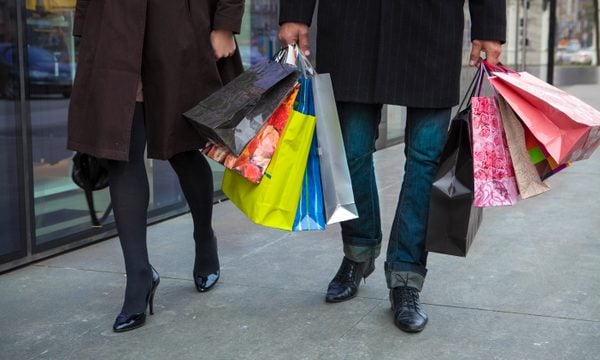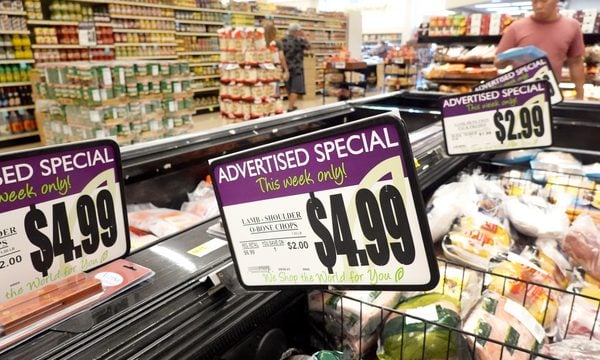



More than 9 in 10 Americans (92%) plan to spend on holiday-related things like gifts, travel and parties this year — referred to as “holiday spenders” throughout this report — according to a new NerdWallet survey of more than 2,000 Americans.
It can be an expensive time. The pressure to spend, but also to save on that spending, are often in conflict.
Saving might have the edge this year: More Americans plan to stay close to home — 31% of Americans say they won’t spend money on flights and hotels for holiday travel this year, compared with just 22% last year — and estimated gift budgets are down 21%.
But Americans will still spend. Holiday spenders say they’ll spend $2,525, on average, for holiday costs: the equivalent of a month of average rent in the U.S., an extra monthly payment on a new car and enough left over to fill that car with gas. Bah humbug.
The survey, conducted online by The Harris Poll, also asked Americans about their approach to using debt, and why they were most likely to overspend during this holiday season.
Key findings
Shoppers are trimming their gift budgets. Americans planning to buy gifts expect to spend $879, on average. That’s down 21% from $1,107, on average, in 2025.
The expected spending for holiday spenders is $2,525, on average. That includes gifts, travel and other holiday purchases, like hosting a holiday party or buying decorations.
The thrill of saving money can lead to overspending. Using coupons (42%) and shopping sales (41%) are among holiday spenders’ top strategies to save money on holiday expenses this year. At the same time, the most commonly cited factor holiday spenders say are likely to lead them to overspend is a deal that seems too good to pass up (27%).
Buy now, pay later (BNPL) is a popular holiday payment method, and a riskier one. Nearly 2 in 5 holiday spenders (38%) plan to use BNPL for such purchases. A higher share of BNPL users (38%) than credit card users (25%) expect they won’t be able to make payments in full and on time.
More people are opting out of holiday travel
Americans have firmer travel plans at this point in the year than they did in 2025, and the shift in preference is clear: Stay home or close to it.
The share of people who aren’t sure whether they’ll spend on travel this holiday season has gone down, from 34% in 2025 to 26% in 2026, and there’s a corresponding higher share of Americans who’ve decided they won’t spend money on flights and hotels this year compared with this point in 2025 (31% this year, 22% in 2025). Higher prices might be keeping some would-be travelers away; flight prices have risen dramatically in 2026.
That still means a lot of people will leave home for the holidays. About 2 in 5 (42%) Americans plan to spend money on flights and hotels during the holidays — referred to as “holiday travelers” going forward — which is similar to 2025, when 45% said the same. Holiday travelers plan to spend $2,439, on average, for travel this holiday season. That’s on par with the $2,586, on average, holiday travelers planned to spend in 2025.
Parents are ready to travel, looking to save
Traveling with kids can be both expensive and difficult, but many parents seem unfazed. About 3 in 5 (62%) parents with children under 18 plan to spend on flights and hotels this holiday season compared with about a third (33%) of Americans who aren’t parents of children under 18.
Parents are also willing to forgo comfort to save money: 18% of holiday spenders who are parents with children under 18 say they’d be willing to take a less comfortable route, like a late-night trip or a flight with a connection instead of flying direct, in order to save money compared with 8% of those who aren’t parents of children under 18.
“Some brands are recognizing this challenge; we are seeing an uptick in offers directed at families,” says Sally French, travel expert and co-host of NerdWallet’s Smart Travel Podcast. “For example, Walt Disney World has a free dining plan offer for kids through the end of the year, which is stackable with other discounts — something we don’t normally see.”
Gifting: Thrift or splurge?
Most Americans (82%) plan to buy gifts this holiday season. Holiday shoppers plan to spend $879, on average, down 21% from 2025, when shoppers planned to spend $1,107, on average.
Underneath this average lies a split between those spending much less than $879 and those spending much more. Nearly half (46%) of those who plan to buy gifts expect to spend less than $500 while 31% say they’ll spend $1,000 or more.
Gen Z: It’s the thought that counts
Gen Z is approaching gifting with a frugal mindset: One-third (33%) of Gen Zers who will purchase gifts plan to spend $100 or less. That’s a higher share than millennials (20%), Gen X (15%) and baby boomers (8%). Homemade gifts are especially popular among Gen Z holiday spenders: 27% plan to make a gift for at least one person, along with 21% of millennials, 19% of Gen Xers and 11% of baby boomers.
Note: The survey defines Gen Zers as those 18-29; millennials, ages 30-45; Gen Xers, ages 46-61 and baby boomers, ages 62-80.
Parents spend a lot, save a lot
Holiday spenders who are parents with children under 18 expect to spend more ($3,417, on average) than those without children under 18 ($2,032, on average).
That approximately $1,400 difference might be even larger if it weren’t for savings strategies, many of which are adopted at a higher rate by parents with children under 18 compared with other adults:
Popular money-saving strategies
The majority (86%) of holiday spenders say they plan to use at least one money-saving strategy, and 76% of holiday spenders will use multiple. The most commonly cited methods to save are:
42% will use coupons or coupon codes.
41% will shop sales, like Black Friday.
37% will set a budget for some or all of their holiday spending.
28% will set a per-gift dollar limit with family or friends.
28% will cut back on non-holiday spending (e.g., dining out or entertainment, groceries, personal shopping) for a few months.
Overspending during the holidays: Why it happens, how to prevent it
About 3 in 4 (76%) holiday spenders named at least one factor that could lead them to overspend this holiday season. The reasons people listed can be grouped into four categories:
Reason #1: FOMO
Human brains are wired to avoid the possibility of regret in the future. You might better know this concept as FOMO, or the fear of missing out.
This may lead some holiday spenders to buy more, lest they lose something: 27% say that a deal that seems too good to pass up will most likely cause them to overspend while 13% say they’re likely to spend more to qualify for free shipping or another promo.
“It’s hard to make smart purchasing decisions when we feel rushed or stressed out, so one of the best ways to save is to notice when we feel that sense of pressure and to take a break,” says Kimberly Palmer, personal finance expert at NerdWallet. “Letting something sit in your cart for 24 hours is one of the easiest ways to decide if you actually want it. It’s rare that you actually need to act immediately to get a certain deal or promo,” she adds.
Reason #2: Frictionless shopping
Businesses work hard to make spending extremely easy. This is especially true of online shopping, where apps and websites are designed to reduce any swipes, clicks and taps that stand between them and your money. The lack of friction is behind multiple causes of overspending:
About 1 in 5 (22%) holiday spenders say that the ease of shopping online is among the most likely factors that would lead them to overspend this holiday season.
For 17% of holiday spenders, unplanned purchases for themselves while they’re shopping for others is among the most likely factors leading to overspending.
The option to pay with debt (e.g., credit card; buy now, pay later) is likely to make 11% of holiday spenders overspend.
“Adding our own friction to the shopping process, by deleting saved credit cards and passwords from retailer apps or giving ourselves rules, like not shopping late at night, can help us make better purchasing choices,” Palmer says. “The key is to slow down the shopping process through whatever methods work best for you.”
Reason #3: Not enough planning
People often underestimate the time and cost it takes to complete a task. Holiday shopping is an ideal case study.
Waiting until the last minute to shop (16%), buying gifts for more people than originally planned for (15%), not having a specific budget or not tracking spending (13%), and exhaustion (7%) are all listed among the reasons holiday spenders say they’re most likely to overspend this holiday season.
Finding a good deal on flights is a particularly time-sensitive task. If you haven’t booked by mid-November, you may miss the lowest prices. “For travelers who missed that window, the next best option is to be flexible,” French says. “Some days are far pricier than others, with traveling on the holiday itself typically ranking among the cheapest days to fly.”
Reason #4: Outside pressure
Human behavior is shaped by the influence of others. We want to fit in, and we avoid conflict.
So it’s no surprise that 13% of holiday spenders are prone to overspend this year in an effort to meet the expectations from friends or family members and 18% are likely to overspend because they enjoy giving a good gift.
We can even be influenced by people we don’t know. Nearly 1 in 10 holiday spenders (9%) say social media will make them likely to overspend, and 6% say the same about direct marketing from companies.
“Sometimes it helps to be honest with friends and family and explain that you are trying to spend less this year,” Palmer says. “You might discover they feel the same way, and you can agree to scale back together.”
Credit cards and BNPL
About 3 in 4 (74%) holiday spenders will use a credit card for holiday-related expenses while 38% will use buy now, pay later services (BNPL).
Millions of Americans say they’ll spend with these products during the holidays knowing they won’t be able to pay the bill on time.
Overall, more holiday spenders say they’ll wind up with credit card bills they can’t pay in full and on time (19%) than BNPL bills (15%). However, there are nearly two credit card users for every one BNPL user. About 2 in 5 (38%) BNPL users expect they won’t be able to make payments in full and on time compared with 1 in 4 (25%) credit card users who don’t expect to make payments in full and on time.
Using debt to pay for holiday expenses can lead to a lower level of financial resilience.
“If you do need to make purchases that you can’t afford to pay in full by the billing cycle, look for cards with 0% APR offers,” says French. “These products let you charge purchases to the card without paying interest for a period of time, usually between 12 and 21 months.”
Cite as NerdWallet (2026). “2026 Holiday Spending Report” Retrieved from https://www.nerdwallet.com/credit-cards/studies/holiday-spending-report
Methodology
This survey was conducted online within the United States by The Harris Poll on behalf of NerdWallet from Sept. 8-10, 2026, among 2,060 U.S. adults ages 18 and older. The sampling precision of Harris online polls is measured by using a Bayesian credible interval. For this study, the sample data is accurate to within +/- 2.7 percentage points using a 95% confidence level. This credible interval will be wider among subsets of the surveyed population of interest. For complete survey methodology, including weighting variables and subgroup sample sizes, please contact [email protected].
Disclaimer
NerdWallet disclaims, expressly and impliedly, all warranties of any kind, including those of merchantability and fitness for a particular purpose or whether the article’s information is accurate, reliable or free of errors. Use or reliance on this information is at your own risk, and its completeness and accuracy are not guaranteed. The contents in this article should not be relied upon or associated with the future performance of NerdWallet or any of its affiliates or subsidiaries. Statements that are not historical facts are forward-looking statements that involve risks and uncertainties as indicated by words such as “believes,” “expects,” “estimates,” “may,” “will,” “should” or “anticipates” or similar expressions. These forward-looking statements may materially differ from NerdWallet’s presentation of information to analysts and its actual operational and financial results.
Article sources
- 1.Apartments.com. Rent Trends in the United States. Accessed Oct 2, 2026.
- 2.Experian.com. Average Car Payment in 2026.