With more than 15 million members, Navy Federal is the nation's largest credit union. But unlike some big nationwide credit unions, it doesn't let just anyone join. Navy Federal's mission is to serve those who have served us. So its membership is restricted to current or former members of the military, current or former employees of the Department of Defense or Pentagon contractors, or immediate family members of someone who fits the criteria.
If you qualify for Navy Federal membership, you have a fairly strong menu of credit cards to choose from.
BEST NAVY FEDERAL CREDIT CARDS OF NOVEMBER 2026
Navy Federal Credit Union® cashRewards Plus Credit Card: Our pick for straightfoward cash back
Navy Federal Credit Union® Flagship Premier Visa Signature® Credit Card: Our pick for travel rewards
Navy Federal Credit Union® More Rewards American Express® Credit Card: Our pick for bonus rewards on everyday expenses
Navy Federal Credit Union® Platinum Credit Card: Our pick for balance transfers and/or low ongoing interest
Navy Federal Credit Union® cashRewards® Secured Credit Card: Our pick for building credit
Navy Federal Credit Union® cashRewards Plus Credit Card
Our pick for: Straightforward cash back
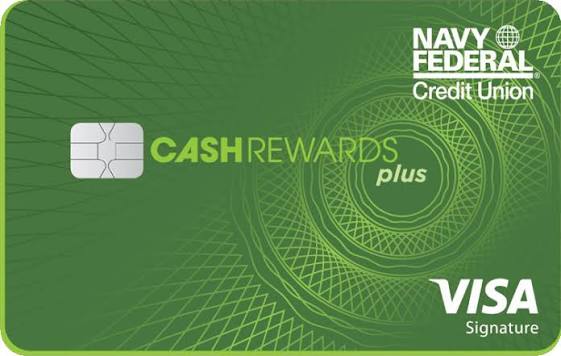
Annual fee: $0.
Rewards: 2% cash back on all purchases.
Bonus offer: Earn $250 bonus cash when you spend $2,500 within 90 days of account opening. Expires January 3, 2027.
Why we like it: The unlimited 2% you earn on all purchases with the Navy Federal Credit Union® cashRewards Plus Credit Card matches what you'll get on the best $0-annual-fee flat-rate cards from mass-market issuers. If you have no patience for tracking bonus categories or spending caps (or if you want a card to use on everything that doesn't fall into the bonus categories on other cards), this is the one for you. The bonus offer stacks up well against those cards as well, although the spending requirement to claim it is on the high side. It doesn't offer an intro APR period for purchases, so it's not the best choice for a big expense you want to finance over time. Now for the big caveat: When you apply for this card, you might be approved instead for a version that earns only 1.5% on purchases. Which one you're offered depends on your creditworthiness, so read carefully when applying.
Read our pros and cons for this card
Pros
High rewards rate on all purchases.
New cardholder bonus offer.
Rewards can be redeemed as a statement credit or to your Navy Federal bank account.
During the application process, you can choose either Visa or Mastercard as the payment network. Each comes with perks specific to the brand.
$0 annual fee.
Cons
No intro APR period for purchases.
Some applicants for this card might be offered only a lower-earning version: the Navy Federal Credit Union® cashRewards Credit Card (no "Plus" in the card name). It earns just 1.5% cash back.
» READ OUR REVIEW: Navy Federal Credit Union® cashRewards Plus Credit Card
Navy Federal Credit Union® Flagship Premier Visa Signature® Credit Card
Our pick for: Travel rewards
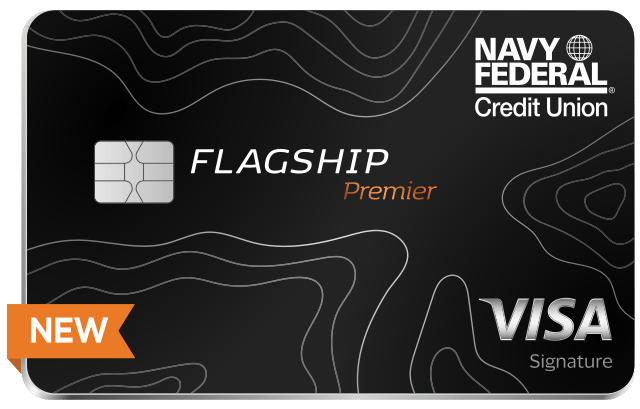
Annual fee: $95.
Rewards:
4 points per dollar spent on travel.
3 points per dollar on dining
1 point per dollar on all other purchases.
Bonus offer: For a limited time, open a new card account and earn 50,000 bonus points (a $500 value) when you spend $4,000 in your first 90 days. Expires January 3, 2027.
Why we like it: This is Navy Federal's answer to popular travel cards like the Capital One Venture Rewards Credit Card and the Chase Sapphire Preferred® Card. It has a similar annual fee, comes with an annual airline credit that can essentially offset that fee, and offers strong rewards on travel (4X) and dining (3X). Unlike competing cards from mass-market issuers, however, you do not have the option of transferring points to airline or hotel partners for potentially greater value. Points are typically worth 1 cent apiece for cash, according to the issuer; values may vary for other redemption options, which include statement credit, travel, a deposit into a Navy Federal account, gift cards, merchandise and more. On the whole, it might sit a notch below those bigger-name options, but if you're a Navy Federal devotee, it's a solid choice.
Read our pros and cons for this card
Pros
High rewards rates on travel and dining.
New cardholder bonus offer.
$100 annual credit for airline purchases.
Credit for application fee for TSA PreCheck or Global Entry.
Travel coverages, including accident insurance, lost luggage protection and rental card collision damage waiver.
Cons
Has annual fee.
No transfer partners.
Does not offer the airline- or hotel-specific perks of a branded card, such as free checked bags or complimentary nights.
» READ OUR REVIEW: Navy Federal Credit Union® Flagship Premier Visa Signature® Credit Card
Navy Federal Credit Union® More Rewards American Express® Credit Card
Our pick for: Bonus rewards on everyday expenses

Annual fee: $0.
Rewards:
3 points per dollar spent at supermarkets.
3 points per dollar at restaurants and on food delivery.
3 points per dollar on gas and transit.
1 point per dollar on other purchases.
Bonus offer: Earn 20,000 bonus points when you spend $2,000 within 90 days of account opening. Expires on Jan. 3, 2027.
Why we like it: Navy Federal offers two points cards for everyday expenses — the Navy Federal Credit Union® More Rewards American Express® Credit Card and the Navy Federal Credit Union® GO REWARDS® Credit Card. The "More" card offers, well, more, with triple points on three of the biggest line items in many household budgets, as well as a decent bonus offer for new cardholders. If it's lacking anything when compared with similar cards, it would probably be an introductory APR period. But if you don't carry a balance (which you really shouldn't) and you're not looking to finance a big purchase, you won't even notice. Points are typically worth 1 cent apiece for cash, according to the issuer; values may vary for other redemption options, which include statement credit, travel, a deposit into a Navy Federal account, gift cards, merchandise and more.
Read our pros and cons for this card
Pros
Strong rewards in everyday categories: supermarkets, restaurants, gas.
New cardholder bonus offer.
You can apply with average credit; comparable cards from other issuers typically require good credit.
$0 annual fee.
Cons
No intro APR period.
» READ OUR REVIEW: Navy Federal Credit Union® More Rewards American Express® Credit Card
Alternative: For an intro APR offer
The Navy Federal Credit Union® GO REWARDS® Credit Card gives you 3 points per dollar spent on dining and gas and 1 point per dollar elsewhere. Unlike the More Rewards card, it doesn't earn bonus rewards at supermarkets and it doesn't come with a bonus offer. It does, however, come with an introductory low-interest period: 0.99% intro APR on purchases for the first 6 months, and then the ongoing APR of 13.74%-18.00%, Variable APR.
Navy Federal Credit Union® Platinum Credit Card
Our pick for: Balance transfers and/or low ongoing interest

Annual fee: $0.
Rewards: None.
Interest rate: 0.99% intro APR for 12 months from account opening on balance transfers made within the first 60 days, and then the ongoing APR of 10.49%-18.00%, Variable APR.
Balance transfer fee: None.
Why we like it: The Navy Federal Credit Union® Platinum Credit Card is a pretty good balance transfer card. It's one of the few options still available with a low introductory interest rate for transfers and a $0 balance transfer fee. (Such cards were common for a brief period in the late 2010s but have all but disappeared since then.) The introductory APR for transfers isn't 0%, but it's close enough. And while we generally discourage carrying a balance and paying interest on any card, doing so on this one can be significantly cheaper. Some applicants can qualify for an ongoing rate of 10.49%, which is remarkably low in an era when the average credit card is charging 22.36% as of August 2026, according to the Federal Reserve. There's no promotional APR for purchases, however.
Read our pros and cons for this card
Pros
With a $0 annual fee, a $0 balance transfer fee and a super-low introductory APR, you can pay down debt at very little cost.
Some applicants may be able to qualify for one of the lowest ongoing interest rates available from a major credit card issuer.
Cons
The intro APR period lasts only 12 months, while other balance transfer cards offer 0% periods approaching two years; if you're going to need a long time to pay down transferred debt, consider a different card.
This card offers no rewards.
» READ OUR REVIEW: Navy Federal Credit Union® Platinum Credit Card
Navy Federal Credit Union® cashRewards® Secured Credit Card
Our pick for: Building credit
Annual fee: $0.
Security deposit: $200 minimum; $5,000 maximum. (This is a secured card, meaning it requires a cash security deposit equal to your credit line. You can get that deposit back later when you upgrade or close the account.)
Rewards: 1% cash back on all purchases.
Interest rate: The ongoing APR is 18.00%, Variable APR.
Why we like it: The Navy Federal Credit Union® cashRewards® Secured Credit Card checks nearly all the boxes for a great credit-building card. There's no annual fee (some cards designed for credit building charge outrageous fees). The interest rate is reasonable (although you should aim to pay your balance in full each month so that you never pay interest at all). And the card has a clearly defined upgrade path. Within three months, you can be eligible for a higher credit limit without having to deposit additional money; after six months, Navy Federal reviews your account monthly for an upgrade to a regular cashRewards card (at which point you'll get your deposit back). If this card were available to the general public, it would be one of our go-to recommendations for anyone looking to build or rebuild credit.
Read our pros and cons for this card
Pros
$0 annual fee.
Earns rewards.
Security deposit is kept in an interest-earning Navy Federal membership savings account. (The card places a hold on the funds in the account that you have allocated to your deposit.)
Cons
The $200 deposit minimum is pretty standard but can still be an obstacle for some.
» READ OUR REVIEW: Navy Federal Credit Union® cashRewards® Secured Credit Card

How we choose the best credit cards
Our team of credit card experts has developed a rigorous methodology to determine how much value a card delivers and how it stacks up against its competitors.

400+
Cards reviewed
NerdWallet’s experts have reviewed more than 400 cards, from the most popular options at the biggest banks to store cards to niche cards from startups and small issuers.

8
Categories scored
Credit cards are so diverse that properly rating them with a single formula is impossible. We’ve built eight rubrics, plus variations, so we can score each card on what matters.

50+
Data points analyzed
Our ratings consider not just a card’s rates, fees, rewards and perks, but also how easy or hard it is to get that card, manage it and enjoy its advertised benefits.
Star rating categories
What you want out of, say, a cash back credit card is fundamentally different from what you’re looking for in a balance transfer card or a card for building credit. That’s why we have different scoring models that put weight on different features.
See what goes into our formulas
Cash back cards: Our formula looks at how much cash back you could expect to earn from typical household spending. We consider rewards rates and categories, bonus offers and the cash value of other benefits, as well as any annual fee. The rating is also influenced by the complexity of the rewards structure.
General travel cards: We consider how many points you could expect to earn from typical household spending, along with per-point values and redemption options. We add in the cash value of bonus offers and other benefits, subtract annual fees and other costs, and take into account the complexity of the rewards structure.
Balance transfer cards: Our balance transfer rubric calculates how much money a card could save you with a low or 0% interest rate. Primary factors include the length and structure of the introductory APR period and the balance transfer fee. We also consider long-term value, such as whether the card offers rewards.
Branded airline cards: We calculate how many miles you could expect to earn from typical household spending and what those miles are worth based on our valuations. We add in the cash value of bonus offers and perks such as free checked bags and lounge access, and we subtract annual fees and other costs.
Branded hotel cards: We calculate how many points you could expect to earn from typical household spending and what those points are worth based on our valuations. We add in the cash value of bonus offers and perks such as free nights and automatic elite status, and we subtract annual fees and other costs
Credit builder cards: Our rubric focuses on accessibility (such as whether a credit check is required), out-of-pocket costs (such as annual fees or minimum security deposits), credit-building features (such as bureau reporting and access to a free credit score) and upgrade options when you’re ready to move on.
College student cards: Our formula calculates the rewards you could expect to earn on spending typical for a college student and takes into account the cash value of bonus offers and other benefits. Accessibility to students without established credit is a key consideration, as is the effort required to manage the card.
Small business cards: Our star ratings criteria for small business credit cards are similar to those for consumer cards, although they account for potentially higher spending levels and higher credit limits, as well as rewards structures and bonus categories tailored specifically to entrepreneurs and business operators.
NerdWallet's Credit Cards team selects the best credit cards in various categories based on overall consumer value, as evidenced by star ratings, as well as their suitability for specific kinds of consumers. Factors in our evaluations include fees, promotional and ongoing APRs, and sign-up bonuses; for rewards cards, we consider earning and redemption rates, redemption options and redemption difficulty. Because different consumers can have markedly different needs, preferences and spending habits, we recognize that there is rarely a single credit card that is "best" for everyone. That's why this page includes a variety of options to suit an array of circumstances. Also, a single card is eligible to be chosen as among the "best" in multiple categories.
Our star ratings provide a quick way to compare credit cards. We assess the features of a card, score those features according to how they compare with other options on the market, and assign the card a rating of 1 to 5 stars based on those features. In general, a card that rates 4.5 stars will be a better value for more people than a card that rates 4.0 stars. However, the 4.0 card might be better than the 4.5 card for an individual consumer depending on that person’s circumstances. Further, ratings are only comparable within categories. If you're looking for rewards, for example, a 3.5-star cash back card will be of greater value than a 5.0-star balance transfer card or a 4.5-star credit-builder card. Star ratings are an important consideration in which cards appear on our "best" pages, but they are not the sole determining factor. Learn how NerdWallet rates credit cards.