






- A homeowners insurance declarations page lists key details about your policy like your coverage limits, deductibles and premium.
- Keep your declarations page in a safe place in case you need to make a claim.
You may find your full homeowners insurance policy too long or confusing to read word for word. The summary called the insurance declarations page can help.
If you’re a new homeowner, it’s especially worthwhile to take a few minutes to look over the declarations page to make sure you have the coverage you expect.
What is a home insurance declarations page?
Sometimes referred to as a “home insurance declaration page,” this document is where you’ll find the most important information about your policy. This one- or two-page overview explains things like how much coverage you have, when your policy takes effect and how much it costs.
If you make changes to your coverage during your policy term, the insurer will likely reissue the declarations page to reflect your new limits.
Where to find your home insurance declarations page
When you buy or renew a homeowners policy, your insurance company will often send you a copy of the declarations page either in the mail or electronically. You may also be able to access your policy details by logging in to your insurer’s website or mobile app.

What’s on a declarations page for home insurance?
The layout of a homeowners insurance declarations page varies slightly from one company to the next, but you’ll usually see the following:
📅 Your policy’s start and end dates. A typical homeowners policy term is one year.
🏠 The address of the insured property. If your mailing address is different, it may appear on the declarations page, too.
🧑The name(s) of the people insured on the policy. These are usually the legal owners of the home. The page may also list the name and address of your mortgage lender, if you have one.
#️⃣ Your policy number and other insurance company information. For example, the policy may list the name and contact details of your local agent, plus the name and address of the insurance company.
💲Your coverage limits. A standard homeowners insurance policy has six types of coverage, each with its own limit that will be listed on your declarations page. These are often labeled with different letters of the alphabet and include:
Coverage A: Dwelling
This covers the basic structure of your house. Think: Walls, floors, windows and roofs. It also includes built-in appliances.
Coverage B: Other structures
This part of your policy applies to fences and other detached structures like sheds or stand-alone garages.
Coverage C: Personal property
This covers the contents of your home, including personal belongings like clothing and furniture.
Coverage D: Loss of use
This part of your coverage pays for you to stay elsewhere if your home is unlivable after a covered disaster.
Coverage E: Personal liability
This pays for damages and legal expenses if a court finds you liable for hurting someone else or damaging their property.
Coverage F: Medical payments to others
This covers medical bills and other expenses when someone is hurt on your property. You don’t have to be at fault for this coverage to apply.
➕ Your endorsements. A declarations page may also show additional types of coverage, often called endorsements or riders. These are optional types of coverage that you’ve added to your policy. For example, they might include identity theft insurance or coverage for water damage from backed-up drains.
➖ Your deductibles. A home insurance deductible is the amount subtracted from a claim payout, which you’ll be responsible for paying. Your deductible may be a flat amount, such as $1,000, or a percentage of your dwelling coverage. Keep an eye out for multiple deductibles that apply to different types of claims. For instance, you might have a $1,000 deductible for most claims but a 2% deductible for damage from hurricanes.
🧾 Your premium and discounts. If your insurer gave you a discount for bundling policies or signing up for autopay, the declarations page often lists them. It’ll also show how much you’ll pay for the policy.
What does a home insurance declarations page look like?
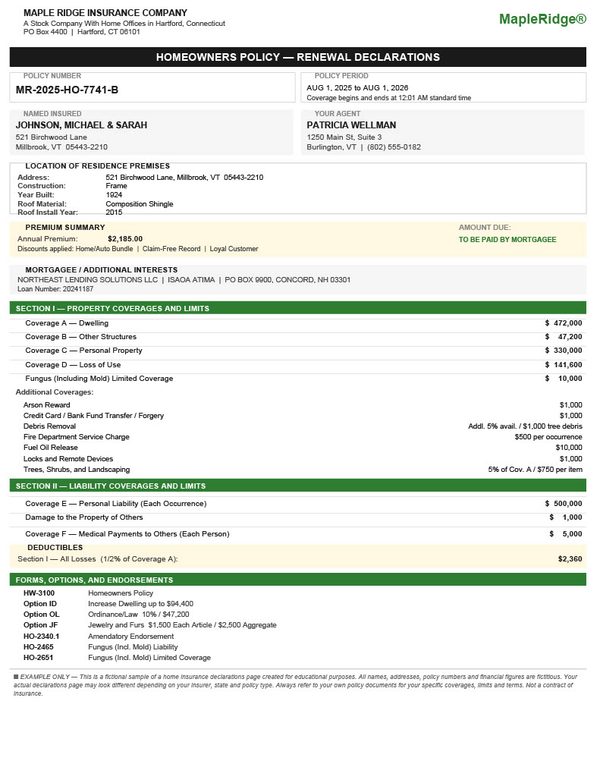
If you’re sifting through policy documents and not sure what to look for, this is an example of a home declarations page created with the help of AI. Your homeowners insurance declarations page may look different based on your insurer and whether you’re accessing the information online or in a printed document.
What’s not on a home insurance declarations page
The declarations page offers an overview of your coverage, but when it comes to insurance, the details matter. Here’s what you won’t find on your homeowners declarations page.
Specifics about your coverage
For instance, the declarations page may say that you have $100,000 worth of coverage for your personal belongings. But it may not tell you that you’re covered for jewelry theft only up to $1,500.
What’s excluded from your coverage
The declarations page may note that you have coverage for the structure of your home up to $250,000. However, it may not mention that the coverage won’t apply to flood or earthquake damage.
For specifics like these, you’ll need to read the policy itself. Look for sections with words like “exclusions” or “special limits” to get a clearer sense of where your coverage might fall short.
For help reading your policy, see our guide to what homeowners insurance covers.
How to use your home insurance declarations page
Look over the declarations page carefully. Make sure your name and address are correct and the coverage, discounts and premium are as expected. If something doesn’t look right or you have questions, reach out to your agent or insurance company.
Your mortgage lender, if you have one, may ask to see your declarations page as proof that you’ve bought enough insurance for your home.
If it’s not accessible online through your insurer, keep your declarations page and insurance policy in a secure place such as a safe or in the cloud. That way you’ll have important coverage details handy if you need to make a claim after a fire or other disaster.