





If your understanding of a VA home loan starts and ends with “it’s for the military,” you’re not alone. For many eligible veterans and service members, the intricate workings (and benefits) of this U.S. government-backed mortgage are obscured behind lackluster guidance.
While there are classes and resources available, the military is broadly wary of steering members in a specific direction, says Alex Rodino, a real estate agent and U.S. Army veteran who served 10 years as an infantry officer and military advisor. “A lot of the course material is just very generic,” he says.
And that’s not a surprise. Considering the sheer size and scope of the military, providing personalized advice on VA loans to all its members would be no easy task.
That leaves real estate agents and lenders as the last line of defense, which is where a big part of the knowledge gap exists. Rodino purchased his first home in 2020 with a VA loan and says he didn’t like how ignorant he felt during the process.
“The reason I actually got my real estate license to begin with was because of that experience I had,” Rodino says. “Looking back on it, I had a lot of questions that didn't really get answered.”
But how can VA borrowers navigate this knowledge gap without having to become mortgage experts in their spare time? Here are some of the most important things to know when considering a VA loan, according to the financial experts and borrowers who have lived it.
Hire the right team
“My mortgage broker said, hey, you might qualify for this, look it up,” says Elizabeth Valente, a real estate investor and former U.S. Army officer who bought her first home using a VA loan in 2021. When it came to the application process, she felt crucial information wasn’t readily available to her or fully explained.
In hindsight, Valente says, working with an agent or lender who had detailed VA loan experience would have been beneficial. Not only would it help untangle the specific paperwork and appraisal requirements, but that expertise offers an important layer of support for military borrowers.
“For some processes in the military, it's very hand-holding,” Valente says. “I'll tell you what to wear, what to bring, when to be there.” But that’s not always true when transitioning back to civilian life, and parsing specifics of a loan process can be challenging. “I don't think a typical Realtor would understand what that person's going through,” Valente says.
Finding professionals with the right expertise involves asking questions — and lots of them.
“If I'm the smartest person in the room, we have an issue,” Valente says. “Don't be afraid to tell someone if something doesn't make sense or if you don't understand the numbers.”
Before agreeing to work with a lender or mortgage broker, ask how their process works, what companies they work with, and how familiar they are with VA loans. Treat the initial conversation like an interview — you’re hiring them, not the other way around.
Make sure you understand your entitlement
Knowing where to find your Certificate of Eligibility (COE) and how much you might be eligible to borrow is the responsibility of the person applying, Valente says. “All that information — it is available in the [VA] website but you really have to dig for it.”
And this information isn’t recreational reading — your COE lists your "basic entitlement," which is a crucial figure in VA lending. If you have full basic entitlement, the U.S. Department of Veterans Affairs (VA) generally guarantees 25% of the loan, which in most cases lets you put 0% down.
Why? With a quarter of the loan guaranteed by the VA, the lender is more protected and thus more willing to forgo a down payment.
So how do you know if you have full basic entitlement? Look for the figure $36,000 on your COE. This dollar amount represents full entitlement. Technically, basic entitlement is for loans up to $144,000, but then your bonus entitlement kicks in and you can go higher. The VA doesn’t set loan limits when you have full entitlement — though your lender will still decide how much you can borrow based on your income, debts, credit and the home’s appraised value.
Let’s say you want to buy a home in Fayetteville, North Carolina, and you need a $200,000 loan. In order to put no money down, your entitlement needs to cover at least 25% of the loan amount — in this example, that’s $50,000. After you purchase the home, your COE will show your basic entitlement as $0 and the entitlement charged to a previous loan as $50,000.
VA loans can be investment pathways
“Serving in the military is a unique investing opportunity that most people don't get,” Rodino says. “I wish someone had told me to buy a house when I got to my first duty station.”
If he’d known it was possible or understood how, Rodino says he would have been able to buy in 2017, move in 2020, rent out his first home and then repeat the process. “I'd have three by now and the first one would probably be paid off.”
This particular plan is partly based on the unique schedule of many military members. “Generally, you're moving anywhere from two to four to six years,” Rodino says. Owning multiple properties also leverages two big (and often misunderstood) perks of the VA loan: It’s possible to have more than one active loan at the same time, and after one year, you may be able to convert your primary residence to a rental.
Let’s go back to Fayetteville, North Carolina. After two years, you decide to rent out the home because you’re moving to Bell County, Texas. The home you want to buy in Bell County is $300,000, and in order to make no down payment, you need the VA to guarantee 25% of the loan ($75,000).
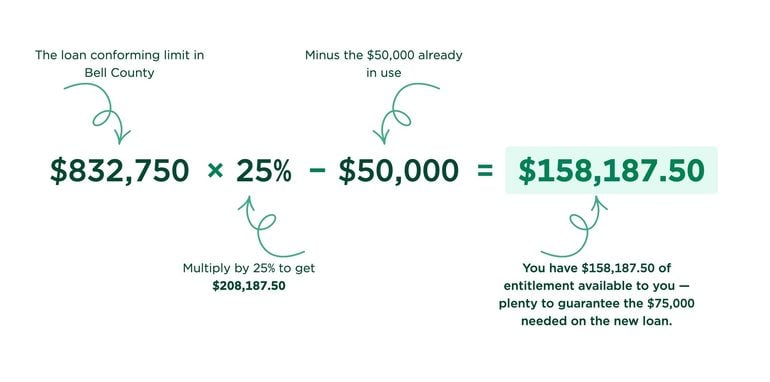
Because you no longer have full basic entitlement — remember, you already have an active VA loan elsewhere — your entitlement is capped at 25% of the conforming loan limit in the county where you plan to buy, minus what’s already being used on your first loan ($50,000 in our Fayetteville example).
Now for the math: The current conforming loan limit in Bell County is $832,750. Multiply this figure by 25% and subtract the $50,000 already in use: You have $158,187.50 of entitlement available to you — plenty to guarantee the $75,000 needed on the new loan.
If all of this sounds overwhelming, you’re not wrong. There are resources out there to help you figure all of this out, Rodino says. “The problem is, they're not always practical or they're not always apparent.”
The VA has a website that can walk you through entitlement calculations, but you should also ask your lender, broker or agent. If you’re working with experienced folks, they’ll be able to explain these details and help you get the most out of the VA’s guarantees.
Zero down still comes with strings
The key takeaway is this: While each VA loan must initially be for a primary residence, borrowers can leverage their entitlement to build an investment portfolio without needing to cough up large down payments.
But these examples don’t consider all of the factors that go into approvals. Like most mortgages, your income, debts and assets dictate your eligibility. And although the VA doesn’t impose credit score minimums, most lenders do — NerdWallet's analysis shows 620 is a common floor.
It’s also important to note that a VA loan’s 0% down isn’t free. VA loans carry a funding fee based on how much you’re putting down and whether it’s your first or subsequent use (certain disabled veterans are exempt). You can pay this up front at closing or roll it into the loan amount; again, your team of professionals should be able to walk you through your options.
You don’t have to use it
“I think there's the assumption that this is what we do: We get our VA home loan and we go buy a home,” says Julie Soares, financial readiness director for the Wounded Warrior Project. When we’re given access to a benefit that offers discounts and perks, it can be hard not to take advantage of it. But this is why financial awareness is critical.
There are a lot of conversations happening right now around homeownership and whether it’s the right choice, especially as affordability remains challenging. So if you haven’t heard it recently, here’s a reminder: Buying property is not the only way to build wealth or create financial security.
“The financial readiness program at Wounded Warrior Project is really leaning into getting further upstream in those conversations,” Soares says. Having a clear understanding of your benefits before you need to use them allows you to make more informed choices.
While it's helpful to understand your entitlement and what you may be eligible to borrow, you don't have to know every little detail about mortgages, or navigate the process alone. Sometimes, the most important thing to know about VA loans is where to turn for help.
If you are unsure of your eligibility or want more information about home loans, you can call the VA's home loans hotline at 877-827-3702.
“Please reach out to Wounded Warrior Project, reach out to the VA, reach out to any service organization,” Soares says. “Not one organization is gonna be able to fix or solve all of these problems. We have to do this as a group.”