







Mileage Plan is out and Atmos Rewards is in.
Atmos Rewards, the joint loyalty program for Alaska Airlines and Hawaiian Airlines, launched today, retaining Alaska’s most compelling differentiator among major U.S. airline loyalty programs: allowing passengers to earn miles based on distance flown.
Later in 2026, Atmos Rewards will go a step further by giving passengers the choice of how to earn miles and status, whether that’s via distance traveled, segments flown or money spent.
The airline loyalty program is also shaking up its elite status tiers. Status at the highest levels will be harder to reach, but the most loyal flyers will soon get a unique upgrade benefit. Plus, all Atmos Rewards members will be able to access Starlink across both airlines, with installation targeted to finish by 2027 on Alaska’s planes. (A large portion of Hawaiian’s fleet is already outfitted with Starlink.)

By signing up, you will receive newsletters and promotional content and agree to our Terms of Use and acknowledge the data practices in our Privacy Policy. You may unsubscribe at any time.
Mileage Plan accounts will automatically convert to Atmos Rewards accounts today. HawaiianMiles members will see their accounts transition into Atmos Rewards on Oct. 1, 2025. HawaiianMiles members who haven’t linked their account to a Mileage Plan account will receive a new account number.
Here’s everything you need to know about Atmos Rewards.
New ways to earn points (not miles)
If you fly on Alaska or Hawaiian, you’ll now earn “Atmos points,” instead of Alaska or Hawaiian miles. Elite-qualifying miles are now called status points. The new nomenclature makes sense since you might not earn points based on mileage as part of Atmos Rewards’ innovative “choose-how-you-earn” model.
Under Alaska’s Mileage Plan, passengers earned miles based on the distance flown with adjustments based on cabin class. Most airlines around the world have largely done away with that earning scheme in favor of a revenue-based earning structure, where you earn miles based on the amount you spent on your ticket.
Starting later in 2026, you'll be able to earn points in one of three ways with Atmos Rewards:
Distance traveled: Earn 1 point for each mile flown. This is a solid option for those who travel long distances on cheaper fares. Status points for award travel will be earned based on distance, as well.
Price paid: Earn 5 points per $1 spent on airfare, less taxes and fees, as well as paid upgrades to premium cabins. If you spend a lot on tickets (maybe you’re accustomed to buying last-minute tickets or flying business class), this option is your best bet. Travelers will also earn points on award flights at a rate of 1 point per 20 points redeemed.
Segments flown: Earn a flat 500 points per segment flown. Those who primarily fly short hops on Alaska or Hawaiian — such as frequent travelers between the Hawaiian islands — should choose this option. For award travel, you’ll earn 500 status points per segment.
You won’t be able to pick and choose how you want to earn for each flight. You’ll need to stick with one option, though you'll be able to change your selection once a year.
Other ways to earn Atmos points include spending on Atmos-branded or Hawaiian-branded credit cards, transferring points from Bilt Rewards to Atmos Rewards, riding with Lyft and other spending with Atmos partners.
As for redeeming your Atmos Rewards points, there will be no devaluations to award charts as part of the loyalty program’s rollout, says Brett Catlin, Alaska’s vice president of loyalty, alliances and sales.
New loyalty tiers with harder requirements for top-tier elite status
Atmos Rewards is also rolling out new status tiers. Like Mileage Plan, there will be four elite levels. However, the higher tiers of status will be harder to earn, starting with the 2026 qualification year. (Elite status requirements will remain the same for 2025.)
Atmos Silver: 20,000 status points.
Atmos Gold: 40,000 status points.
Atmos Platinum: 80,000 status points (up from 75,000 elite-qualifying miles).
Atmos Titanium: 135,000 status points (up from 100,000 elite-qualifying miles).
Atmos Platinum will require 5,000 more status points to earn compared to its Alaska MVP Gold 75K equivalent, while Atmos Titanium will require 35,000 more status points than Alaska MVP Gold 100K, a 35% increase. One downside for Atmos Silver members (previously MVPs) is starting in 2026, these elites will only get one free checked bag for themselves and their companions on Alaska flights, down from two.
However, if you earn either of those statuses in 2025, you’ll get a head start toward qualifying next year. In February 2026, Atmos Platinum members will get 5,000 status points deposited to their accounts, while Titanium elites will get 20,000 status points.
While the loyalty team considered more creative names for its status tiers, it ultimately went with names that passengers are used to, Catlin says. American Airlines, Delta Air Lines and United Airlines all have similarly named tiers, while Marriott Bonvoy uses the same descriptors for its elite levels.
Those looking to earn elite status faster will benefit from holding the Atmos™ Rewards Summit Visa Infinite® Credit Card, the program’s premium offering with a $395 annual fee. That comes with an automatic 10,000 status point deposit each year after your first cardholder anniversary, meaning the earliest someone can get the deposit is next year. Cardholders also earn 1 status point for every $2 spent, compared to 1 per $3 spent for those who hold the $95-annual-fee Atmos™ Rewards Ascent Visa Signature® Credit Card.
New elite upgrade perks
While Atmos Titanium will be harder to earn, it will come with a valuable perk that no other U.S. airline offers: free upgrades to business class on international long-haul flights. This new perk starts spring 2026, and Titanium elites and a companion will be eligible for the complimentary day-of-departure upgrades on Alaska and Hawaiian flights.
That’s a big deal because other airlines require elite status holders to use some kind of upgrade currency (such as United PlusPoints) just to be on the upgrade waitlist for international long-haul business class.
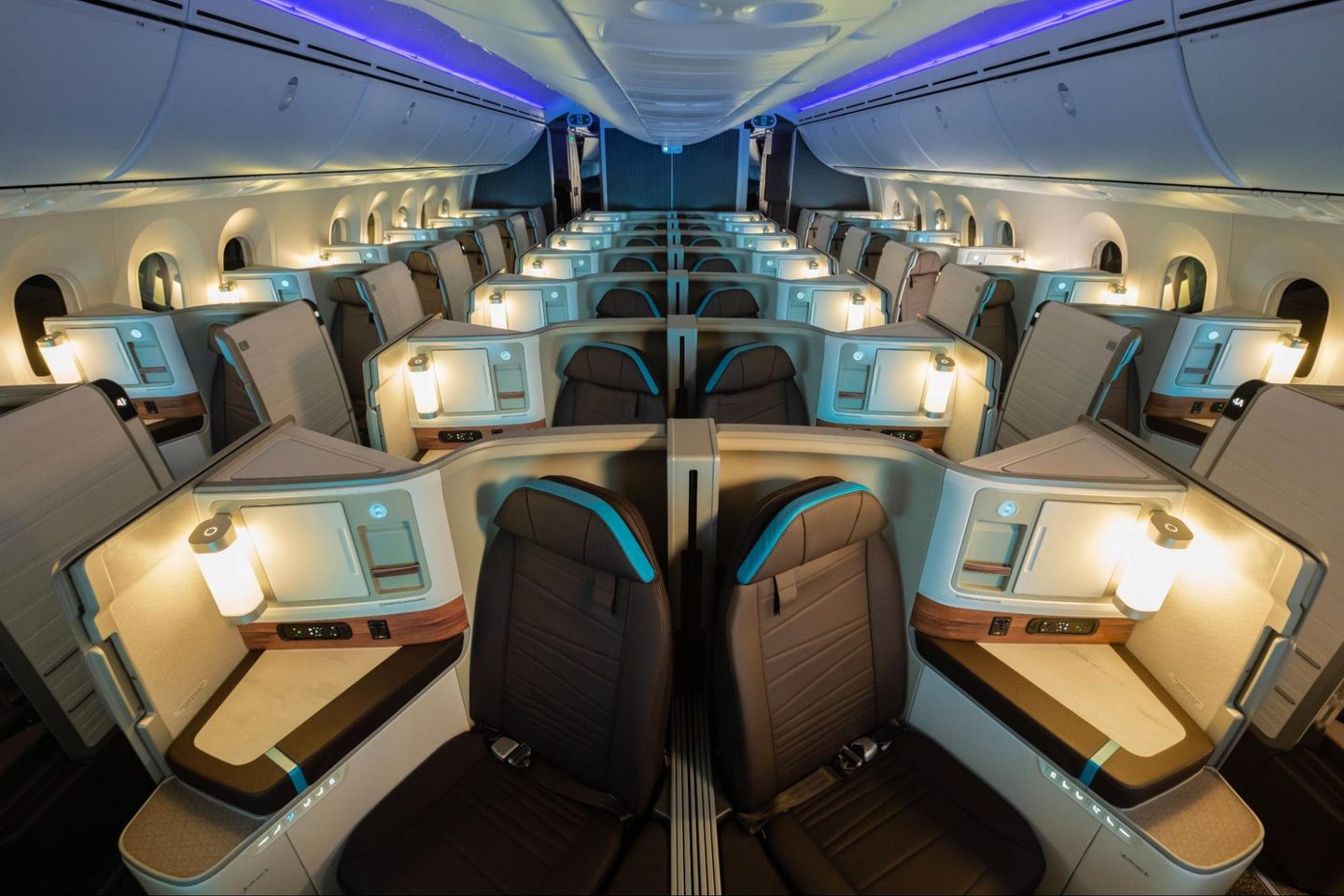
This unique perk might be enticing, but remember that all of Alaska’s intercontinental flights — both current and planned — depart out of Seattle, while Hawaiian flights are out of Honolulu. For East Coast travelers heading to Europe, it wouldn’t make sense to fly west to Seattle and double back.
Starting spring 2026, all Atmos status holders and a companion will also be eligible for complimentary upgrades on Hawaiian flights within North America.
Free Starlink Wi-Fi rolling out across the Alaska fleet for Atmos Rewards members
Like its sister airline Hawaiian, Alaska is adding Starlink to its entire fleet. The service will be free for all Atmos Rewards members, and the rollout is expected to be complete by 2027.
Free Wi-Fi is becoming the industry norm among U.S. carriers, with Delta and Hawaiian already offering it across large portions of their fleets. American and United have also said they would roll out free Wi-Fi to their passengers.
Atmos Communities are on their way
Starting in 2026, Atmos Rewards will introduce Atmos Communities, which Atmos members can join to gain access to benefits tailored to their interests.
Some of them are based on geographic residence, such as the existing Huaka’i by Hawaiian and Club 49 programs for residents in Hawaii and Alaska.
Other communities expected to launch in 2026 include Global Locals (for non-U.S.-based members), Culinary Journeys (for foodie travelers), Active Escapes (for outdoor explorers) and Families On the Go.
Top photo courtesy of Alaska Airlines.
How to maximize your rewards
You want a travel credit card that prioritizes what’s important to you. Here are some of the best travel credit cards of 2026:
Flexibility, point transfers and a large bonus: Chase Sapphire Preferred® Card
No annual fee: Wells Fargo Autograph® Card
Flat-rate travel rewards: Capital One Venture Rewards Credit Card
Bonus travel rewards and high-end perks: Chase Sapphire Reserve®
Luxury perks: American Express Platinum Card®
Business travelers: Ink Business Preferred® Credit Card