







Nvidia (NVDA) has become one of the best-known AI stocks in recent years because its high-performance chips are in great demand for AI applications. Although it remains one of the biggest players in the market, there are a few publicly traded companies that are starting to compete.
2026 hasn't been a great year for Nvidia shareholders: The stock is down year-to-date, in large part due to a sharp selloff following the resignation of co-founder and longtime CEO Jensen Huang .
Nvidia’s major competitors
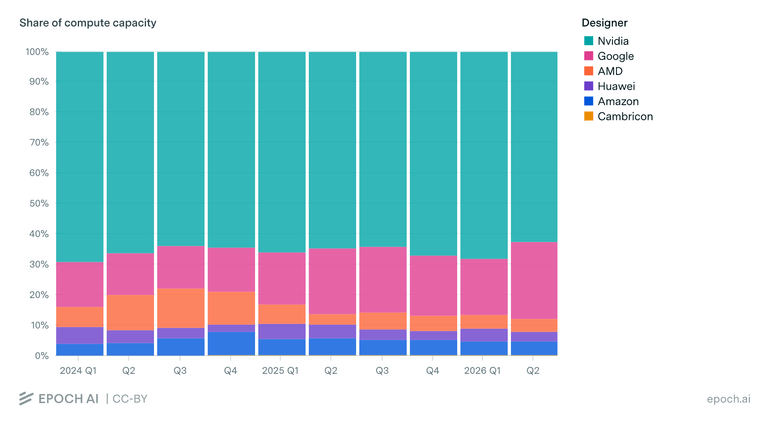
According to October 2026 data from Epoch.ai, a nonprofit AI research organization, Nvidia still controls a large majority of the market for AI chips. But three other publicly-traded companies also have some market share:
Alphabet (GOOG), which sells its custom Tensor Processing Unit (TPU) AI chips to third parties and also leases out computing capacity on its own TPUs via Google Cloud.
Amazon (AMZN), which leases out computing capacity on its custom Trainium AI chips via Amazon Web Services.
Advanced Micro Devices (AMD), Nvidia's longtime rival in the pure-play chip design business.
Other publicly traded AI chipmakers
Together, Nvidia, Alphabet, Amazon and AMD make up most of the market for AI chips, but these three are not entirely alone in the chipmaking space. Many big tech companies are creating their own AI hardware, too — they just don’t sell very much of it at the moment. These minor chipmakers include:
IBM (IBM).
Qualcomm (QCOM).
Broadcom (AVGO).
Some of these companies, such as Apple, Meta, Microsoft and IBM, have negligible shares of the overall AI chip market because they’ve primarily developed chips for “in-house” use — to power their own AI products and systems.
Others, such as Qualcomm and Broadcom, have business models that involve partnering with other firms to help them design custom AI chips.
Is there a case for investing in Nvidia competitors?
The companies listed in the previous sections control small shares of the AI chip market — but that doesn’t mean they’re small companies. All of them are blue-chip tech stocks, and all except IBM, AMD and Qualcomm are worth trillions of dollars. A well-diversified portfolio will likely have exposure to some or all of these stocks, either through index funds or individual shares.
What do analysts think?
Wall Street analysts are still fairly bullish on Nvidia. Of 38 who cover the stock, 27 rate it a "buy" and 11 rate it a "hold." But analysts are even more bullish on Nvidia's major competitors:
Alphabet: 10 of 11 analysts rate it a "buy," one rates it a "hold."
Amazon: 42 of 43 analysts rate it a "buy," one rates it a "hold."
AMD: 29 of 32 analysts rate it a "buy," three rate it a "hold."
The author owned shares of Nvidia at the time of last update.
Article sources
- 1.Reuters. Jensen Huang resigns as Nvidia CEO amid reports of extramarital affairs - as it happened.
- 2.Epoch.ai. AI chip market share by designer. Accessed Nov 14, 2026.