





When are mortgage rates going to drop? Or at least stop going up? Mortgage rates move for many reasons — Fed decisions, economic data and shifts in the bond market, to name a few — and understanding what's going on can help you see what may be ahead.
But the input doesn't guarantee the outcome: A finely tuned prediction using the most comprehensive data available can be upended by one unexpected market-moving event. So whether we're trying to look years, months or even just days ahead, we can only work with what we know now.
The goal here isn't to give you a vision of the future. It's for you to have clarity on what's happening now and what it could mean is coming next. That way, whether you're looking to buy or refinance, you can feel more confident about whether it's the right time for you to make a move.
🔮 Mortgage rate predictions
No one can know exactly where mortgage rates will be next year, but the teams of economists that put out monthly forecasts for the average 30-year mortgage rate provide a well-informed benchmark.
Fannie Mae made an unusually big splash with its latest forecast. Usually these updates are nonevents, but the government-sponsored enterprise's team of economists got a fair amount of press coverage after raising their previous projections more than half a percentage point.
Wells Fargo and the Mortgage Bankers Association also raised their projections, though not quite as much. Wells Fargo's economists biggest raise was 20 basis points, and they foresee rates easing down over the course of next year. MBA more or less splits the difference between the Fannie and Wells predictions.
Latest prediction from ... | Q4 2026 | Q1 2027 | Q2 2027 | Q3 2027 |
|---|---|---|---|---|
Fannie Mae | 7.40% | 7.50% | 7.50% | 7.50% |
Mortgage Bankers Association | 7.30% | 7.20% | 7.20% | 7.20% |
Wells Fargo | 7.10% | 7.05% | 7.00% | 6.95% |
The percentages reflect predictions for the quarterly average rate for the 30-year, fixed-rate, conventional mortgage in Freddie Mac's weekly survey. The most recent predictions available are always those made the previous month: currently, that’s October.
Last month I said "I wouldn't be surprised to see upward revisions next month," and yup, that's exactly what happened. Though the forecasts aren't identical, now everyone's seeing rates remaining in the 7% range for the time being.
If you're considering a home search, here's your takeaway: Everything is pointing toward a higher-for-longer rate environment. It's important to budget around what you can afford at today's interest rates. If you're hoping to refinance down the road, be aware that a "marry the house, date the rate" scenario may look more like a serious LTR than a couple of dinners out.
Are you a homeowner eyeing a refinance? Same deal. If your refi math starts mathing, make your move. We've seen occasional pockets of lower rates this year that put more folks in the money on a refi, but they've been brief.
📆 Where are mortgage rates headed in November?
At a month or less out, a prediction can point to specific forces that are already shaping mortgage rates today. Again though, you can't count out the unexpected. Mortgage rates looked poised to keep dropping back in March, then a war started.
It's a little unclear where mortgage rates are going in November, and it really all comes down to inflation.
On one hand, we've got our standard inflation-is-bad-so-rates-will-probably-go-up scenario. Inflation has been above the Federal Reserve's 2% target for more than five years, but recently we've seen price pressures intensify. The Iran war, which has crimped traffic through a key trade route and disrupted oil production, has done plenty to spur inflation. It's been quiet for a minute, but there are credible reports that the U.S. will resume strikes after the midterms.
Raising the federal funds rate, which is the short-term borrowing rate the Fed adjusts, is the central bankers' main tool for calming inflation. The Fed hiked the funds rate in September, and even with a wait-and-see approach in October, markets' anticipation of another hike in December is contributing to higher-for-longer vibes.
Based on all of the above you'd think predicting mortgage rates will be higher in November is the obvious move. But toward the end of October, mortgage rates started to fall — and in a surprise twist, higher inflation actually helped push rates lower.
Here's the situation. Investors have started to grow anxious over just how much money tech companies will actually have to make in order to see profits from AI. Companies are borrowing billions for AI buildout at a time when both building costs and borrowing costs are going up. To see strong returns (or even just to pay back investors who bought corporate bonds), tech companies will need to make extraordinary profits.
These jitters grew strong enough that we saw a shift away from tech stocks, and (and this is the surprising part) stronger demand for Treasury bonds, which are usually considered among the safest investments. This is where mortgage rates enter the picture.
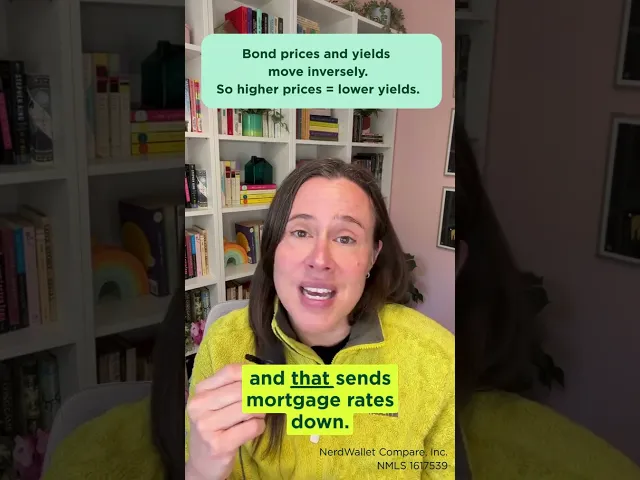
Mortgage rates are generally benchmarked to the yield on the 10-year Treasury, so changes in the bond market translate pretty quickly to changes in mortgage rates. Usually, inflation's not good for bonds and pushes up yields (and rising bond yields are exactly what drove mortgage rates up so quickly earlier this fall). Bond prices and yields move inversely, so when one goes up, the other goes down, and vice versa.
In this case, though, investors seem to have decided inflation's the lesser evil. Increased demand for bonds pushed prices up, allowing yields — and mortgage rates — to fall. There's an argument to be made that this is just a correction; basically, that yields and rates had risen too high too quickly this fall and this is a normalization. But the narrative around big tech and AI implies that this isn't just an adjusting-to-what-the-market-will-bear sort of settling.
So oddly enough, continued strong inflation could actually bring mortgage rates down, if that inflation keeps adding to investor unease about the tech sector.
Don't forget, though — on top of everything I've already mentioned (inflation, the Iran war, the Fed, tech companies, AI, the stock market, the bond market), we're also kicking off the month with the midterm elections. Depending both on how the elections go and what kind of reaction the results get, we could have another significant variable (or more than one) to add to this mix.
Mortgage loans from our partners

at New American Funding
N/A
0%

at Tomo
600
3%

at Chase
620
3%




Mortgage loans from our partners
at New American Funding
N/A
0%

at Rocket Mortgage, LLC
580
3.5%

at Veterans United
620
0%
at Tomo
600
3%
at Chase
620
3%



🗞️ What's moving mortgage rates this week?
Mortgage rates eased downward a little this week, but they're still firmly north of 7%.
The average rate on a 30-year fixed-rate mortgage slid eight basis points to 7.26% APR in the week ending Oct. 22, according to rates provided to NerdWallet by Zillow. (A basis point is one one-hundredth of a percentage point.) We calculate our weekly average using daily APRs recorded over the past five business days.
Mortgage rates have been above 7% for roughly a month, which is about how long they spent at that level in spring 2024, the last time we saw rates this high.
🤓 Kate on Rates, 10/22/26

📈 What are mortgage rates now?
Need more context? Here's where mortgage rates have been over the past 30 or so days. We only collect rates on weekdays (they don't change much over the weekends, since markets are closed). That's why you might notice some dates missing on the x-axis.
» MORE: Compare today's mortgage rates
NerdWallet's Homebuying Climate Index
If you're curious about mortgage rates because you're considering buying a home, our Homebuying Climate Index is another data point to check out. We use five different economic indicators to judge what the market's like for home buyers. Read more ...
🔎 AMA, mortgage rates edition
Hi, I'm Kate. I wrote most of what you're reading on this page, and I make weekly videos about mortgage interest rates. These are the kinds of questions I see on Reddit a lot (and definitely the sort of stuff I get asked when someone I've just met at a party finds out I work for NerdWallet).
I'm going to talk to you like I'd talk to an actual human person right in front of me, so be forewarned, I'm legit nerdy. I'm also real loquacious and I love me an emdash. Now let's get real about mortgage rates.
Will we ever see a 3% mortgage rate again?
I wouldn't hope for it, frankly. The ultra-low rates we saw in 2020 and 2021 were a historical anomaly. "But markets are cyclical—" let me stop you right there. Here's a graph showing average 30-year fixed rates from 1971 to today. Tell me what cycles you see.
Exactly. Sure, mortgage rates go up and down incrementally all the time. But when you zoom all the way out, it's hard to discern anything you could call a pattern. Both big, sudden shifts and long slopes correspond to changes in the U.S. economy, in federal monetary policy, in the bond market, stuff like that. It's not a "what goes up must come down" situation.
I say I wouldn't hope for 3% rates because the Federal Reserve dropped borrowing costs that drastically as an extreme measure to stave off economic collapse in the midst of the pandemic. (In order to make it possible for mortgage lenders to confidently drop rates that low, the Fed also bought up billions of dollars' worth of mortgage-backed securities, but that's a whole other story.) Yes, it was inexpensive to borrow to buy a home, but big picture, things were not going well for the country.
You could also argue (and I definitely do) that those ultra-low rates in 2020 and 2021 more or less broke the U.S. housing market by taking existing trends to the extreme. Sure, home values had been appreciating, but super-low rates brought in a massive influx of buyers, driving up prices extremely rapidly. Inventory was already tight, and it got worse. Demand continues to outweigh supply, even at today's prices, because supply is so low. And a big reason supply remains low is because homeowners who bought or refinanced at ultra-low mortgage interest rates are extremely reluctant to let go of their very affordable mortgages.
Things would have to be going real badly on the whole for us to see 3% rates again, and if we did, we'd probably get a buyer stampede that would send home prices into the stratosphere.
Will mortgage rates go down to 5% in 2027?
Right now, the prospect of 5% mortgage interest rates in 2027 does not look good, but that's not to say it couldn't happen. When we started 2026, rates were trending toward 5% territory, and it certainly wasn't obvious that rates would abruptly reverse course and go on to pass 7%, but here we are.
Let's walk through a couple of scenarios that could move rates to 5% next year. I'm going to take two extremes, one where it's darn near painless and one where it's almost all pain.
Everybody wins version: The war in Iran ends, and trade and oil production get unsnarled relatively seamlessly. That slows inflation, allowing the Federal Reserve to be less restrictive (so, no more Fed rate hikes). Businesses are able to rebound as prices stabilize, so hiring remains steady and the country doesn't tip into a recession. (As you'll see in a moment, unemployment would likely lead to lower mortgage rates, as the Fed would start cutting to boost the labor market. But this is the everybody wins version, so we're keeping our jobs. And anyway, the Fed holding steady is still decent news for mortgage rates.) With inflation under control, prices for Treasuries rise, lowering their yields. This is significant, because mortgage rates are often benchmarked to the yield on the 10-year Treasury. On top of all that, Freddie Mac and Fannie Mae step up their purchases of mortgage-backed securities, allowing the spread between mortgage rates and the 10-year Treasury yield to narrow. All of this still might not be enough to get all the way to 5%, but mortgage rates would likely get within shouting distance.
Everything comes at a horrible cost version: This actually starts off the same, with the war ending, inflation slowing, and the Fed no longer needing to raise the funds rate. But then this timeline gets a lot darker. Even though inflation's gotten better, too much damage has already been done, and job growth goes negative. The Fed needs to cut rates to try to encourage hiring. At the same time, investors lose confidence in the promise of AI, so the tech stocks that have been driving stock market growth start to tank. Investors pile into the bond market, as U.S. Treasuries suddenly seem like a much better bet. Bond prices rise dramatically, and bond yields plunge — again, mortgage rates follow the yield on the 10-year Treasury. Between the Fed dropping the funds rate and Treasury yields falling, yes, we'd see much lower mortgage rates. But the whole thing where there are widespread layoffs and the stock market tanks? That all spells recession with a capital R, and even if mortgage rates went below 5%, those rates probably wouldn't be worth the trade-offs.
Will either of these happen? Who knows. And obviously, I've cooked up two opposing scenarios — you could come up with more that take some pieces from each, or that bring in variables I haven't considered here.
But the multitude of factors illustrates how much goes into what borrowers pay in interest to take out mortgages, and why it's so complicated to try to project mortgage rates very far into the future.
What will mortgage rates be in the next 5 years?
Did you read what I just said about 2027? We can't be sure what'll happen next year, let alone in 2031. Five years ago, who would have said "Well, mortgage rates will rise in 2026 because tech companies issuing corporate bonds to fund their AI buildout will shake up the bond market"? Literally nobody. In 2021, for most of us AI was just a Steven Spielberg movie with the kid from The Sixth Sense.
It's possible to make a solid prediction for mortgage rates a week or even a month out, since at that point, you can point to specific, identifiable forces that are already in motion.
For example, say inflation data comes in that shows inflation is slowing. That's probably good news for mortgage rates. The Federal Reserve doesn't set mortgage rates, but its predicted actions can have considerable influence. If inflation's slowing, the chances of the Fed raising the federal funds rate drop. Less inflation is also generally good news for the bond market, bringing up bond prices. Bond prices and yields move inversely, so higher bond prices bring lower yields. Again, 30-year mortgage rates generally track the yield on the 10-year Treasury.
That's an excessively detailed example to show why a short-term prediction is possible. It works because a prediction is essentially a very educated guess. We know what's happening now, and we can infer what's likely to come next.
That doesn't work for five years out. A mortgage rate forecast for 2031 can't take into account forces that might not exist yet. Best case, that kind of forecast can use really conservative estimates based on formulas and historical data to say, “okay, if nothing weird happens, here's where we'll probably end up.” But let's face it. Something. Weird. Always. Happens. It might be a pandemic, or a revolutionary technology, or a war. And we can't know what it's going to be.