





SBA loans typically require a personal guarantee from anyone who owns 20% or more of the business. A personal guarantee is a legal agreement that makes you personally responsible for your business’s debt. If your business can’t repay the loan, the lender can go after your personal assets, such as savings or real estate, to get its money back.
Many lenders require a personal guarantee because it lowers their risk when lending to small businesses. Here’s what you need to know.
How much do you need?
Most SBA loans require a personal guarantee
SBA loans usually require an unlimited personal guarantee from anyone who owns 20% or more of the business. This includes SBA 7(a) loans, SBA 504 loans and SBA microloans.
Lenders may also ask owners with smaller stakes, such as 15%, for a limited or unlimited guarantee.
SBA lenders must also get unlimited guarantees from:
Spouses who own 5% or more of the business when the combined ownership interest of both spouses is 20% or more.
Corporate entities that own 20% or more of the business.
Trusts that own 20% or more of the business.
Trustors, if the trust that owns 20% or more of the business is revocable.
If no one owns 20% or more, at least one owner must give an unlimited personal guarantee.
Are SBA disaster loans personally guaranteed?
Like other types of SBA loans, SBA disaster loans typically require a personal guarantee.
The SBA may adjust guarantee rules for these loans depending on the disaster, however. During the pandemic, for example, COVID-19 EIDL loans only required a personal guarantee for amounts over $200,000.
Unlimited vs. limited personal guarantees
In most cases, you’ll need to provide an unlimited personal guarantee when applying for an SBA loan. Your lender, however, may ask for a limited personal guarantee from anyone who owns less than 20% of the business.
Here’s what you need to know about the differences between these two types of guarantees.
Unlimited personal guarantee
This agreement guarantees that you’ll pay back the loan in full if your business can’t. The lender is not required to seek payment from any other source before going to you for repayment.
Lenders may use SBA Form 148 for this type of personal guarantee or their own equivalent form.
Limited personal guarantee
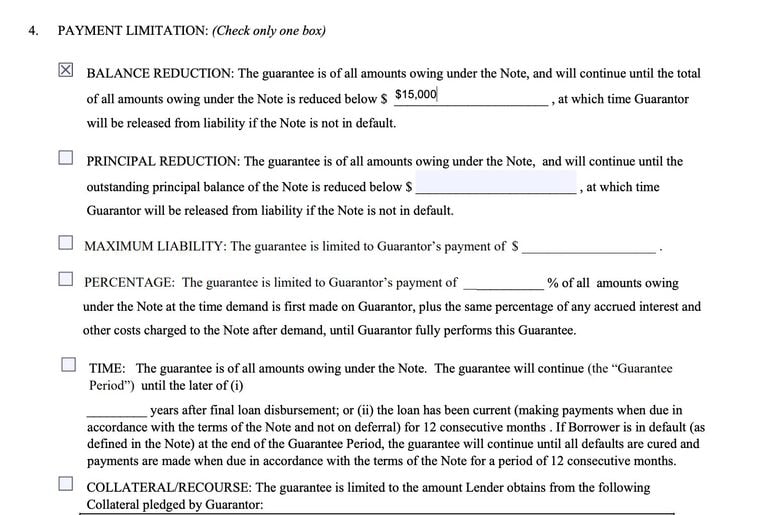
A limited personal guarantee caps what you have to repay if your business can’t cover the debt. The cap is set using one of these options:
A set dollar amount. This can be structured a few ways, such as a cap on your total liability.
A percentage of the loan amount.
A period of time.
The money the lender gets from selling specific collateral you pledge.
Your share of property you own with your spouse, if you pledge it as collateral.
If the lender asks in writing, you must pay what the guarantee covers. As with an unlimited guarantee, the lender can come to you first, before trying to collect payment from any other source.
Lenders may use SBA Form 148L for the limited personal guarantee, or their own equivalent form, and specify the guarantee option in the authorization (as shown in the example below).
What happens if you can’t pay your SBA loan?
If you start missing payments on your SBA loan, your lender will classify it as delinquent. It’ll likely reach out to request immediate payment. If you don’t pay or contact your lender after three to four months, the loan will fall into default.
Once your loan is in default, your lender and the SBA will make every effort to collect repayment. This might include:
Going after your personal assets and savings (in other words, acting on the personal guarantee).
Claiming and selling your collateral.
Sending the debt to the U.S. Treasury for collection. The Treasury can garnish your wages, tax refunds or other government benefits. It can also file a lawsuit against you.
Can you avoid or limit an SBA personal guarantee?
Because the SBA sets the rules for personal guarantees, lenders don’t have much flexibility.
If you own 20% or more of the business, you’ll have to sign an unlimited guarantee to get SBA funding. If you own less than 20%, you may be able to negotiate a limited guarantee.
If a personal guarantee is a dealbreaker, some lenders offer options without them — though they usually cost more.


Article sources
- 1.U.S. Small Business Administration. SOP 50 10 Lender and Development Company Loan Programs.
- 2.U.S. Small Business Administration. SOP 50 30 9 Disaster Assistance Program .
- 3.U.S. Small Business Administration. SBA Form 148L.