






When I woke up the other morning, I wondered what I wonder most mornings lately: How bad is crypto doing today?
I opened Coinbase to find out. Things were bad, but that wasn’t surprising. What was surprising was the new asset listed on my homescreen: Stocks.
Stocks? On Coinbase?
Yes, Coinbase now offers stock and ETF trading directly in the app. They first announced this was coming toward the end of 2025, but today they announced it has rolled out to all accounts. I noticed it in my account a few weeks ago, so naturally I had to test it.
The signup process was quick and easy; exactly what you’d expect from an app like Coinbase. I was approved for stock trading in less than two minutes and promptly bought a tiny bit of Walmart stock (not a recommendation; this was a fairly random choice for testing purposes) using my USDC balance. USDC is Coinbase’s preferred stablecoin, issued by Circle. This was a cool, convenient touch, since it’s typical to keep cash as USDC in Coinbase, rather than USD.
After that, I could see a small balance next to the word “stocks” on my home screen, which appears below my crypto balance. So easy.
Beyond ease, there are a few other good things about this new feature — and, in my opinion, some pretty bad things.
TL;DR: If you already have Coinbase, and you don’t yet have a traditional brokerage account, it could suffice for getting some exposure to equities. But my preference is still to use Coinbase for crypto, and a separate, dedicated brokerage for stocks.
What I like about Coinbase’s new stock trading feature
It's extremely convenient. Coinbase is on a mission to become the “Everything Exchange,” much like Robinhood. And it’s true that the ability to sell crypto, then turn around and use that cash to buy stocks, is very convenient. It’s also easy to see your allocations split between digital and traditional assets. Everything about the stock-buying process is slick and simple.
Stock trading is available 24 hours a day, 5 days a week — a crowd accustomed to round-the-clock crypto trading will likely applaud this. Buying stocks directly with USDC means moving funds between crypto and equities is about the easiest it’s ever been.
It's free. You can’t really get away with charging a commission for stock trades these days, so as would be expected, there’s no fee to users to buy and sell stocks.
Fees $0per trade | Fees 0.5%-5.5% |
Account minimum $0 | Account minimum $1 |
Promotion Get 12 free shareswhen you open and fund an account with Webull | Promotion Noneno promotion available at this time |



What doesn’t work for me
No ACATs transfer. I have to imagine this will change in the future, but right now, there’s no way to transfer investments from another brokerage account. To get your portfolio from your current broker into Coinbase, you’d have to sell everything and transfer it into Coinbase as cash. This is likely something most investors would want to avoid doing — for one thing, there can be tax consequences for selling investments.
It feels tacked on. It’s funny; I said the same thing about Robinhood when it started offering crypto trades. But there’s really not a lot going on here, which makes it feel like an afterthought. When looking for stocks to buy, you get about 100 words explaining what the company does, links to SEC filings and some “key stats,” which include the day’s open, high, low, and volume, plus the 52-week range and current market cap. It’s all very perfunctory, and it feels to me like it’s designed more than anything to get you through to the final buy or sell button.
Things are getting crowded and confusing. Webull is also facing this problem. Coinbase started with a beautiful app that was very good at doing one thing. Then the company slowly added to it over the years, ultimately degrading the user experience that made it so groundbreaking to begin with. For years I’ve unflinchingly said that Coinbase is the best crypto app for beginners, but I’m questioning that now.
The bigger issue with the “Everything Exchange”
The individual pros and cons of Coinbase’s stock trading feature are actually kind of a distraction from what I think is a much bigger discussion that extends beyond Coinbase, to be sure, but is especially apparent here.
Coinbase’s goal of becoming an Everything Exchange means putting stocks in the same category as crypto, derivatives and prediction markets, which I find problematic.
Do you really need everything?
Coinbase has made it easy to invest in what are generally considered the riskiest assets — crypto, derivatives, prediction markets and individual stocks. When I opened my Coinbase app the other morning, rather than just a clean crypto and cash balance, I also saw $0 balances for derivatives, predictions and stocks. I never indicated I wanted any of those products nor did I open accounts with which to trade them. (I didn’t sign up for stock trading until I clicked on my $0 stock balance out of curiosity and was prompted to sign up.) Yet overnight, my app interface became a cornucopia of speculative assets presented as a one-stop shop for investing.
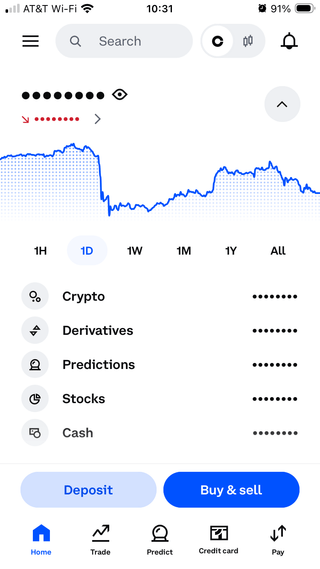
What concerns me the most is that my stocks balance is presented next to my prediction market balance. Online betting was once sequestered to betting apps. There was at least a bit of friction between your brokerage account and the gambling table.
That friction is gone now; equity or crypto profits can be plowed directly into prediction markets. Yes, gambling winnings could also get swooshed back into stock investments, but where does it end? Will profitable investments then be used to fund Super Bowl bets? Might you sell stocks at a loss to fund your March Madness bets? It’s far too easy to shuffle funds from one asset to the next in service of making short-term bets and chasing momentum.
My final take
All that said, Coinbase is still one of the best places to hold or trade cryptocurrency. I’ve used Coinbase for crypto since 2017, and I’ll continue to, because I think cryptocurrency has a place in a highly diversified portfolio. But there’s no reason to use Coinbase to trade stocks, and the natural guardrails that exist when you use one platform for speculating and another for wealth building will likely serve you better in the long run.
You can read our full review of Coinbase's crypto offering here, or see how it compares to other exchanges on our list of the best crypto trading platforms.
Article sources
- 1.Coinbase. Transfer assets (ACATS).