Japan-based All Nippon Airways and Japan Airlines (also called JAL) offer some of the best experiences in the skies. But which airline comes out on top in the ANA versus Japan Airlines battle?
Let's review five categories — from route maps to add-on fees — to determine the better airline.
Where they’re based and where they fly
Winner: Tied
Both ANA and Japan Airlines operate nearly an equivalent number of international routes. ANA offers a slightly larger worldwide network, but Japan Airlines operates to more destinations in the United States.
ANA
From its hub in Tokyo, ANA currently flies to 43 international destinations in 22 countries. Among those destinations are eight routes to the U.S.:
Chicago-O’Hare.
Honolulu.
Houston-George Bush.
Los Angeles.
New York-JFK.
San Francisco.
Seattle.
Washington D.C.-Dulles.
Japan Airlines
Tokyo-based Japan Airlines currently operates flights to 39 international destinations in 21 countries. That includes 10 routes to the U.S.:
Boston.
Chicago-O’Hare.
Dallas-Fort Worth.
Honolulu.
Kona, Hawaii.
Los Angeles.
New York-JFK.
San Diego.
San Francisco.
Seattle.

By signing up, you will receive newsletters and promotional content and agree to our Terms of Use and acknowledge the data practices in our Privacy Policy. You may unsubscribe at any time.
Travel credit card availability
Winner: ANA
Both airlines offer a rather unappealing credit card for U.S. residents, so the difference comes down to transfer partners. ANA's partnership with American Express gives it the edge in this category.
ANA credit cards
ANA offers a single credit card in the U.S., but the simply named ANA Card U.S.A isn't compelling for U.S.-based travelers.
Instead, the card is intended for Mileage Club members who have newly relocated to the U.S. and don't have a credit history. New cardholders earn 5,000 bonus miles after their first purchase and 1 mile per dollar spent on all purchases.
» Learn more: What to know about the ANA Card U.S.A.
However, the ANA Card U.S.A. isn't the only way to earn ANA Mileage Club miles through credit card spending.
ANA Mileage Club is a 1:1 transfer partner of American Express Membership Rewards. That means you effectively earn 5x ANA miles on eligible flight and hotel purchases (up to $500,000 on these purchases per calendar year) using the American Express Platinum Card® or 4x ANA miles at restaurants (up to $50,000 in purchases per calendar year) and grocery stores (up to $25,000 in purchases per calendar year) using the American Express® Gold Card.
Terms apply.
Japan Airlines credit cards
Like ANA, Japan Airlines offers a rather meh U.S. credit card. The basic JAL USA Card offers just 1 mile per $2 spent, although you can upgrade to the premium rewards card to boost that earning rate to 1 mile per $1 spent.
The sign-up bonus on the card is just an additional 5,000 miles on your first international flight on Japan Airlines.

Japan Airlines only partners with one major hotel points program: Marriott Bonvoy. Travelers will get 1 Mileage Bank mile per 3 Bonvoy points transferred, plus a 5,000-mile bonus for transferring at least 60,000 Bonvoy points.
More appealing is its partnership with Capital One. Capital One miles transfer to JAL Mileage Bank at a 2:1.5 ratio.
» Learn more: The best airline credit cards right now
Airline loyalty programs
Winner: ANA
ANA Mileage Club loyalty program
The ANA Mileage Club is quirky but one of the most underrated loyalty programs in the points and miles ecosystem.
The sweet spots of the ANA Mileage Club program are many. For example, travelers can book business class awards between North America and Japan for as few as 75,000 miles round-trip. That's a similar price to what other programs charge each way.
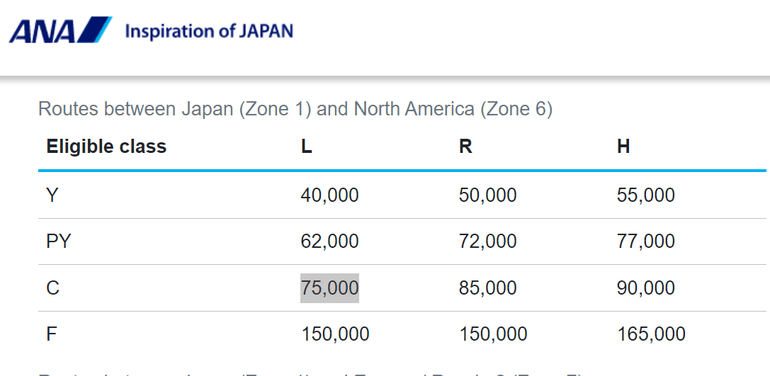
The main limitation of the ANA Mileage Club program is that travelers can't book one-way awards.
» Learn more: The guide to ANA Mileage Club
Japan Airlines JAL Mileage Bank loyalty program
Japan Airlines miles can be pretty valuable, but the program is often overlooked because collecting a significant balance of JAL Mileage Bank miles is hard (unless you can flex the Capital One transfer option).
Among Japan Airlines' sweet spots are creative multi-destination hops through the U.S. and longer-distance premium cabin awards on Japan Airlines or its partners Cathay Pacific and Emirates.
For instance, fly Emirates business class from New York to Dubai for just 110,000 JAL Mileage Bank miles round-trip.
» Learn more: The points collector’s guide to Japan Airlines
Extra fees
Winner: Japan Airlines
Both ANA and Japan Airlines include everything you may need in the cost of your ticket — from free checked bags to onboard meals.
However, ANA charges for standard seat selection on discount economy tickets, while Japan Airlines only charges for extra-legroom exit row seats.
ANA
When flying on ANA, you can get at least two free checked bags weighing up to 50 pounds (23 kilograms) per piece, plus one carry-on bag weighing up to 22 pounds (10 kilograms).
Business- and first-class passengers get even more checked bags and can check bags weighing up to 70 pounds (32 kilograms) each.
Economy passengers on certain discount fares (booking class V, W, S, L and K) have to pay to select certain types of seats. For flights between Japan and North America (except Honolulu), Europe and Oceania, the cost is:
Exit row seats with extra legroom: $55.
Other types of seats (window/aisle): $25.
Japan Airlines
Japan Airlines' policies are almost identical to ANA. All passengers get at least two pieces of checked baggage weighing up to 50 pounds (23 kilograms) each, plus one carry-on bag of up to 22 pounds (10 kilograms).
Japan Airlines doesn't charge for standard seat selection. The only seats you'll need to pay to reserve are extra-legroom seats in exit rows. These cost $100 per segment for flights between Japan and Europe, North America, Australia and India.
» Learn more: The best airlines that fly to Japan
In-flight experience
Winner: Tie
Sure, you can nitpick the differences between the two. But ANA and Japan Airlines offer some of the best in-flight experiences in the skies — regardless of the cabin.
ANA
From economy to first class, ANA offers a top-notch experience. In economy, passengers get a better-than-average 34 inches of pitch, various movies and audio programs and surprisingly good food. ANA premium economy passengers get more-spacious seats and even airport lounge access.
The experience gets even better as you move forward on the plane.
The experience in ANA business class varies depending on which aircraft type you're flying. But, ANA's new "The Suite" first-class product is widely regarded as one of the best first-class experiences in the world.
» Learn more: ANA first class “The Suite” review
Japan Airlines
Like ANA, Japan Airlines offers an incredible onboard product.
Japan Airlines' economy was recently recognized as the World's Best Economy Class, and anyone that's flown the airline can understand why.
Economy seats live up to the "sky wider" nickname as Japan Airlines only uses eight seats per row on Boeing 787 aircraft — versus nine seats wide on almost every other airline.
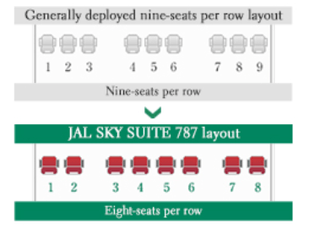
Likewise, Japan Airlines premium economy, business class and first class are all considered some of the top experiences in their respective classes.
» Learn more: Tokyo-Haneda ANA lounge review
ANA vs. Japan Airlines recapped
ANA scores an ever-so-slight victory in the competition of ANA versus Japan Airlines.
However, travelers really can't lose with either option. Both airlines provide travelers with a much-better-than-expected experience onboard, and you won't be nickel-and-dimed on either.
That makes either airline a great option for flying between the U.S. and Japan — or beyond into Asia.
The only downside is that both ANA and Japan Airlines offer a rather unappealing credit card for the U.S. market. However, ANA's partnership with AmEx (and likewise JAL's partnership with Capital One) allows travelers to earn very valuable Mileage Club miles effectively.
How to maximize your rewards
You want a travel credit card that prioritizes what’s important to you. Here are some of the best travel credit cards of 2026:
Flexibility, point transfers and a large bonus: Chase Sapphire Preferred® Card
No annual fee: Wells Fargo Autograph® Card
Flat-rate travel rewards: Capital One Venture Rewards Credit Card
Bonus travel rewards and high-end perks: Chase Sapphire Reserve®
Luxury perks: American Express Platinum Card®
Business travelers: Ink Business Preferred® Credit Card