Thinking about booking a flight with Allegiant Air but confused by the add-on fees? You’re not alone: Ultra-low-cost carriers like Allegiant are built around the “a la carte” model, where the base airfare doesn’t include basics like bags, seat assignments or a pack of crackers.
Allegiant also carries loads of “gotcha” fees for unaware passengers. For example, failing to print your own boarding pass (or use the Allegiant app to get a digital pass) will incur a ludicrous $5 “boarding pass printing fee.” And paying for a checked bag at the airport can cost 100% more than paying during booking. Knowing about these fees can save you a headache and a bunch of money.
It’s also important to keep in mind that most of these fees apply to each leg of a journey, so a round-trip flight on Allegiant can end up costing much more than the advertised price. On the other hand, savvy Allegiant travelers can avoid these dodgy fees and reap lower fares.
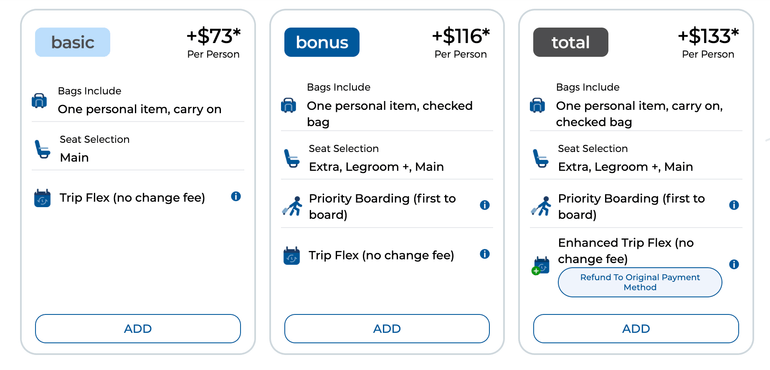
The airline offers three fares: Basic, Bonus and Total.
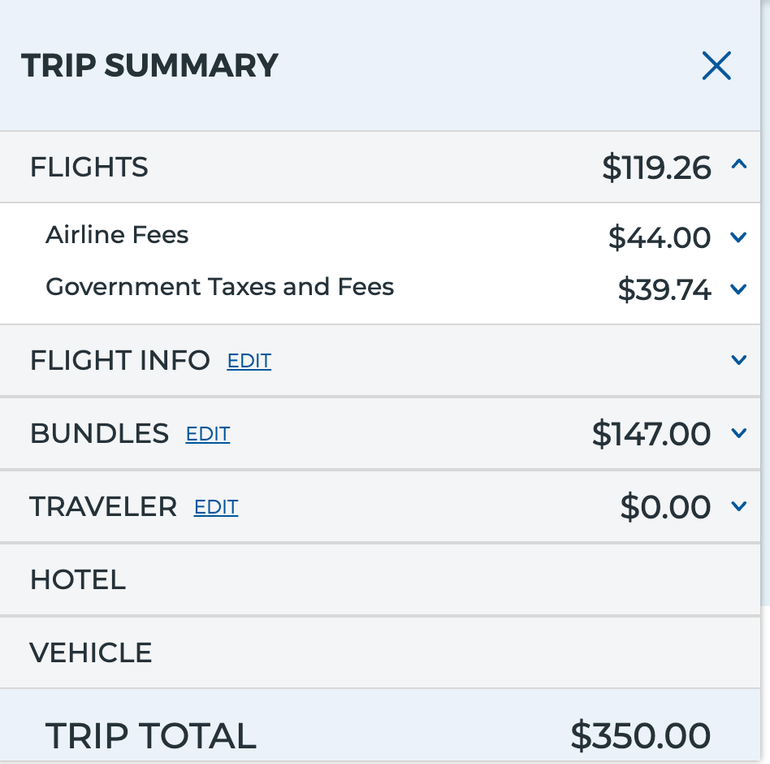
Since these fees vary from flight to flight, we’ll look at a real-world round-trip flight from Austin, Texas, to Las Vegas. The base price of this ticket was $92. With the Basic bundle — which gets you one personal item and one carry-on, Main seat selection and Trip Flex protection — the fees and taxes, the total comes to $350. You can skip the bundles, but if you do, you'll still need to pay for bags and seat selection, and that could end up being more expensive.
Allegiant Bonus and Allegiant Total are more expensive than Basic. The main differences boil down to seat selection options and baggage allowances.
Now, take a look at the various types of fees you may encounter during your Allegiant process.

By signing up, you will receive newsletters and promotional content and agree to our Terms of Use and acknowledge the data practices in our Privacy Policy. You may unsubscribe at any time.
Baggage fees
All domestic airlines charge for bags, but Allegiant has one of the most expensive and confusing baggage fee systems. There are two pieces of this system that are crucial to keep in mind:
Allegiant charges for overhead carry-on bags if you don't purchase a bundle that allows for a carr-on.
Allegiant charges far more for bags paid at the airport than online. Paying for a checked or carry-on bag at the airport usually costs $75 each, which would total $300 for a round-trip ticket if you had one of each. Avoid these fees at all costs.
» Learn more: Which airlines have the best (and worst) fees?
Checked bags
Allegiant charges for checked bags, and the cost per bag depends on the route flown and when the bag is paid for. Paying for these bags at booking is cheapest, paying “pre-departure” (online but not during booking) is more expensive and paying at the airport is always $75 per bag.
It’s much more cost-effective to pay during checkout. However, many travelers don’t know this far ahead of time whether they will be checking a bag or not. This creates a dilemma, which is exactly what Allegiant is banking on. When in doubt, either pay for bags ahead of time or plan to travel light.
Carry-on bags
Passengers are allowed one free personal item that fits underneath the seat. All roller bags and other larger carry-ons carry a fee, and these fees follow a similar structure to checked bags: They vary by route and cost more when paid closer to the day of the flight.
Here is the carry-on bag fee for the same example as above, Austin to Las Vegas:
The only difference between this and the checked bag fees is that paying for an overhead carry-on at booking costs $5 less. Paying for the same bag at the airport still costs a whopping $50 each way.
Seat selection
Many airlines now charge for seat selection, which means you either have to pay extra to secure a decent seat or roll the dice and let the airline assign your seat at the last minute. Allegiant makes this process especially confusing by the way it prices individual seats.
During checkout on allegiantair.com, you’ll see a standard seat selection screen like this:
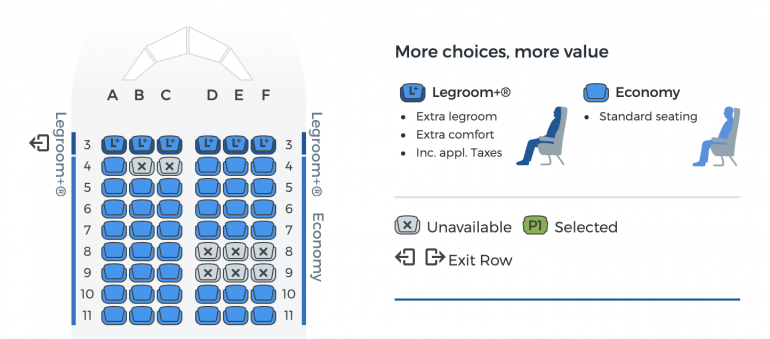
However, there’s no way to see the cost of a given seat without selecting it. Seat selection fees can range from $0 to $80.
The strategy here is simple: Either pony up for a decent window or aisle seat if the benefit outweighs the price, or skip seat selection altogether. There’s no reason to pay $10 for a middle seat.
Other fees
Change and cancellation fees: $25 per segment (each way)
Technically, changes are not allowed on base Allegiant fares, and the airline charges $25 per segment for cancellations, so $50 for a round-trip fare.
Ready for another complication? Allegiant lets you buy “Trip Flex” protection for $8 to $20 per person, per segment, which allows you to change or cancel your flight without penalty fees, though cancellations result in a travel credit rather than a full cash refund. Yet, since the cancellation fee is the same as this “Trip Flex” fee, the only added benefit is the ability to change the flight for free.
Boarding pass printing: $5
As mentioned, Allegiant will charge you to print your boarding pass at the airport. You can either get a mobile boarding pass or print your own at home to avoid this fee.
Food and beverage: $2-$7
If you’re used to flying full-service carriers, you may be surprised to learn that Allegiant does not offer complimentary nonalcoholic drinks or food. Expect to pay a few bucks for snacks.
Phone booking fee: $14.99 per segment
Booking over Allegiant's ticketing phone line will set you back $14.99 for each flight segment (i.e., for each stop). In other words: Don’t book over the phone.
Pet fee: $50 per segment
Allegiant allows pets in soft-sided carriers, and charges $50 per segment.
Since these are all optional or easily avoidable fees, we won’t include them in our overall price total.
So many fees
Allegiant Air charges a lot of fees. In our example, the cost of the base airfare more than doubled once baggage and seat selection were included, and this did not include other tricky fees like higher bag fees at the airport or boarding pass printing fees.
If you don’t mind playing Allegiant’s game and paying for only the add-ons you need, you can save some cash. But it’s easy to get taken for a ride by these convoluted fees.
How to maximize your rewards
You want a travel credit card that prioritizes what’s important to you. Here are some of the best travel credit cards of 2026:
Flexibility, point transfers and a large bonus: Chase Sapphire Preferred® Card
No annual fee: Wells Fargo Autograph® Card
Flat-rate travel rewards: Capital One Venture Rewards Credit Card
Bonus travel rewards and high-end perks: Chase Sapphire Reserve®
Luxury perks: American Express Platinum Card®
Business travelers: Ink Business Preferred® Credit Card