








A typical dating profile may showcase a photo and interests, but would your debt load make someone swipe left? According to a new NerdWallet survey, 10% of Americans say they would never date a person with credit card debt. Gen Zers (ages 18-27) and millennials (ages 28-43) are even more likely to say this than Gen Xers (ages 44-59) and baby boomers (ages 60-78) — 15% and 13%, compared to 7% and 6%, respectively.
The survey of more than 2,000 U.S. adults, commissioned by NerdWallet and conducted online by The Harris Poll, asked Americans how much debt would be a dealbreaker in a romantic relationship. Turns out, for most Americans, it depends on the amount and the plan, or lack thereof, to pay it off.
$20K in credit card debt may be a dating dealbreaker
Most Americans (90%) would theoretically date someone with credit card debt. In fact, 2 in 5 of those who said this (40%) say no amount of credit card debt is a dealbreaker in a relationship. However, others say they have limits to how much credit card debt they would abide in a romantic partner.
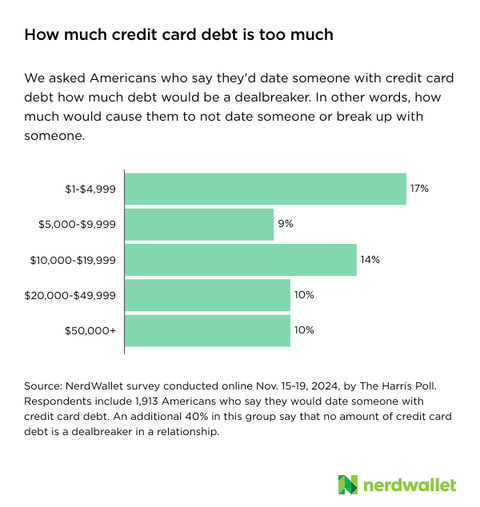
On average, $20,711 is the amount of credit card debt that would be a dealbreaker in a relationship, though the median is much lower at just $1,000.
Attitudes toward debt vary and plenty of Americans aren’t concerned about their partners’ balances. Nearly 2 in 5 Americans (39%) say they don’t care how much debt (of any kind) their partner has, and more than three-quarters of Americans (77%) would be OK with their partner having student loan debt.
What you can do: Pay off debt for yourself, not a potential partner
It’s recommended that you pay off your debt to limit interest costs and give yourself breathing room so you can afford all of your needs and some of your wants, as well as put money away for the future. But the truth is, paying off your debt may not result in finding and dating your ideal partner.
“Many people make changes to themselves to become more attractive to potential partners. One of those changes could be getting your finances in order,” says Sara Rathner, a NerdWallet credit cards expert. “But ultimately, you should pay down your debt for your own sake. Maybe you’ll find a partner, and maybe not, but either way, being debt-free gives you the freedom to try out different life paths.”
Financial responsibility is important in life and love
Most Americans (85%) say financial responsibility is an important quality in a romantic partner. This could mean a lot of things, but in general, financial responsibility includes living within your means, saving toward your goals and investing for the future.
What you can do: Get your financial house in order (and help your partner do the same)
Again, financial responsibility is a good goal to aim for not because it makes you potentially more dateable, but because it gives you peace and options. If your financial house is in order, you’re probably less likely to settle for someone who earns more than you, but maybe isn’t an ideal partner otherwise.
“Knowing how to handle your finances shows other people that you’re more capable of being a true life partner,” Rathner says. “Money isn’t romantic, but it plays a big role in the life you’d plan with another person.”
Practice some financial self-care to get yourself to a good place money-wise. This might involve setting goals and tracking your spending to free up more cash to help you achieve them. With this know-how, you’ll be better equipped to help a current or future partner to do the same.
A payoff plan is a green flag, lying about debt is a red flag
If a new partner calls you the wrong name (repeatedly), it might be a relationship red flag. Ditto for lying to you about their debt load. Around two-thirds of Americans (67%) say they wouldn’t continue to date someone who lied about how much debt they have.
On the flip side, having future plans may be a green flag, or positive, behavior. The survey found that more than three-quarters of Americans (76%) say having consumer debt — like credit card or personal loan debt — wouldn’t be a relationship dealbreaker if the person had a plan to pay it off.
What you can do: Be honest about your finances in a relationship
Honesty is the best policy, as long as it’s safe for you to be open with your partner. While a person’s value isn’t determined by their debt load, the amount you owe can impact your relationship. For example, you might have to forgo a trip together or postpone a wedding if you’re focusing on paying down debt. Open up with your partner about your financial situation, and be a safe person for them to open up to as well.
At the end of the day, a lot of our innocuous relationship “dealbreakers” would likely go out the window for the right person. Give yourself and your partner, current or future, some grace when navigating financial struggles. Building a financial future together may be messier than you imagined, and that’s OK. As long as you have compatible financial goals, wading through the money mess may be worth it as you grow and change as a couple.
Methodology
This survey was conducted online within the United States by The Harris Poll on behalf of NerdWallet from Nov. 15-19, 2024, among 2,099 U.S. adults ages 18 and older. The sampling precision of Harris online polls is measured by using a Bayesian credible interval. For this study, the sample data is accurate to within +/- 2.5 percentage points using a 95% confidence level. This credible interval will be wider among subsets of the surveyed population of interest. For complete survey methodology, including weighting variables and subgroup sample sizes, please contact [email protected].
Disclaimer
NerdWallet disclaims, expressly and impliedly, all warranties of any kind, including those of merchantability and fitness for a particular purpose or whether the article’s information is accurate, reliable or free of errors. Use or reliance on this information is at your own risk, and its completeness and accuracy are not guaranteed. The contents in this article should not be relied upon or associated with the future performance of NerdWallet or any of its affiliates or subsidiaries. Statements that are not historical facts are forward-looking statements that involve risks and uncertainties as indicated by words such as “believes,” “expects,” “estimates,” “may,” “will,” “should” or “anticipates” or similar expressions. These forward-looking statements may materially differ from NerdWallet’s presentation of information to analysts and its actual operational and financial results.