Traveling during peak season can be a drag. Visiting Europe in the summer, for example, means contending with higher prices, tight availability and throngs of fellow travelers.
That’s why many savvy travelers choose to vacation during “shoulder seasons” that lie between peak season and low season — spring and autumn for many destinations. Yet remote work and overcrowded peak seasons have increased the popularity of these shoulder seasons.
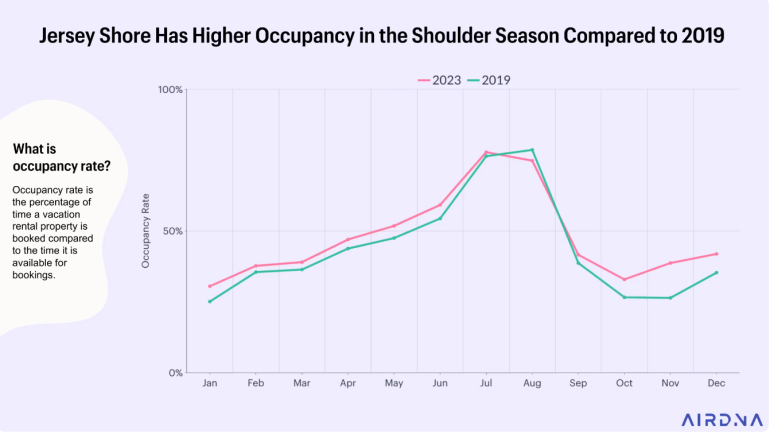
Take the Jersey Shore, a popular seaside destination in New Jersey, for example. This coastal region has seen a significant increase in visitors during the fall months, with October through December occupancy rates in 2023 up by as much as 50% compared to pre-pandemic levels, according to a 2024 report from AirDNA, a short-term rental analytics firm. And it’s not the only place that’s getting more visitors outside of peak season.
As many destinations see more tourists spill into the shoulders, what’s the best way to avoid these offseason crowds?
Avoid trendy destinations
If everyone is zagging their travel plans, maybe it’s a good time to zig.
For example, Japan saw a huge influx of travelers this spring. The number of U.S. citizens departing for Japan in March through May of 2024 rose 17% compared with the same months in 2023, and jumped a whopping 41% compared with the same months in 2019, according to the International Trade Administration. Similarly, Greece saw nearly three times as many U.S. visitors from March through May in 2024 compared to the same period in 2019.
Closer to home, popular national parks have seen a surge in shoulder season crowds.
In Maine, “Acadia National Park, which was once highly seasonal with peak demand only in July and August, now sees high demand stretching from June through October,” Chloé Garlaschi, a communications manager for AirDNA, said in an email. “This trend is part of a broader shift where national park destinations are attracting visitors outside of their traditional peak periods.”
If everyone you know is talking about visiting Tokyo or Athens, Greece, maybe it’s worth researching locales that have seen fewer tourists in recent years. For example, Australia saw 27% fewer U.S. visitors in the spring months of 2024 compared with the same months in 2019. China, which has seen much less U.S. tourism since the start of the COVID-19 pandemic, had 78% fewer U.S. visitors this spring compared with 2019.
Embrace the offbeat
Even within popular destinations, it’s possible to venture to offbeat locales with far fewer tourists. Most travelers to Japan visit the Eastern cities of Tokyo and Kyoto, but fewer venture inland to mountain towns such as Takayama, which boasts impressive temples and a quiet, quaint atmosphere. And few foreign tourists visit the island prefecture of Okinawa in Japan’s south, despite its warm weather and distinct culture from the mainland.
In the U.S., well-known national parks like Acadia (in Maine) and Yosemite (in California) may be popular during shoulder season. But lesser-known parks such as Great Sand Dunes National Park in Colorado or California’s Channel Islands National Park may see smaller crowds.
Avoid high prices
When demand for travel to a destination peaks, so do prices for airfare, accommodations and ground transportation. So looking for deals can save you money and help you avoid the most crowded spots.
According to data provided by Hopper, a travel booking platform, these destinations in the U.S. are seeing the biggest spike in flight booking demand this autumn:
Seattle.
Portland, Ore.
Salt Lake City.
San Jose, Calif.
Hawaii Island, Hawaii.
Spokane, Washington.
Lihue, Hawaii.
Indianapolis.
Portland, Maine.
Asheville, N.C.
Meanwhile, these international destinations are seeing the biggest price spikes:
Seoul, South Korea.
Shanghai.
Athens, Greece.
Frankfurt, Germany.
Venice, Italy.
Zurich.
Lima, Peru.
Brussels.
Kuala Lumpur, Malaysia.
Bangalore, India.
Of course, just because a flight is expensive doesn’t mean the destination will be crowded, but it does provide a proxy for demand. These lists give a sense of which spots are hot even when the weather isn’t.
Know thy shoulder
Not all shoulder seasons follow the same pattern, so knowing the right time to travel to avoid crowds means more than just leaving in the spring or fall.
“In Phoenix and Scottsdale, [Arizona], we see an unconventional seasonal pattern,” Garlaschi said. “The peak season actually falls in February and March due to the mild winter climate.”
And keep in mind that, even though travel data show shoulder seasons getting more popular, crowds (and prices) will still be much lower during these off-peak periods. You don’t have to travel to the North Pole in winter to avoid overtourism.
How to maximize your rewards
You want a travel credit card that prioritizes what’s important to you. Here are some of the best travel credit cards of 2026:
Flexibility, point transfers and a large bonus: Chase Sapphire Preferred® Card
No annual fee: Wells Fargo Autograph® Card
Flat-rate travel rewards: Capital One Venture Rewards Credit Card
Bonus travel rewards and high-end perks: Chase Sapphire Reserve®
Luxury perks: American Express Platinum Card®
Business travelers: Ink Business Preferred® Credit Card