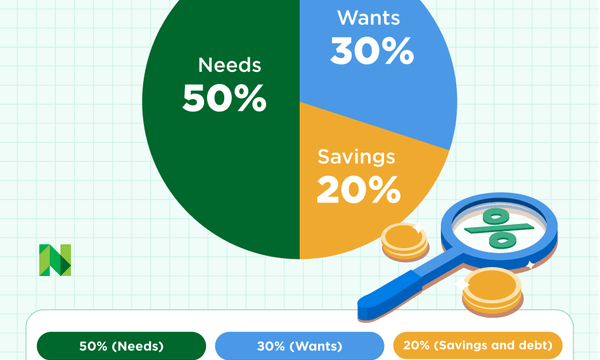


The latest budgeting method to go viral on TikTok is the 70/20/10 budget. But before you try it out, know how it works and be clear on how it compares with other budget strategies, such as the 50/30/20 and 60/30/10.
What is the 70/20/10 budget rule?
In this percentage-based budget, your take-home pay (money you receive after taxes) is divided this way:
70% for living expenses (needs and wants combined)
20% for savings and investments
10% for debt repayment and charitable giving
Here’s what that looks like in real numbers.
Let’s say you earn $4,000 each month. Using the 70/20/10 budget, here’s how that money would be divided:
Living expenses and entertainment (70%): $2,800
Savings/investments (20%): $800
Debt paydown/charity (10%): $400
🤓 Meet MoneyNerd,
your budget's new bestie
NerdWallet's twice-weekly newsletter offers practical, no-fluff guidance to help you spend smarter, save more, and make confident money decisions. Delivered free to your inbox.
How does the 70/20/10 budget compare with other options?
Let’s continue the real-numbers example to see how this budget stacks up against other popular options:
50/30/20 budget | 60/30/10 budget |
|---|---|
Needs (50%): $2,000 Wants (30%): $1,200 Savings/debt (20%): $800 | Needs (60%): $2,400 Wants (30%): $1,200 Savings/debt (10%): $400 |
Some differences rise to the surface:
70/20/10 seems like it gives you more flexibility for living expenses, but the math proves otherwise
Why? Because in the 60/30/10 budget, needs and wants together could add up to $3,600. But 70/20/10 caps your whole living-expenses bucket at $2,800. That’s $800 less each month.
70/20/10 pushes you to save more than 50/30/20
How? Even though both budgets set aside 20% for the future, the 50/30/20 budget mixes savings and debt payments into one group ($800/month), while the 70/20/10 keeps them separate ($800 for savings and an additional $400 for debt).
Ideally you end up saving $1,200 total instead of $800 — but that’s not always the case if you’re paying off debt, have an emergency, or prioritize charitable giving.
70/20/10 factors in investments
While the other two budgets are vague about investing, the 70/20/10 budget builds it right in.
Naima Bush, a certified financial planner in the Washington, D.C., area, says that’s what she likes about this budget.
“If you’re thinking about the future and aligning your dollars that way, let’s make sure we’re doing some investing,” Bush says.
Downsides of the 70/20/10 budget
Needs and wants are lumped together
The 70/20/10 budget is the only percentage-based budget that combines necessary spending (housing, transportation, utilities, food) with “wants” (dining out, subscriptions, gym memberships and other “extras”).
“I went on TikTok to see what things people were saying about it,” Bush says. “And my initial reaction was like, ‘Oooh, I don’t know if I want my fixed expenses commingled with my more flexible spending because things can get muddy really fast.'”
Combining these two categories creates a lack of clarity that the other two budgets have. For example, what if someone spent 60% of the 70% bucket on “wants” and only left 10% for rent? For most rental markets, $280 won’t cut it.
To make this budget work, you’d have to make sure you accounted for your needs first. Whatever is left over is your “wants” money. But wait … that sounds like another budget.
High-interest debt could balloon
If you have credit card or other high interest debt, this budgeting method might not be for you. Dedicating only 10% to debt payments could result in that debt lingering for longer — and you paying more interest on it.
Spending problems are harder to diagnose
With wants and needs combined, it’s harder to figure out how overspending happens. When wants and needs are separated, like in the 50/30/20 or 60/30/10, you can see which type of spending is going up, and make efforts to cut the things from your budget that aren’t essential.
The 70/20/10 budget might be good for …
There are a few groups of people who might find this budget helpful.
Penny pinchers
Bush says people who know exactly how much they’re spending would be a good fit. This group might include older adults, who are on fixed incomes and don’t have huge fluctuations each month.
Sinking fund savants
People who have sinking funds for travel expenses, holiday gifting or home and car repairs might also like this budget, Bush says. That’s because they can pull from those savings buckets to cover sudden or planned costs that push their spending over that 70% threshold.
» Learn more about savings accounts with buckets
The 70/20/10 budget might be problematic for …
Splurge spenders
“For people who have a spending problem or who are just not as constrictive with their spending, I think the lines would be too blurred,” Bush says.
Because the 70/20/10 budget puts necessary spending and “fun” money together, you might suddenly find that you’ve spent a portion of your rent or grocery money on a new pair of shoes or a fancy dinner out.
Bush says having the guardrails between “wants” and “needs” can help people understand what they need each month before they start prioritizing savings goals or things from your “wants” list.
» Next steps: Needs vs. wants and how to budget for both
🤓 Meet MoneyNerd,
your budget's new bestie
NerdWallet's twice-weekly newsletter offers practical, no-fluff guidance to help you spend smarter, save more, and make confident money decisions. Delivered free to your inbox.