







RTO — or return to office — is a mandate by many employers in recent years eager to get their employees back on site in the wake of the pandemic, whether for productivity, camaraderie or simply to justify the cost of the building lease. It’s also old news. But with rising fuel prices and overall increased cost of car ownership — paired with a tough job market that may preclude other options — that commute might feel particularly intolerable lately.
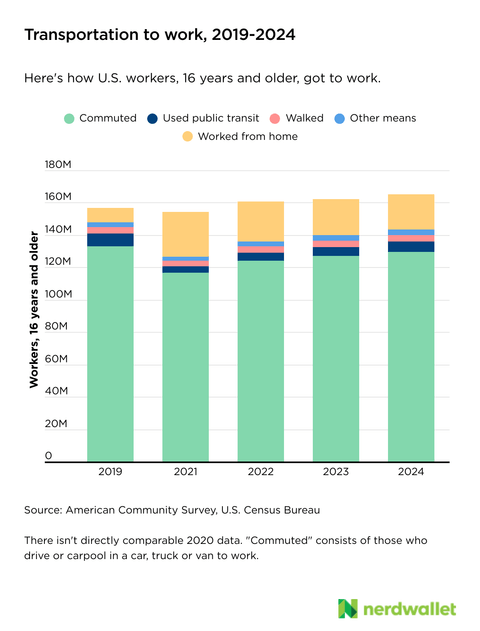
According to the most recent American Community Survey from the U.S. Census Bureau, 87% of workers traveled to their job, with 78% of workers getting to work by car, truck or van, in 2024. (We’ll refer to this latter group of drivers and carpoolers as “commuters” throughout this analysis.) That leaves 13% working from home, down from 15% just two years before.
Nearly 3 million more workers in 2024; most are commuting
Between 2023 and 2024, the number of workers 16 and older rose by 2.9 million. The vast majority — 2.6 million — are commuters, while work-from-home numbers dipped by around 420,000 year over year, the third year this group has shrunk.
Prior to the pandemic, the number of telecommuters was on a gradual rise, hitting nearly 6% of all workers in 2019. While data wasn’t collected in 2020, at the height of the pandemic, the share of telecommuters reached 18% in 2021, and has been falling since. In 2024, that share was 13%. Because telecommuting was becoming more popular before the shock of the pandemic, it’s unlikely we’ll see pre-pandemic numbers for remote workers again. But it’s also become harder to find a remote position in recent years.
Men more likely to commute to work than women
There’s a small, but notable, gap between men and women commuting versus working from home. In 2024, 12% of male workers and about 15% of female workers worked from home — that’s 10.4 million and 11.6 million workers, respectively.
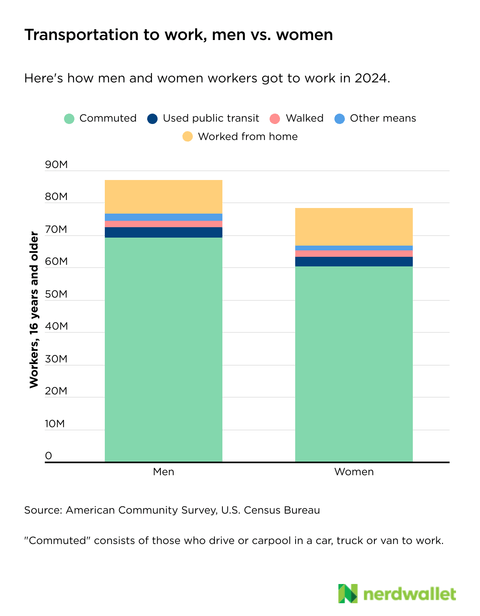
Part of this gap might be attributed to the need for schedule flexibility for caregiving duties, which disproportionately fall to women. According to Census data, while around 3.8 million fathers work from home, the same is true of 4.5 million mothers. And a recent report from Pew Research shows that women are more likely to be caregivers of aging parents, spouses or partners than men. Commuting, in addition to being potentially costly, also adds time to the workday that could otherwise be spent caring for others at home.
Over 121 million commuter vehicles on the road as costs soar
In 2024, an estimated 121 million vehicles were used in commuting — a jump of 2.3 million commuter vehicles from the year prior — according to data from the U.S. Census Bureau. From December 2023 to December 2024, the cost of car ownership rose 6%, according to NerdWallet’s Vehicle Ownership Costs Index. Since then, these costs have continued to rise, particularly this year.
From December 2024 to April 2026, the cost of car ownership increased by nearly 11%. The majority of that increase happened in March and April 2026 — ownership costs increased by close to 8% in a two-month span due to higher gas prices triggered by the war in Iran.
Fuel isn’t the only increase in recent years. According to data from Kelley Blue Book, the average transaction price of a new car is nearly $50,000 in April 2026, up 1.8% from last year. And a recent NerdWallet survey found that more than a quarter of Americans with auto insurance (27%) report that their insurance premium increased in the past 12 months.
"The consistent rate hikes in insurance right now are a significant pain point for household budgets,” says Kaz Weida, an insurance expert at NerdWallet. “Certainly it’s tempting to drop your auto coverage down to whatever minimum your state requires to save money. Unfortunately, that could leave you financially responsible in the event of a serious accident.
“Instead, shop around a bit and explore bundling your auto and home policies with the same insurer. And definitely don’t forget that your credit score can have an outsized effect on your insurance costs. I like to say raising your credit score is a ‘rising tide’ strategy. It lifts ‘all boats,’ with the potential to save you money on both home and auto insurance."
How to save on commuting
Individual commuters can’t do much about external forces — like a war impacting the cost of gas — but there are some things workers can do to keep transportation costs down. If remote work isn’t an option that’s available or appealing, here are some other ways to trim costs when hitting the road.
1. Reduce gas costs
Fuel prices are top of mind for many right now, and there are ways to reduce the cost of a fill-up. Gas apps allow you to check local fuel prices, as well as get gas discounts and cash back. And gas credit cards often earn rewards on gas and other purchases.
There are also gas stations — and even grocery stores — that offer rewards programs for discounted fuel. Those who regularly fill up at Exxon Mobil, Shell or Marathon, or buy groceries at Kroger or Albertsons, can look into their rewards programs for gas discounts, (This list is non-exhaustive; check to see if your preferred gas station or grocery store has a similar program).
Members of a warehouse club, like Costco, BJ’s or Sam’s Club, will likely get the best prices at the associated gas stations.
2. Compare insurance options
Shopping around for insurance could save hundreds, if not thousands, of dollars a year. And just around 1 in 5 Americans who have auto insurance (22%) say they’ve shopped around for a new auto insurance company in the past 12 months, according to the NerdWallet survey.
If you haven’t recently compared auto insurance companies, consider shopping around. You might be overpaying for coverage.
3. Look into alternative transportation options
Driving your own vehicle to work may be the most convenient option, but it’s likely not the most cost- effective. Just 9% of workers carpooled to their jobs in 2024, according to the Census data. If you have a nearby work buddy you wouldn’t mind sharing a car with, see if they’d be interested in swapping driving duties with you to save some gas (and have some company).
About 4% of workers used public transit to get to work in 2024. This isn’t an option for everyone, but if you haven’t yet explored your city’s bus and train availability, now might be the time. While it could add time to commuting, it might be worth it for the savings and time to zone out, read a good book or even get a head start on work for the day, if you’re so inclined.
4. Consider all the costs when buying a new vehicle
This isn’t going to save money immediately, but buying a car with all the associated costs in mind could save significant cash over your working (and commuting) life.
The next time you’re in the market for a new (or new to you) vehicle, consider not just the price of the car but also the required fuel grade, the miles per gallon it boasts and the maintenance costs to come. This may mean forgoing the dream car for now, but it could also mean you can better weather the rising costs of car ownership.
Cite as NerdWallet (2026). “Analysis: Commuters (and Cars) On the Road Increase, As Prices Spike.” Retrieved from https://www.nerdwallet.com/insurance/auto/studies/commuter-analysis
Methodology
The Vehicle Ownership Costs Index includes data from the consumer price index of the Bureau of Labor Statistics for vehicle repair and maintenance goods and services, licensing and registration costs, auto insurance, gasoline, parking fees and tolls. These measures are weighted according to expenditure shares in the 2024 Consumer Expenditure Surveys of the BLS.
The U.S. Census Bureau did not publish comparable 2020 1-year estimates for the American Community Survey, and therefore that year was excluded in this data analysis.
Census data for mothers and fathers working from home came from the 2024 American Community Survey Public Use Microdata Sample (PUMS). Variables used included means of transportation to work (JWTRNS), sex and family presence and age of related children (FPARC), and the data was weighted by PUMS person.