

Best Brokers for Beginner Investors: Top Picks for 2026
We spent hours analyzing the best brokers for beginners to find ones that offer low costs, helpful educational content and a broad investment selection. Our testers also looked for trading platforms that are easy to navigate.The investing information provided on this page is for educational purposes only. NerdWallet, Inc. does not offer advisory or brokerage services, nor does it recommend or advise investors to buy or sell particular stocks, securities or other investments.


Our deep, independent analysis cuts through the details to find and evaluate the information investors want when choosing an investing account. To see our full methodology and learn more about our process, read our criteria for evaluating brokers and for evaluating robo-advisors.
Over 60 investment account providers were reviewed and rated by our expert Nerds.
More than 50 years of combined experience writing about finance and investing.
Hands-on testing of the account funding process, provider websites and day trading platforms.
Dozens of objective ratings, rubrics and strict guidelines to maintain editorial integrity.
When you’re a beginner investor, the right broker is more than a platform for buying stocks — it should also offer investing educational resources, be easy to use and allow you to practice before you make real-world trades if you want to.
We also know that buying a full share of a stock or ETF can be expensive. If you’re looking to start investing with a small amount of money, we’ve highlighted which brokers let you trade with fractional shares.
Our editorial team's picks for the best brokers for beginner investors
Company | NerdWallet rating | Fees | Account minimum | Promotion | Learn more |
|---|---|---|---|---|---|
Best App for Investing | 5.0/5 | $0 per trade for online U.S. stocks and ETFs | $0 | None no promotion available at this time | Learn moreon Fidelity's website |
Learn moreon Fidelity's website | |||||
Learn moreon Fidelity's website | |||||
4.5/5 | $0 on trades of stocks, ETFs and their options. Other fees may apply. | $0 | None no promotion available at this time | Learn moreon Robinhood's website | |
Learn moreon Robinhood's website | |||||
Learn moreon Robinhood's website | |||||
4.6/5 | $0 per trade. Other fees apply. | $0 | Get up to $1,500 when you open and fund an E*TRADE brokerage account. Terms apply. | Learn moreon E*TRADE's website | |
Learn moreon E*TRADE's website | |||||
Learn moreon E*TRADE's website | |||||
4.2/5 | $0 per trade for online stocks, ETFs and Vanguard Funds. | $0 | None no promotion available at this time | Learn moreon Vanguard's website | |
Learn moreon Vanguard's website | |||||
Learn moreon Vanguard's website | |||||
4.9/5 | $0 per online equity trade | $0 | Up to $500 when you make a qualifying net deposit | Learn moreon Charles Schwab's website | |
Learn moreon Charles Schwab's website | |||||
Learn moreon Charles Schwab's website | |||||





More about our picks
Fidelity
Fidelity frequently scores highest on nearly every feature we test, making it a well-rounded choice for beginner investors. Although it doesn't have a paper trading platform, the educational support offered is truly exceptional, making it easy for novices to learn about every facet of investing. What we like in particular: It's a broker that can grow with you as you advance your trading strategies and skills.
Good to know: Fidelity is one of only two brokers that offer free index funds. And free really means free. Fidelity’s ZERO family consists of four funds with no expense ratios or minimums. This allows more of your money to be invested in the market instead of going toward fees.
Fractional shares available? Yes, both stocks and ETFs. The minimum purchase is $1.
Fidelity is one of the largest and most well-established brokerages, and it shows. Fidelity charges no trading commissions, offers an extensive set of no-fee, no-minimum index funds. It also stands out for its top-notch research tools, a renowned trading platform and very strong customer service.
Educational support
User experience
Mobile app rating
Paper trading platform
None.
Robinhood
Robinhood's educational resources are a bit thinner than those of other brokers on this list, but there's no denying that the broker makes investing fun and incredibly accessible. If you get bogged down with old-fashioned platforms and apps that feel like they were developed in the '90s, Robinhood may be an attractive choice.
Good to know: If you’re looking to invest for retirement, Robinhood offers one of the best IRA matches of all the brokers we review. All users get a 1% match on contributions, but the $5-per-month Gold subscription bumps your match up to 3%.
Fractional shares available? Yes, on all stocks and some OTC stocks. The minimum purchase is $1.
At Robinhood, trades of stocks, ETFs and their options are commission free, as are cryptocurrency trades. (Other fees may apply, including on index options.) Robinhood Gold offers a high interest rate on uninvested cash and low margin rates. The company does not offer mutual funds or individual bonds.
Educational support
User experience
Mobile app rating
Paper trading platform
None.
E*TRADE
E*TRADE has an excellent selection of educational materials, including webinars, videos and articles. There are daily webcasts focused on the markets, and Bloomberg TV is embedded into all trading platforms. While E*TRADE's platform could be slightly intimidating for a true beginner at first, the educational resources offer a level of hand-holding that makes up for it.
Good to know: E*TRADE is the only broker outside of Fidelity that offers free index funds. The broker offers five index funds with no expense ratios and no minimum investments.
Fractional shares available? Only for ETFs and mutual funds, and you must be enrolled in E*TRADE’s automatic investment program. Fractional shares of stocks are only available through a dividend reinvestment program.
E*TRADE from Morgan Stanley has long been one of the most popular online brokers. The company's $0 commissions and strong trading platforms appeal to active traders, while intermediate investors benefit from a large library of educational resources.
Educational support
User experience
Mobile app rating
Paper trading platform
Charles Schwab
Schwab gets a shout-out here for its paper trading platform — a tool that allows you to practice trades without putting your real money on the line. It also offers a large selection of investments for beginners to try their hand at. Once you're ready to graduate from fake money, the broker's platform will more than meet your needs.
Good to know: Schwab’s 24/7 customer service is top tier, especially its phone line. In our testing, technical account issues were resolved within just minutes of calling. If you prefer in-person help, Schwab also has hundreds of physical branches.
Fractional shares available? Yes. Schwab previously limited fractional shares to S&P 500 companies but has since expanded its offerings to include most stocks and ETFs. The minimum purchase is $1.
Charles Schwab has earned its strong reputation: The broker offers high-quality customer service, four free trading platforms, a wide selection of no-transaction-fee mutual funds and $0 commissions for stocks, ETFs and options.
Educational support
User experience
Mobile app rating
Paper trading platform
Vanguard
Vanguard has long been known as the place for hands-off retirement investors, and its platform makes this clear. While active trading in individual stocks is possible, the user experience is better suited to a set-it-and-forget-it approach, which typically serves beginner investors well. Like Fidelity, you won't find a paper trading option here if you're interested in some practice before diving into the real thing.
Good to know: Vanguard is an industry leader in low costs. Popular mutual funds like VFIAX and VTSAX carry 0.04% expense ratios. However, if you’re starting small, be aware of Vanguard’s mutual fund investment minimums, which are generally around $3,000. Vanguard’s ETFs can have slightly lower expense ratios and do not have investment minimums if you buy through the broker.
Fractional shares available? Only for Vanguard ETFs.
Vanguard is the king of low-cost investing, making it ideal for buy-and-hold and retirement investors. It offers a top-notch selection of proprietary, low-cost mutual funds, including many ESG options. Despite its $0 online stock trade commission, active traders will find the broker falls short due to the lack of a strong trading platform.
Educational support
User experience
Mobile app rating
Paper trading platform
None.
SoFi® Active Investing
SoFi doesn't offer practice trading, but it is one of the few brokers we review that offers investors a meeting with a financial advisor. All members get one meeting; SoFi+ members can meet with advisors as much as they want. For new investors, this can be an incredible resource that many other brokers charge a hefty fee for.
Good to know: SoFi’s app is simpler than some of its competitors in terms of UX, which may actually be ideal if you’re new to investing. If you already know what you want to invest in, you won’t have to wade through a bunch of data and research tools before placing your trade.
Fractional shares available? Yes, on a limited selection of stocks and ETFs. The minimum to purchase is $5.
SoFi Active Investing's $0 trading commission, fractional shares and $0 account minimum are attractive to new investors. More advanced investors will appreciate the company's wide mutual fund selection and IPO access.
Educational support
User experience
Mobile app rating
Paper trading platform
None.
M1 Finance
You may be surprised to see a broker with a lower overall score listed among our top picks for beginners, but M1's custom portfolio feature makes it stand out. If you're committed to long-term investing and want to choose your own stocks and ETFs, M1 is a platform worth reviewing.
Good to know: Rebalancing your portfolio is part of DIY investing, but M1 makes this task easy with its Dynamic Rebalancing feature. This gives you one of the perks offered by robo-advisors for free — you’ll just have to be a bit more hands-on.
Fractional shares available? Yes, on stocks and ETFs. The minimum to purchase is $1.
M1 Finance stands out for its unique investment approach — it helps investors visualize their portfolios as a pie, with "slices" made up of different securities. The mix of automation and manual investing will appeal to beginner investors who want to grow their skills and long-term investors who want help maintaining their portfolio allocation.
Educational support
User experience
Mobile app rating
Paper trading platform
None.
Alternative to consider: Wealthfront
If you'd rather have a robo-advisor pick and choose investments for you, Wealthfront scores highly on our list. It also offers a middle ground for those who aren't sure — you can opt to have a robo-advisor managed portfolio and trade stocks and ETFs on your own within the same platform.

AD
Paid non-client promotion
Wealthfront is our highest-scoring robo-advisor thanks to its blend of automated investment portfolios and DIY stock investing portfolios, its wide variety of account options, excellent tax strategy and low management fee. Wealthfront's only weak spots are its account minimum ($500) and its lack of access to human advisors.
Questions you might have before opening an account
How exactly do you open an account?
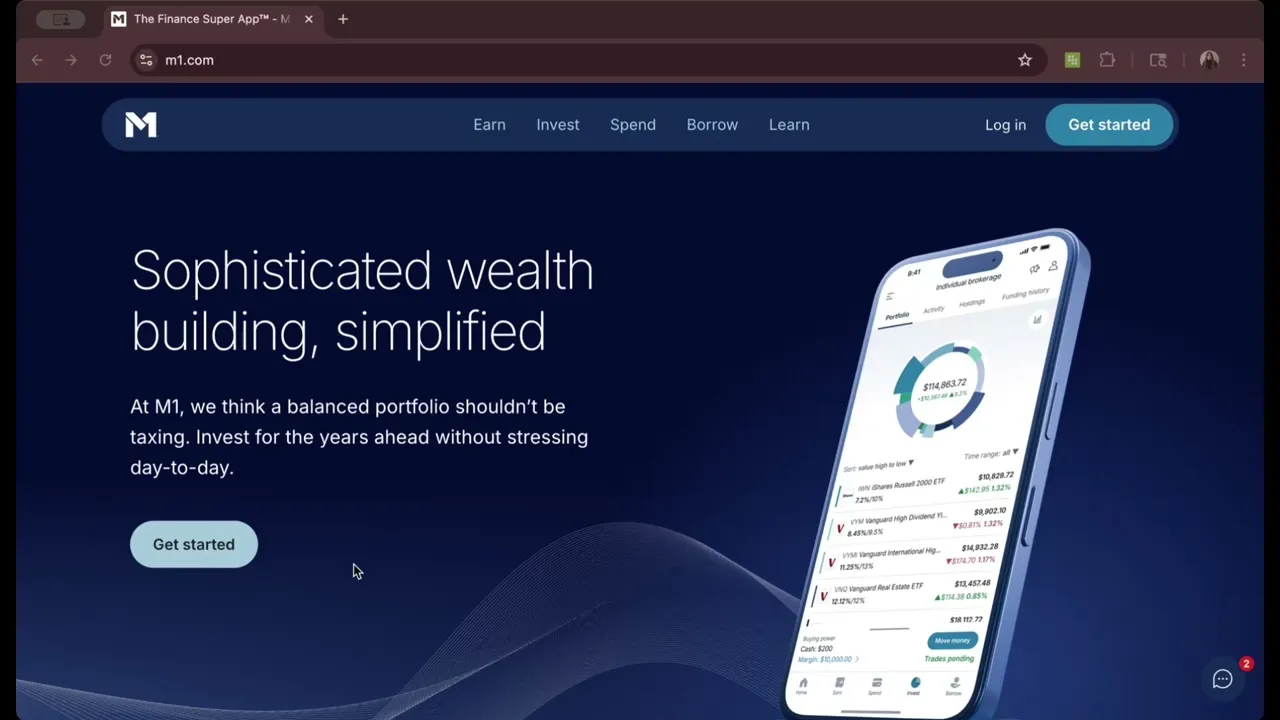
The process isn't all that different from opening a bank account, so don't be intimidated. To walk you through, one of our Nerds recorded the step-by-step process of opening an account as part of our research for this list.
How do you start investing?
Picking a broker is just the first step here. Once you've done that and opened your account, you'll need to fund it, either by transferring money in from a bank account or from another brokerage account.
Once your account is funded, you can pick and choose investments. The brokers on our list all have handy tools for this to help beginners out, including screeners that allow you to search for stocks or funds that meet your goals. You can also select a diversified fund if you're investing for a set goal, like a target-date fund. These automatically invest your contributions based on a specific timeline, taking less risk as you approach that deadline.
How do I fund my account?
Once you've opened an account at one of the online brokers on our list, you can fund the account through a bank transfer or by initiating an ACAT transfer from another brokerage. If you're switching from another brokerage account, an ACAT transfer will allow you to move eligible investments to your new broker without selling them. (If you're not sure how to do this, your new broker will be happy to walk you through the process.)
Is money safe with a broker?
The Securities Investor Protection Corporation (SIPC) insures cash and securities up to $500,000, with a $250,000 limit on cash losses. But this protects you only in the event your stockbroker fails. Many investments, including stocks, carry the risk of loss, and you're not protected if an investment you purchase goes down in value. You should expect the value of your investments to fluctuate, but over a long time horizon, the stock market has historically returned an average of 10% per year before inflation.
It may also be a little nerve-racking to start investing when the stock market is volatile. But if you're investing for the long term, these bouts of volatility shouldn't deter you. In fact, falling stock prices can even mean more affordable entry points into the market.
Note: All of the brokers we review and list here uphold high standards for security and carry SIPC insurance. They are also regulated by the Securities and Exchange Commission (SEC) and the Financial Industry Regulatory Authority (FINRA).
How much does a broker cost?
The brokers on our list generally have low fees as a requirement to appear here, and as you can see above, they don't charge commissions to trade stocks or most other investments. It also doesn’t take a lot of money to get started — many online stock brokers allow you to open an account with no minimum deposit requirement.
But you will need enough money to purchase the investments you choose. Stock share prices can vary widely, but some brokers allow you to purchase fractional shares, which are a smaller slice of a stock. We have a list of the best brokers for fractional shares. Other investments, like mutual funds, may have investment minimums, but generally speaking, you can find options that don't — especially at the brokers we've chosen to appear here.
» Have $500? Learn how to invest it
Can you take money out of these accounts?
Yes, but it will take more time than getting cash from your ATM — often a few business days. Your broker may need to sell securities (like stocks, bonds or mutual funds) equivalent to the amount you want to withdraw, so it's not as simple as removing cash from a savings account.
If you're taking all your money out, whether transferring to a different stockbroker or cashing out to move to Tahiti, there may be account-closing fees as well.
How we review brokers for beginners
Our editorial team does a deep, comprehensive analysis of online brokers, which involves not just collecting data points about their offerings, but also hands-on testing of each broker. We rate brokers on a scale of 1 to 5 stars, with 5 being the best possible score. The ratings are incremented in tenths of a star. Detailed information about how we rate brokers and the factors we consider in our assessments is available in our full ratings methodology.
NerdWallet’s comprehensive review process evaluates and rates the largest U.S. brokerage firms by assets under management, along with emerging industry players. Our aim is to provide an independent assessment of providers to help arm you with information to make sound, informed judgments on which one will best meet your needs.
We collect data directly from providers through detailed questionnaires and conduct first-hand testing and observation through provider demonstrations. The questionnaire answers, combined with demonstrations, interviews of personnel at the providers and our specialists’ hands-on research, fuel our proprietary assessment process that scores each provider’s performance across more than 20 factors.
We score each online broker against a set of criteria that factors in both the features offered and the actual user experience of using those features. This includes how easy it is to sign up for and fund a new account. Note that a broker may score highly for the stock trading platforms, tools or research it offers, but low for the experience of actually using those features. This means a broker can offer an advanced stock trading platform, but if it is clunky to use or the process of opening an account is unnecessarily arduous, that will be reflected in their score.
The final output produces star ratings from poor (one star) to excellent (five stars). For more details about the categories considered when rating brokers and our process, read our full methodology.