



If you're ready to start investing or considering a switch but are torn between Fidelity and Vanguard, let me reassure you that this is a good problem to have. Both are excellent, reputable brokers with decades of experience serving investors.
Fidelity is a powerhouse that serves both beginners and more advanced traders. You can save for your golden years, or trade options and crypto if that's more your speed. And if you already have your 401(k) with the firm, having all your accounts in one place can be appealing.

If too much complexity feels overwhelming for you — and you just want to invest for retirement or create a simple portfolio — there’s certainly an argument for Vanguard being a competitive choice. Its web and app experience caters to the retirement investor, and it has some of the most well-regarded funds out there today.

Here are some questions I would ask when deciding between the two firms.
On this page
- Question 1: What do you want to invest in? And is it available?
- Question 2: What account fees should I know about?
- Question 3: What will it cost me to place trades?
- Question 4: What's the experience of using the online platform and the app?
- Question 5: What happens to my idle cash?
- Question 6: How do I get help?
- Bottom line: It depends on what matters to you
Question 1: What do you want to invest in? And is it available?
Vanguard and Fidelity have all the typical things you’d expect to see: stocks, ETFs, index mutual funds, CDs, bonds and other fixed-income products. For some people (read: me), this might be perfectly sufficient. Just because I’m an investing editor at NerdWallet doesn’t make me the type of person who wants to dabble in penny stocks or trade cryptocurrency. I’m pretty risk-averse with my money.
That said, if you are the type of investor who wants to actively buy and sell assets beyond what you’ll find at the country fair, Vanguard lacks the infrastructure to support that. It doesn’t have an advanced trading platform, nor does it offer IPO access or direct access to foreign markets. Fidelity or another broker (see our top picks for day trading platforms) may be a better fit.
Vanguard vs. Fidelity: Investment Selections
Investment type | Vanguard | Fidelity |
|---|---|---|
Stocks | Yes | Yes |
ETFs | Yes | Yes |
Mutual funds | Yes | Yes |
Target-date funds | Yes | Yes |
Index funds | Yes | Yes |
Options | Yes | Yes |
Bonds | Yes | Yes |
Treasuries | Yes | Yes |
CDs | Yes | Yes |
Precious metals | No (funds only) | Yes |
Cryptocurrency | No (only via funds) | Yes |
OTC/penny stocks | No | Yes |
International stocks | No (ADRs only) | Yes |
IPOs | No | Yes |
Futures | No | No |
Futures options | No | No |
Forex | No | No |
Let’s talk about fractional shares
If you’re in the market for a stock or an ETF but don’t want to purchase an entire share or can’t afford to, some brokers allow you to purchase securities as fractional shares (you might see this called dollar-based trading in the wild). We think highly of fractional shares at NerdWallet because they allow you to affordably diversify your portfolio or start investing without breaking the bank.
Fidelity offers fractional shares for most stocks and ETFs, at a starting cost of $1. Vanguard lags here: You can only purchase fractional shares of Vanguard’s proprietary ETFs and mutual funds, at a minimum of $1 (though most mutual funds have higher initial minimum investments).
But this may not matter to you much if you're interested in Vanguard’s collection of popular funds — and there are so, so many of them.
Question 2: What account fees should I know about?
Annual and inactivity fees
Fidelity has fewer account-related fees to navigate than Vanguard. There are no annual or inactivity fees.
Vanguard makes some of this stuff kind of annoying. There’s a $25 annual fee that can be waived if you sign up for electronic delivery of your account statements (or meet a few other random rules). A big deal? Not really. I’d venture to say most of us would prefer to get less mail. An annoying stipulation? Absolutely.
Transfer fees
If you’re shopping for a new broker, you might be tempted to skip over this section. The last thing on your mind might be what it would cost you to leave a firm you haven’t even signed up with yet — but sometimes it’s good to know what you’re getting into, and this is one of those situations.
Vanguard charges $100 to transfer all of your assets to another broker. That’s not uncommon, but it is on the higher end of what the providers we review charge.
Of course, there’s no charge if you choose to liquidate your holdings for cash and keep the account open with nothing in it, but who wants that tax bill when you weren't even planning to realize those gains for years down the road?
Most of us would rather take the L and pay a fee rather than contend with tax consequences of selling. Sure, you could also do a partial transfer (free), but then you’re adding another broker to the queue of things you need to supervise. I know I’m at the point in my life where the fewer things I have to keep track of, the better.
At Fidelity, none of this is a concern. If you want to leave, the firm won’t charge you anything to transfer your assets to another broker. A nice parting gift.
Account fees | Vanguard | Fidelity |
|---|---|---|
Annual account fee | $25* | $0 |
Inactivity fee | $0 | $0 |
Account closure / full transfer out | $100 per account** | $0 |
* Waived if you have a Cash Plus account, choose to receive account statements electronically, or meet any of the other conditions found here. | ||
** Waived if you have assets over $5 million or are enrolled in a Vanguard advisory service. | ||
» Want to dive deeper? Explore our picks for the best brokers for first-time investors
Question 3: What will it cost me to place trades?
Stocks and ETFs
As is standard these days, you can buy stocks online commission-free at both brokers. ETFs have historically followed the same commission-free pattern as stocks, but we've been tracking a broader industry trend in which some brokers are starting to pass certain service fees on to customers that ETF issuers no longer want to pay.
Fidelity is one of the first brokers to signal a willingness to pass the buck rather than absorb the costs: In June, the firm began charging a service fee on more than 100 ETFs. The fee is 5% of your purchase price, capped at $100. This may not be a huge deal to customers who aren’t interested in the affected funds (see the list here), but it’s a development worth watching.
Vanguard hasn’t indicated it will follow suit, and I’m gonna guess it likely won’t, given its structure as an investor-owned company. ETFs at the firm are still available commission- and transaction-fee-free, so this is a detail to consider, especially if you’re heavy into ETF investing.
Mutual funds
Every year, we reach out to brokers to ask about how many no-transaction-fee funds they have — in other words, how many mutual funds do they offer without a service or transaction fee attached to it. Vanguard and Fidelity are competitive here: Fidelity has 3,220, and Vanguard has more than 3,600.
But what about the mutual funds that do have fees attached to them (i.e., third-party mutual funds)? Well, it’s worth pointing out that Vanguard charges less. Most investors will pay $20 per trade through Vanguard versus $49.95 through Fidelity.
Why does this matter? (Does it even matter?) Well, say you wanted to buy a Fidelity fund through Vanguard or a Vanguard fund through Fidelity; you might be hit with a higher fee to do so through Fidelity.
If you don’t necessarily have a strong allegiance to a specific fund family, Fidelity might be the easier entry point, since their proprietary mutual funds don’t have investment minimums.
Some Vanguard mutual funds may have steeper minimum investments, but subsequent purchases can be made in any amount over $1.
Trading Fees | Vanguard | Fidelity |
|---|---|---|
Stocks (online) | None. | None. |
ETFs (online) | None. | Generally none (but ~100 ETFs have up to $100 service fee). |
Broker-assisted trade | $25*** | $32.95 |
Proprietary mutual funds | None. | None. |
Third-party transaction-fee funds | $20 per trade | Generally $49.95, but can be up to $100 |
Options per contract | $1.00 | $0.65 |
Minimum investment for proprietary mutual funds | Most commonly $3,000, but can range from $1,000 to $100,000. | $0. |
*** Waived if client has $1 million or more in assets, or for clients using Vanguard’s advisory services. | ||
Question 4: What's the experience of using the online platform and the app?
Fidelity’s platform and app run like a well-oiled machine (most of the time****). When you log in, you’re met with a digest of your accounts, portfolio balance, activity, news and more. As someone who likes a hardy dashboard in their life, I love seeing anything and everything that might be affecting my accounts in one place.
There are also multiple ways to place trades online, and the app is pretty intuitive to use. I also love that I can lurk and see what other people are investing in through the “Orders by Fidelity customers” section.
As someone who places a lot of importance on the research side of investing, the way Fidelity structures data scratches my brain in the right way. If you want to learn more about a stock, fund or another security, there’s a ton of helpful information if you click through to each ticker’s page — you can see the performance, fund holdings, fund managers and so on. And it’s all laid out in a very easy-to-read way.
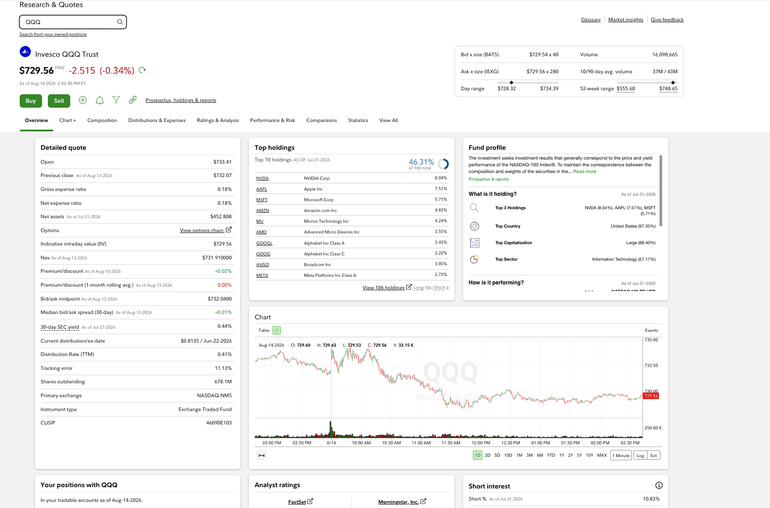
Fidelity also has a more advanced platform called Trader+. It’s available online or through the app. And if you prefer to trade on desktop, you can also download the platform. It’s not as high octane as, say, Interactive Brokers, but there are plenty of charts, a pre-built market, advanced options tools and a multi-trade ticket.
**** Yes, sorry, another footnote. But it is worth noting that in my experience, Fidelity can be kind of… glitchy sometimes? I’ve run into network errors in the browser that were annoying enough to make me stop what I was doing and try again later. And the mobile app does seem to lag once in a while. I’m not an active trader, so nothing I’m trying to accomplish is so time-sensitive that this costs me money or undue stress, but I do hope Fidelity’s engineers find a way to make the experience more consistent.
Vanguard’s UX is very much designed for the retirement investor who wants to set it and forget it. The provider makes it super easy to set up recurring transfers. And as someone who held an IRA with Vanguard for a long time, I really appreciated this feature because who has time to keep track of these things?
I also really love that the “Buy and Sell” screen provides not only different ways to browse securities but also a section with a lineup of funds for people who want to invest toward specific goals, like retirement or buying a home, that might make sense for their timeline. If you’re keen on long-term investing, it really does take the guesswork out of how to get started.
There are also a ton of tools and calculators you can play around with, plus a decent number of educational articles if you want to learn more about investing.
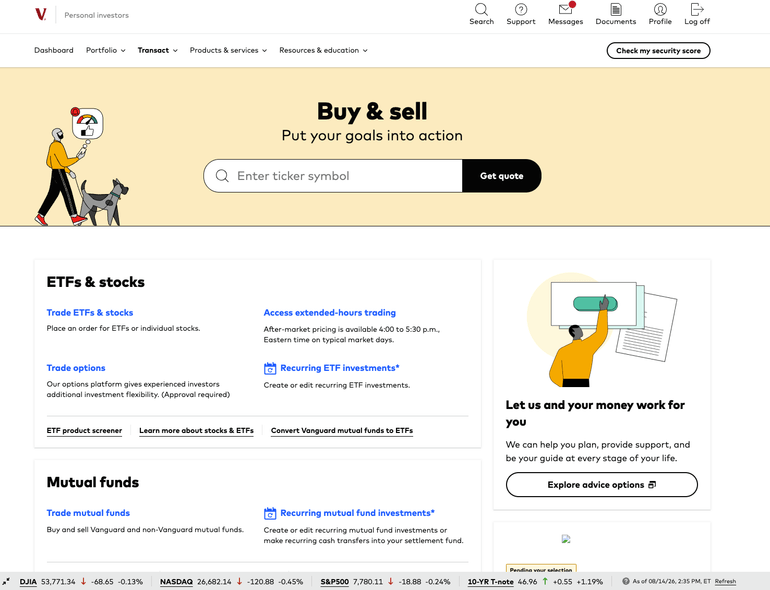
However, finding and comparing quotes and performance is a bit clunky in the online browser experience. There were multiple times I clicked into a fund to learn more but was taken to a new screen without any context, only to have to retype the fund name again. Not ideal, but I didn’t run into these issues at all on the mobile app.
Speaking of the mobile app, it’s gotten a bit of a facelift over the last few years. People like to rag on Vanguard for being less streamlined than other apps, but I find it's quietly becoming competitive. It’s super easy to find the transact or transfer money options, and comparing funds on your phone takes very little effort (their filtering is really designed with beginners in mind — I like that you can select “risk level,” for example).
Of course, I’m going to come back to my main thesis here — it’s not the best provider for you if advanced or active trading is your thing because it’s simply not equipped to help you do the things you’ll need to do.
Question 5: What happens to my idle cash?
A hard lesson I learned early on: sometimes your investments pay dividends, and those funds may sit in your account uninvested unless you set up automatic reinvestments. However, the good news here is that with most brokerages, those funds aren’t just hanging out in purgatory — they may be earning interest.
How does that work exactly? Well, typically brokerages allow you to put the money in a money market fund, which lets you earn interest since the fund is invested in short-term government debt, or in the brokerage’s cash management account, where it might be swept into partner banks that can offer interest. Some brokerages facilitate generous interest rates on this idle cash, while others do not (I’m looking at you, Schwab). The good news is that both Fidelity and Vanguard offer very competitive rates, currently hovering in the 3% range. I’ll note, however, that these change daily, so make sure you check out today’s rate on each broker’s website.
Question 6: How do I get help?
When it comes to issues of money, customer service is … pretty important. I don't know about you, but having the peace of mind that I can reach a rep quickly if I’m having an issue takes a substantial weight off my shoulders. (And yes, I am the editor who called Schwab five times during my review of the broker, and I have to say, I was pretty impressed.)
But anyway, here’s how the two providers stack up when it comes to getting in touch.
Vanguard
Phone support Monday to Friday, 8:00 a.m. to 8:00 p.m. EST; email and chat support also available.
Fidelity
24/7. Hours vary by contact method, but you can get help via phone, email, chat, over social media or at a physical branch.
If you’re looking to get help quickly, you might also be curious about how the brokers' chatbots fare. In an increasingly AI-forward world, this might be the first-order assistance you tap when running into an issue.
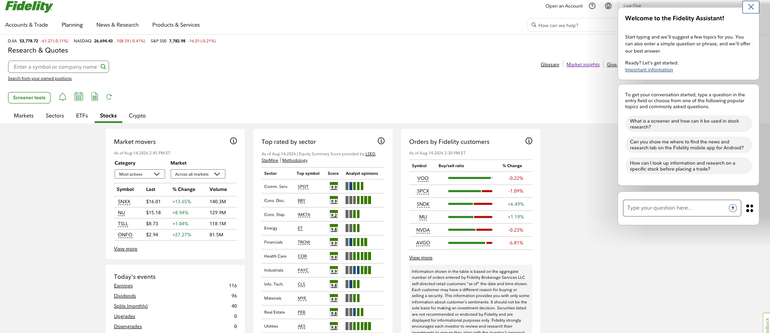
Fidelity’s chatbot — Fidelity Assistant — is excellent at helping with basic questions. (And as someone who has been actively avoiding the optometrist as I glide into my mid-thirties, it’s also super easy to find on every page without having to squint or navigate away.) When I asked it where my tax forms were, it not only gave me a direct link to the tab where I could access them but also told me how many I had with the broker.
Getting a hold of Vanguard’s chatbot isn’t as great of an experience. It takes a little muscle to figure out where it is. Sometimes it appears as a little chat button on the bottom right-hand side of the page you're on, and sometimes it doesn't. The only surefire way to access it is to navigate to support at the top of the website. The bot can answer very simple questions well enough, but it doesn’t offer as many links or suggestions as Fidelity's does.
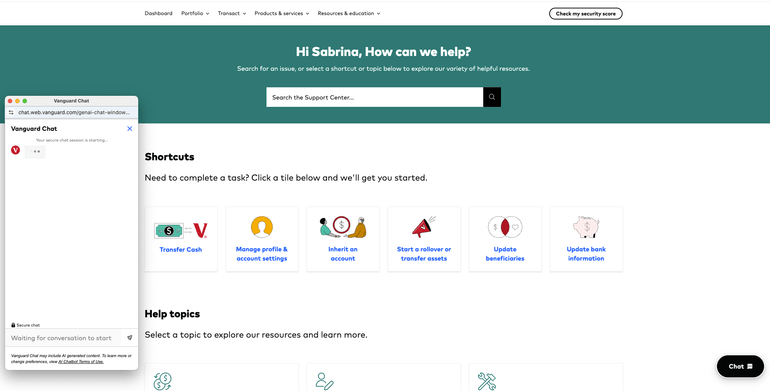
When I asked both chatbots a slightly more complicated question — how I could compare two different types of funds — Vanguard got turned around and instead connected me with a rep. Fidelity was able to get me to the correct page without bringing a human into the mix. I will say, however, that Vanguard’s rep connected with me within a minute and got me an answer almost instantly (thanks, Andrew!). So if you value that type of connection, Vanguard doesn’t score too shabbily in the chatbot department overall.
Bottom line: It depends on what matters to you
At the end of the day, both Fidelity and Vanguard can more than meet the needs of an everyday retirement investor. However, if certain securities, fund families, fees and UX matter to you — it’s worth digging into those areas more to see which provider might make you happiest in the long term.
Side note: Both Vanguard and Fidelity offer robo-advisor services, but we focused on their self-directed brokerage accounts here. To learn more about the robo-advisors, read our reviews of Fidelity Go and Vanguard Digital Advisor.
Methodology
How do we review brokers?
All NerdWallet reviews and lists of the best investing products are created by our editorial team of full-time writers and editors, independent of any business relationships. In this case, our investing team's comprehensive review process evaluates and ranks the largest U.S. brokers by assets under management, along with emerging industry players. Our aim is to provide an independent, balanced assessment of brokerages to help arm you with information to make sound, informed judgments on which ones will best meet your needs. Our highest priority is maintaining editorial integrity.
We collect data directly from brokerages through detailed questionnaires and conduct first-hand testing and observation through demonstrations. The questionnaire answers, combined with demonstrations, interviews of personnel at the brokerages and our specialists’ hands-on research, fuel our proprietary assessment process that scores each broker's performance across more than 20 factors. The final output produces star ratings from poor (one star) to excellent (five stars).
For more details about the categories considered when rating brokers and our process, read our full methodology.