This article originally appeared in NerdWallet's investing newsletter, the Nerdy Investor. You can subscribe for free here.
Two weeks ago, I wrote about the improbable comeback happening in cryptocurrency markets over the last two months. Most of the major cryptos, like Bitcoin, Ethereum, Solana and XRP, have surged 30% or more over that time. But all four of these are still in the red for 2026.
If you’ve dabbled in crypto investing, you’ve probably heard of BTC, ETH, SOL and XRP. Hyperliquid (HYPE) is a little more obscure — and its ticker symbol might feel very on-the-nose to its critics and skeptics.
Nonetheless, HYPE’s price has increased more than 200% year-to-date, making it the 10th-largest cryptocurrency by market cap and the best-performing cryptocurrency with a market cap of more than $10 billion. There are already three spot HYPE ETFs on the market, and one leveraged ETF that tracks the token’s price indirectly.
But here’s where things get weird: Hyperliquid’s core product isn’t the HYPE token. It’s an online trading platform which isn’t currently legal in the U.S. (although that may change soon).
Below, we’re doing our best to shed some light on this complicated and shadowy cryptocurrency project, and the recent dramatic price increase of its core token.
What exactly is Hyperliquid?
As mentioned earlier, Hyperliquid is actually an online trading platform. There’s a crypto token called HYPE that is attached to that platform, but the trading platform is Hyperliquid’s core product.
So, what exactly can you trade on the Hyperliquid platform? Basically, cryptocurrencies and various types of digital gambling chips. Hyperliquid started as a market for perpetual futures — futures contracts that don’t actually correspond to a physical quantity of anything and never expire, and are thus solely designed for vibes-based speculation — before expanding into prediction markets.
Many of these things are very new, very risky and exist in regulatory gray areas, which makes the overall legality of the platform questionable in many countries. To that end, the Hyperliquid website blocks U.S. users from trading, in an effort to avoid getting slapped with a big fine by U.S. regulators.
HYPE is the Hyperliquid platform’s native cryptocurrency, and it is legal and available in the U.S., even though its underlying platform is not.
It’s a pretty weird and confusing situation, and to make matters even more complicated, its legal status is in flux right now.
What’s the deal with Hyperliquid’s legal status in the US? How does President Trump factor in?
Back in August, President Trump said during a press conference that the Commodity Futures Trading Commission was “working to bring Hyperliquid into the United States in a fully compliant and legal fashion.”
Later that month, Bloomberg reported that Hyperliquid’s developer organization, Hyperliquid Labs, is in talks with the parent company of crypto exchange Kraken to offer access to Hyperliquid’s markets.
In an interview with The Block, former Securities and Exchange Commission counsel Ashley Ebersole estimated that this onshoring process could take at least 10 months. And according to Hyunsu Jung, the CEO of blockchain company Hyperion DeFi, there’s no guarantee that the U.S. will ever fully legalize every part of the Hyperliquid trading platform.
“The biggest unanswered question may be what ‘Hyperliquid in the U.S.’ actually means. It doesn't necessarily mean that an American retail investor will open the existing Hyperliquid interface and immediately receive access to every product currently available internationally,” Jung said in an email interview.
There are already spot and leveraged Hyperliquid ETFs
Despite the Hyperliquid platform’s evolving legal status, the SEC has already approved three spot ETFs that track the HYPE token. They’re listed below in order from lowest to highest fee.
Fund name & symbol | Fee |
|---|---|
Grayscale Hyperliquid Staking ETF (HYPG) | 0.29% |
21Shares Hyperliquid Staking ETF (THYP) | 0.30% |
Bitwise Hyperliquid ETF (BHYP) | 0.34% |
Source: SEC EDGAR database and fund websites. Data is current as of October 22, 2026, and is intended for informational purposes only. | |
There are also two leveraged ETFs that track HYPE, the 21Shares 2x Long HYPE ETF (TXXH) and the Defiance Daily Target 2X Long HYPE ETF (HYPU). Both use various Hyperliquid derivatives (like futures) to target twice the daily returns of HYPE.
(If you’re interested in cryptocurrency ETFs, we also have articles on Bitcoin ETFs, Ethereum ETFs, Solana ETFs and XRP ETFs. We also have a roundup of the best ETF platforms.)
Why is HYPE up so much this year?
According to Jung, one thing that has propelled HYPE’s strong returns this year is the popularity of its underlying platform. “Hyperliquid has grown into one of the largest venues for on-chain derivatives trading and has generated substantial trading fees,” he said.
According to data aggregator site Token Terminal, Hyperliquid has generated more than a billion dollars in revenue since launching less than two years ago, making it the largest crypto derivatives exchange by revenue.
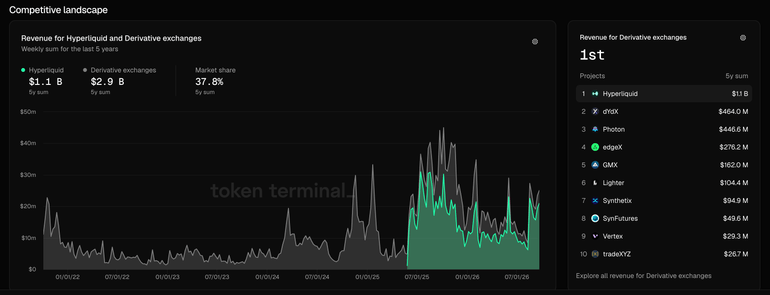
Source: Token Terminal. Data is current as of Sept. 30, 2026, and is intended for informational purposes only.
On top of this, Hyperliquid has a sort of buyback mechanism in which the exchange itself routes the majority of its revenue into repurchases of HYPE tokens from the open market. Put simply, when people trade on the platform and pay fees to it, the platform automatically buys the HYPE token and makes the price go up.
What are the risks of trading HYPE or HYPE ETFs?
Jung said that Hyperliquid’s legalization in the U.S. is not a sure thing, and that “delays, restrictive conditions or an unfavorable change in regulatory treatment could reverse some of the optimism currently being priced into HYPE.”
He also noted that the Hyperliquid buyback mechanism has played a large role in the token’s price increases this year, and that buyback mechanism is dependent on the underlying trading platform continuing to be popular and pull in a lot of revenue. “If trading volumes or market share decline materially, fewer fees would mean less capital flowing into HYPE purchases. That would challenge one of the strongest parts of the current valuation thesis,” he said.
And trading could very well decline if people or governments catch on to the fact that, frankly, the Hyperliquid platform is a sketchy internet casino. All of the things that you can “invest” in on the platform are purely speculative assets with almost no real-world economic value.
Here’s the bleak thing: We live in a time when sports gambling apps like Kalshi are running ads during NFL games. There’s certainly demand for online gambling, and regulators currently don’t seem to care much about the potential harms of that demand.
So if things continue at their current pace, the HYPE token’s near-future trajectory may very well point upward. If you want to try to profit from that, and feel okay with doing so, check out our list of the best crypto exchanges — many of them offer HYPE.
Article sources
- 1.CoinMarketCap. CoinMarketCap. Accessed Oct 2, 2026.
- 2.Bloomberg. Trump Opens Door to Hyperliquid In 'Unprecedented Move'. Accessed Oct 2, 2026.
- 3.Bloomberg. Hyperliquid in Talks with Kraken Parent on US Market Entry. Accessed Oct 2, 2026.
- 4.The Block. Hyperliquid seeks US foothold through Kraken parent Payward in crypto perpetuals deal: Bloomberg. Accessed Oct 2, 2026.
- 5.Token Terminal. Hyperliquid. Accessed Oct 2, 2026.
- 6.Hyperliquid Labs. Infrastructure to House All Finance. Accessed Oct 2, 2026.