

This article originally appeared in NerdWallet's investing newsletter, the Nerdy Investor. You can subscribe for free here.
Crypto has managed to shrug off several pieces of bad news in the last few weeks.
The Fed hiked interest rates in mid-September, and signaled that it will likely do so again before the end of the year, spooking investors into a more risk-averse mindset. And the Clarity Act, a crypto regulation bill that the industry had high hopes for, stalled in the Senate.
Yet Bitcoin is still up more than 30% in the last six weeks, and Ethereum, XRP and Solana are each up more than 40%.
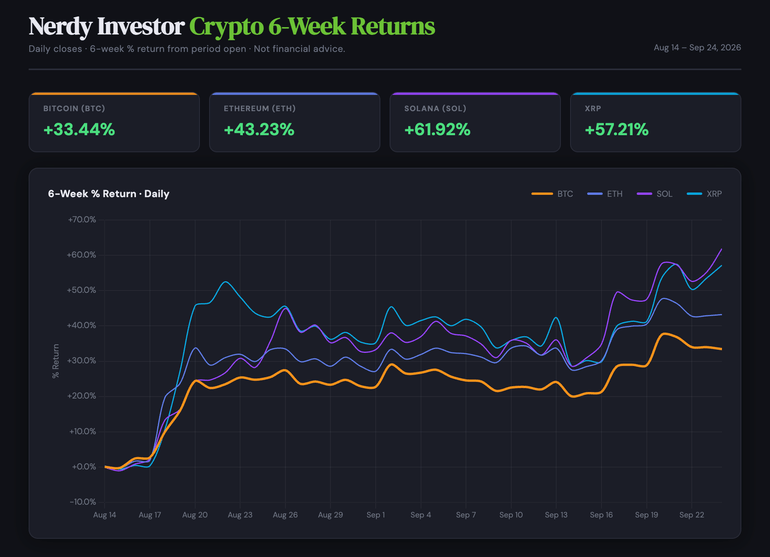
We asked industry experts why, and what might happen next. And we asked a financial advisor how crypto should fit into your portfolio at a time like this.
Why did crypto start rallying last month?
According to Diana Pires, chief business officer at crypto exchange sFOX, Bitcoin’s ~27% surge in late August could be attributed to a few factors:
The ballooning national debt and dollar weakness: “Bitcoin works as a currency debasement hedge,” Pires said in an email interview. As the national debt soared past $40 trillion on Aug. 18, the value of the U.S. dollar briefly faltered. As we wrote last year, the price of Bitcoin tends to go up when confidence in the dollar declines.
Crypto ETF inflows: “That macro shift channeled over $3.5 billion in net spot ETF inflows as traditional managers bought summer dips,” Pires said. (On a probably-related note, the number of Bitcoin ETFs on the market has ballooned in recent months.)
Optimism about the Clarity Act: After Senate Republicans scheduled a procedural vote on the Clarity Act, the crypto industry felt a brief wave of excitement that Congress would finally pass the regulatory bill it has been cheering on for years as a path to mainstream crypto adoption (although the bill ultimately didn’t pass that vote.)
Lenient actions from the Securities and Exchange Commission: On Aug. 18, the SEC proposed a new rule change, known as "Regulation Crypto Assets," which would federally preempt state-level crypto regulations (which have been a significant barrier to crypto-industry expansion, given strict regulations in certain big states like New York). And on Sept. 17, the SEC issued an “Innovation Exemption” order to relax restrictions on tokenized stocks (basically, crypto assets that represent company shares, but trade on a crypto exchange).
Other cryptocurrencies rallied with Bitcoin, as they often do — and smaller, more volatile coins like ETH, XRP and SOL have seen even bigger comebacks than Bitcoin.
Why has the rally lasted so long?
But here’s the weird thing — a lot of these bullish factors aren't really applicable anymore. The recent Fed rate hike (and the likelihood of another one in the months ahead) has boosted the value of the dollar higher than it was in August. The Clarity Act has hit a brick wall. And crypto ETFs have seen a mix of inflows and outflows in the last few weeks.
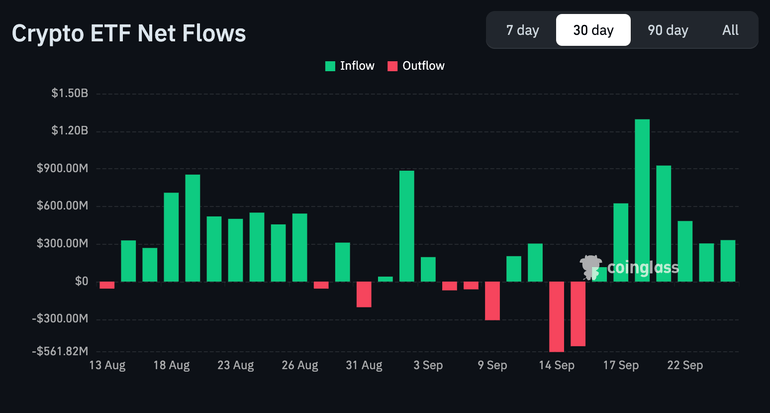
Source: Coinglass.com. Data is current as of Sept. 25, 2026, and is intended for informational purposes only.
Yet Bitcoin is still trading in the $80,000s, and other cryptocurrencies have held onto their recent gains, too. According to Markus Levin, co-founder of XYO, a blockchain technology company, that’s because the risk of these disappointments was already priced in, and the economic climate for crypto going forward might not be that bleak.
“Bitcoin has already absorbed a significant amount of higher-rate expectations,” Levin said in an email statement, and added that if bond yields decline (which they’ve been doing since the Fed’s rate hike announcement) they could reduce borrowing costs, free up some money and thus take some pressure off crypto.
In theory, the recent SEC rulings, which preempt state crypto regulations, could be subject to legal challenges by states with stricter crypto regulations, like New York. But according to David Yermack, a finance professor at the New York University Stern School of Business, such legal challenges would be unlikely to succeed.
"I don't think that individual states have much leeway to pre-empt federal regulation in the securities area, since the 1933 and 1934 Acts pretty clearly delegate the details of federal authority over securities regulation to the SEC," Yermack said in an email interview.
"The SEC has a standard set of rulemaking procedures that require a public comment period, a vote by the commissioners, and so forth, and I think these procedural steps are all that would need to occur for these regulations to take effect, unless and until Congress pre-empts the SEC by writing a statute in this area," Yermack said.
What could break the rally from here?
Pires noted there are still some serious threats to crypto’s comeback. If the Clarity Act’s supporters in Congress give up on the bill entirely, rather than treating the recent failed vote as a temporary setback, that could put a damper on things.
Plus, the underlying cause of the Fed’s rate hikes is stubborn inflation, and the underlying cause of the stubborn inflation is the war in the Middle East, which doesn’t seem like it’ll be over anytime soon.
“Saudi Arabia's main export pipeline to the Red Sea has been down since last week's attack, cargoes to Europe are already being cancelled in November, and Brent [crude oil prices] have moved sharply higher on it. That same inflation pressure just got the Fed to hike, and if it persists, it's what turns ‘one more hike’ into two,” Pires said.
If there’s further bad news on the Clarity Act front or the inflation/interest rate front, we could see big enough outflows from crypto ETFs to end the rally, according to Pires. But for now, that isn’t happening, and crypto seems to be holding its own.
If you’re feeling confident about crypto’s prospects, you have a lot of options nowadays about where to buy it. Below is a list of the stock brokerage apps we review that offer crypto:
Nerdy Perspective: How does crypto fit into a diversified portfolio?
Many financial advisors recommend limiting crypto to a small slice of your overall investment mix. "We say no more than 3%," said Ryan Sterling, the CEO of NerdWallet Wealth Partners.
"With a speculative asset like Bitcoin, you need to use asymmetry to your advantage. What I mean by this is that it technically has unlimited upside. So a 3% weighting can turn into a lot over time. On the other hand, it could go to zero and if you limit your starting position to 3%, that is the most you can lose," Sterling said.
Sterling added that the national debt argument for crypto is potentially strong. “I think what could continue to drive the price higher is continued concern over the national debt and deficits. At this trajectory the only options will be raising revenues (taxes), cutting costs (cutting entitlements), or printing money,” he said.
“Printing money is probably the path we will be forced to take given that raising revenues and cutting costs are not electable talking points. The Bitcoin bulls will point to this as a reason to abandon fiat currency in favor of alternative currencies like Bitcoin and other cryptos,” Sterling said.
But Sterling also cautioned that Bitcoin — by far the largest and most well-established cryptocurrency — is still a risky bet. “I think it is a speculative asset that is priced more by sentiment (or manipulation) than any sort of fundamentals,” he said.
If the recent crypto rally has you thinking about making a big change to your investment mix, consider talking to a financial advisor before you do so. NerdWallet’s roundup of the best financial advisor firms is a good place to start.
Disclosures: The author owned Bitcoin and Ethereum at the time of publication.
The first graphic in this newsletter was created by our editorial team with the assistance of AI. It uses non-AI-generated market data, and has been reviewed by our team for accuracy and quality.
Article sources
- 1.Federal Reserve. Summary of Economic Projections. Accessed Sep 25, 2026.
- 2.Reuters. US Senate fails to advance sweeping cryptocurrency bill in blow for industry. Accessed Sep 25, 2026.
- 3.Reuters. US debt crosses $40 trillion threshold after doubling under Trump and Biden. Accessed Sep 25, 2026.
- 4.Securities and Exchange Commission. SEC Proposes New Regulation Crypto Assets. Accessed Sep 25, 2026.
- 5.Securities and Exchange Commission. SEC Issues “Innovation Exemption” to Facilitate the Trading of Tokenized NMS Stock and Request for Comment. Accessed Sep 25, 2026.