Last year, we wrote in our email newsletter, The Nerdy Investor, about how a handful of stocks dominate the S&P 500 — and how NVIDIA in particular dominates the index. (You can read that issue here.) Not only did this pique the interest of us Nerds; people on Reddit seemed to take note of this, too.
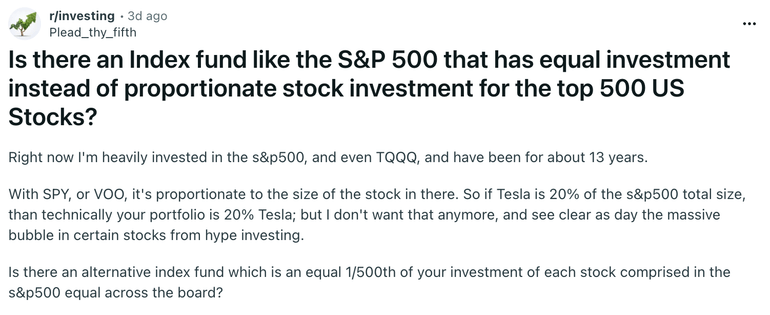
To answer plead_thy_fifth’s question: there are indeed a number of exchange-traded funds like this. They’re called equal-weight S&P 500 ETFs, and we’re looking at their pros and cons below.
Side note: Plead_thy_fifth refers to a “massive bubble” in their post, and they’re not alone in that theory. Even OpenAI CEO Sam Altman has speculated that we may be in an AI bubble. I discussed this in an episode of NerdWallet’s Smart Money Podcast. The Nerdy Investor took a more in-depth look at the AI bubble theory last year (you can read that here).
Two equal-weight S&P 500 ETFs and their fees and returns
At the time of writing, there are two non-leveraged, equal-weight ETFs on the market that track the full S&P 500 index. They're listed below.
The Invesco S&P 500 Equal Weight ETF (RSP) has an expense ratio of 0.20% and is up 15.44% year-to-date. Its 30-day SEC yield is 1.51%.
The Invesco S&P 500 Equal Weight Income Advantage ETF (RSPA) has a net expense ratio of 0.29% and is up 13.20% year-to-date. It sells options on its holdings to generate additional income. Its 30-day SEC yield is 10.23%.
Note: Data is from individual fund websites. Year-to-date returns are as of Aug. 31, 2026 (the most recent month-end data), and 30-day SEC yields are as of the most recently available data published by fund providers. Data is intended for informational purposes only.
Pros and cons of equal-weight S&P 500 ETFs
Con: Higher fees and lower long-term returns. The Vanguard S&P 500 ETF (VOO), the largest S&P 500 ETF by assets under management, has a considerably lower expense ratio of 0.03% compared with equal-weight S&P 500 ETFs. While VOO's 13.11% year-to-date return is lower than RSP's, VOO's one-year, three-year and five-year returns beat RSP's.
Pro: Potentially more protection against a tech bubble. The top seven stocks in VOO, all of which are Big Tech stocks, make up about one third of the ETF’s holdings, despite it being an S&P 500 ETF. In the equal-weight funds listed above, however, each stock accounts for roughly the same fraction of a percent of the ETF’s holdings. If something bad happens to Big Tech in the years ahead — say, if it turns out that the AI boom is overhyped — an equal-weight ETF may not fall as much as a market-cap-weighted S&P 500 ETF like VOO.
Pro: Higher dividend yields. VOO’s 30-day SEC yield is 0.98%, which is lower than the equal-weight funds listed above. Many of the big tech stocks that dominate regular S&P 500 ETFs like VOO do not pay dividends, so equal-weight ETFs may be better for income investors.
Brokerage firms | |
|---|---|



Other equal-weight index funds
There are also equal-weight ETFs on other indexes besides the S&P 500.
The largest equal-weight Dow Jones Industrial Average ETF by assets under management is the First Trust Dow 30 Equal Weight ETF (EDOW). It has an expense ratio of 0.50%, a year-to-date return of 12.47%, and a 30-day SEC yield of 1.10%.
In terms of assets, the largest equal-weight ETF tracking the full Nasdaq-100 index is the Direxion NASDAQ-100 Equal Weighted Index ETF (QQQE). It has an expense ratio of 0.35% and a year-to-date return of 19.59%. Direxion does not publish a 30-day SEC yield for QQQE.
The bottom line on equal-weight S&P 500 ETFs
If you're concerned that your index funds are too concentrated in Big Tech, equal-weight S&P 500 ETFs are a potential solution that could see less volatility in the event that the biggest tech stocks start to underperform. They also generally pay higher dividends than typical S&P 500 ETFs.
But if Big Tech doesn't take a tumble, equal-weight S&P 500 ETFs may continue to lag behind their market cap-weighted counterparts in terms of long-term returns — especially after their fees, which tend to be higher than typical index funds.
More on index fund investing
The author owned shares of the Vanguard S&P 500 ETF at the time of publication.