Travel can be a lot of fun but if your bags are lost or stolen or your luggage is delayed for a significant amount of time, it can be a bad start to the trip. Before you travel, you’ll want to familiarize yourself with baggage insurance, which is offered on travel insurance policies and on premium travel credit cards.
How often does luggage get lost? According to LuggageHero, an airline's chances of losing your bag are slim. And if that happens, the airline is responsible for compensating you for your lost bags and contents. But they may have different liability limits than separate insurance, and there are plenty of other ways luggage can disappear after you leave the airport.
"Baggage insurance" is a general term that encompasses two key benefits: baggage loss and baggage delay. Here’s what you need to know about baggage insurance and how to get it.
How does baggage insurance work?
Baggage insurance can generally be divided into two broad categories: Baggage loss and baggage delay.
Suppose you arrive at baggage claim to get your two pieces of luggage, but they are nowhere to be found. You file a lost report with the airline and head to your Airbnb. However, when you arrive, you find that it doesn’t have many toiletries or even a spare toothbrush. On the third day, one of your pieces of luggage arrives but the other one is lost.
If you purchased a travel insurance policy (or have a premium travel card) that offers baggage insurance benefits, the baggage delay coverage will reimburse you for the purchase of essential items such as a toothbrush, toiletries, change of clothes, etc. for each of the days that you didn’t have your belongings.
Because you only received one of your pieces of luggage, baggage loss coverage will reimburse you for the missing piece, along with the contents up to a specific dollar amount. If you have valuables in your lost luggage, it's likely that they are covered by your homeowners insurance policy, so you’d want to check with that company before seeking reimbursement from the travel insurance provider, which limits the amount you can claim for the high-end items.
When booking your trip, check the airline’s baggage loss and delay policies to ensure you understand what level of coverage you’re comfortable with.
Certain premium travel credit cards offer baggage insurance benefits. For example, the Chase Sapphire Reserve® offers baggage delay insurance of $100 per day for up to five days if your bags are delayed for more than six hours and lost luggage reimbursement of $3,000 per person and up to $500 for luxury items.
What does baggage insurance cover?
Baggage loss
Baggage loss will reimburse you for luggage and personal belongings that are lost or stolen while you’re on your trip. This coverage usually includes three limits:
Per-person overall limit.
Per item limit.
A specific limit for high-end items.
In case your luggage is lost, you’ll need to notify the appropriate local authorities, which will happen when you file your claim with the airline. To get reimbursement for luxury items (such as watches, jewelry, furs, cameras), some insurers may require you to submit original receipts.
» Learn more: How lost luggage insurance works
Baggage delay
Baggage delay lets you purchase necessary items while you’re waiting for delayed bags. This benefit usually kicks in after a specified amount of time and has two limits:
A per-person dollar limit.
A daily limit.
You will need to wait until the minimum amount of time has passed before you can be eligible for reimbursement. Some policies also state that this benefit is available only on the outward leg of your trip, so you’ll want to read the fine print of the policy to know when the coverage applies. Also, make sure to keep your receipts for items you purchase while you wait for your bags, as you will need to submit them with your claim.
For baggage loss and baggage delay, the coverage is usually secondary, which means that the benefits only kick in after the common carrier (airline) provides reimbursement.
» Learn more: How to find the best travel insurance
What is NOT covered by baggage insurance?
Each insurer will have its own list of exclusions for baggage delay and baggage loss, however, some common exclusions are:
Animals.
Auto equipment.
Drones.
Household items.
Money.
Perfumes.
Perishables.
In addition, losses related to a policy’s general exclusions (self-harm, war, illegal acts, etc.) also aren't covered. As always, check the fine print so you’re aware of what is covered.
Coverage included with the Chase Sapphire Preferred® Card, for example, covers up to $500 for jewelry and watches. And plans from World Nomads cover sports equipment and documents like passports.
Before making assumptions, you should always check to ensure lost luggage is covered and for how much, as different plans offer different coverage types and amounts.
There are other exclusions. For example, you can't be reckless with your luggage or where you leave it, like in the back of an open pickup or on a curbside while you enter a cafe.
In addition, you typically must first file a report with the airline or local authorities in the case of theft or loss to file a claim with your travel insurance company. It's also best if you can provide receipts for high-value items to receive full reimbursements.
How much does baggage insurance cost?
Baggage insurance is usually included within comprehensive travel insurance plans. For a two-week trip to Australia that costs $5,000, a search of policies on travel insurance broker Squaremouth ranged from $198 to $447, representing 4.0% to 8.9% of the total trip cost.
One international week-long vacation may run from around $37 to $100 or more based on how much protection you want for the items you're traveling with.
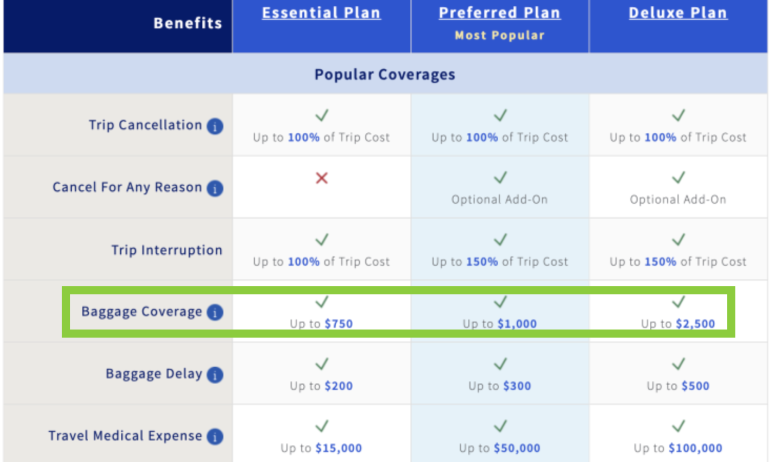
A $63 plan, for example, may cover up to $750 of lost or stolen luggage, while a $103 plan might cover up to $2,500.
As you can see, prices range widely, which makes it easy to find a policy that applies to your individual situation.
If you hold a premium travel credit card that offers trip baggage insurance benefits, this coverage is offered free of charge as long as the trip is purchased with the applicable credit card.
How do I get baggage insurance?
The two main ways to get baggage insurance benefits are by purchasing a trip insurance policy or applying for a premium travel card that offers these benefits.
As mentioned previously, the Chase Sapphire Reserve® covers baggage delay and baggage loss. The American Express Platinum Card® and many other American Express cards provide coverage for lost luggage only, with a $3,000 per person limit and a $1,000 per high-end item limit (see rates and fees). There is no coverage for baggage delay. Terms apply.
These premium cards also offer other travel insurance benefits like trip cancellation, trip interruption, trip delay, emergency assistance and more. If you often buy trip insurance, applying for one of these travel cards could be advantageous, since they offer a lot of useful perks and statement credits that will typically offset at least part of the annual fee.
However, if your luggage and belongings are more expensive than the limits provided by the credit card, purchasing a separate travel insurance policy could make a lot of sense.
Which baggage insurance coverage is best for me?
If you’re traveling with expensive clothes or have high-end luggage, purchasing a comprehensive travel insurance policy that offers baggage insurance benefits is a good idea. If your belongings are relatively low-cost, you’re traveling with a carry-on or backpack or you’re already covered through your credit card, you may not need to purchase a travel insurance policy.
However, if you’d like additional coverage like Cancel For Any Reason (CFAR), travel medical insurance and/or your credit card doesn’t offer sufficient limits, consider a comprehensive travel insurance policy from providers such as AAA, Allianz, AIG or World Nomads.
» Learn more: The best travel insurance companies
Is baggage delay insurance worth it?
If you're traveling with high-value personal belongings, baggage insurance can be worth it.
However, you might not need to pay out of pocket to get coverage. For example, if you used a travel credit card with robust trip protection and luggage insurance to book and pay for your vacation and don't require additional or specialized coverage, that may be sufficient.
Purchasing coverage separately is probably best if you don't have baggage insurance benefits through a credit card or want to customize your coverage. But, again, the right option will depend on your needs and will likely vary from trip to trip.
Insurance Benefit: Baggage Insurance Plan
Baggage Insurance Plan coverage can be in effect for Covered Persons for eligible lost, damaged, or stolen Baggage during their travel on a Common Carrier Vehicle (e.g., plane, train, ship, or bus) when the Entire Fare for a ticket for the trip (one-way or round-trip) is charged to an Eligible Card. Coverage can be provided for up to $2,000 for checked Baggage and up to a combined maximum of $3,000 for checked and carry-on Baggage, in excess of coverage provided by the Common Carrier. The coverage is also subject to a $3,000 aggregate limit per Covered Trip. For New York State residents, there is a $2,000 per bag/suitcase limit for each Covered Person with a $10,000 aggregate maximum for all Covered Persons per Covered Trip.
Eligibility and Benefit level varies by Card. Terms, Conditions and Limitations Apply.
Please visit americanexpress.com/benefitsguide for more details.
Underwritten by AMEX Assurance Company.
How to maximize your rewards
You want a travel credit card that prioritizes what’s important to you. Here are some of the best travel credit cards of 2026:
Flexibility, point transfers and a large bonus: Chase Sapphire Preferred® Card
No annual fee: Wells Fargo Autograph® Card
Flat-rate travel rewards: Capital One Venture Rewards Credit Card
Bonus travel rewards and high-end perks: Chase Sapphire Reserve®
Luxury perks: American Express Platinum Card®
Business travelers: Ink Business Preferred® Credit Card