

The rising popularity of premium credit cards has coincided with a torrent of statement credit benefits offering cardholders cash back for select purchases. Some of these statement credits can be worth hundreds of dollars, and card issuers aren’t shy about flaunting that potential value in marketing material.

However, while card issuers don’t explicitly misrepresent the value of these statement credit benefits, they do project optimal scenarios in which cardholders capture every dollar of credit available. In practice, most cardholders will capture only a fraction of that value.
Rather than accept these benefits at face value, I advocate that cardholders assess for themselves the value of credits based on their own needs, interests and circumstances.

By signing up, you will receive newsletters and promotional content and agree to our Terms of Use and acknowledge the data practices in our Privacy Policy. You may unsubscribe at any time.
Why I don’t take statement credit benefits at face value
Given the choice between a statement credit and its cash equivalent, I would always choose cash. Statement credits are less flexible and add complications you don’t get with cash. I also discount statement credits for other, more specific reasons.
I don’t always need or want the credits I’m offered
Some statement credit benefits cover purchases I already plan to make, such as the $300 annual travel credit on my Chase Sapphire Reserve® card. That benefit reimburses me for a wide variety of travel expenses, including airfare, hotels and rental cars. Since I typically book with that card for its travel protections, the credit is almost as good as cash to me.
I can’t say the same for all such benefits, many of which cover purchases I would be unlikely to make otherwise. I’m happy to try products that are mostly or fully covered, such as the complimentary Walmart+ membership I get from my Amex Platinum card, but I get minimal value from it. Other credits are completely worthless to me, such as the $10 monthly Peloton credit on the Chase Sapphire Reserve card (through 12/31/2027).
» Learn more: How does the Chase Sapphire Reserve travel credit work?
Redeeming credits isn’t always easy
The easier a credit is to redeem, the more it’s worth to me. Unfortunately, many statement credit benefits limit how, where and when they can be used, which makes redeeming their full value more difficult.
Some credits are limited by applying only to a narrow selection of purchases, such as the American Express® Gold Card’s up to $120 dining credit, which is divided into a monthly credit of up to $10 at participating partners (enrollment required; terms apply). The list of eligible partners is restricted to just a handful of food delivery services and restaurants, and since I don’t do business with any of them regularly, the credit is far less valuable to me than one that could be redeemed at any dining establishment.
Other credits are limited by terms that prevent me from redeeming them how I want. For example, the Chase Sapphire Reserve card comes with an annual credit of up to $500 toward stays booked with Chase’s luxury hotel and resort collection, The Edit.
However, that benefit is split into two $250 credits, which apply only to stays of two nights or longer. That means I can’t redeem the full amount at once nor put it toward single-night stays. Those constraints make the benefit much less valuable to me than one $500 credit that I could redeem against any hotel stay.
Finally, redeeming statement credit benefits takes effort. Some credits require enrollment prior to use, and I have to keep track of unused portions so they don’t expire. Occasionally, I run into credits that don’t work as they’re supposed to, which means having to contact my card issuer to get credited manually. These are minor concerns, but they widen the gap in value between statement credits and cash.
» Learn more: How do statement credits work for travel credit cards?
Using credits may mean passing up a better deal
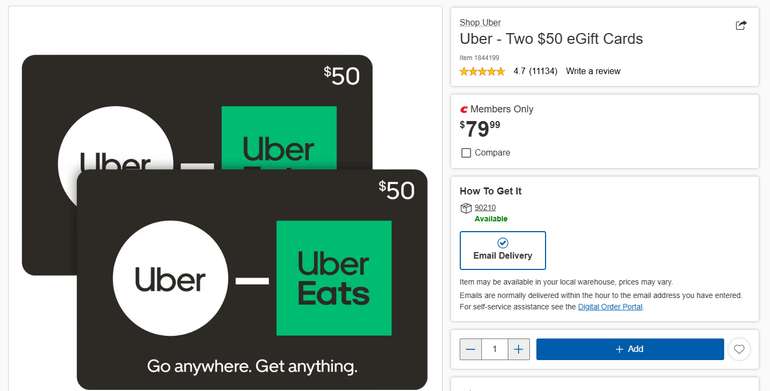
I discount the value of statement credits when I could buy the same credit outright for less than the face value. For example, I get up to $200 of credit toward U.S. Uber Eats and rides each year from my American Express Platinum Card® card. (After adding your American Express Platinum Card® to your Uber account, you'll automatically get $15 in Uber Cash each month, plus a $20 bonus in December, for a total of up to $200 per year.) Enrollment required; terms apply.
However, Costco routinely sells Uber gift cards for around 20% off, so I could buy $200 of Uber credit for a few cents under $160.
Using credits may also mean earning rewards at a lower rate, or not at all. Chase Sapphire Reserve cardholders don’t earn points for any portion of a purchase that qualifies for the card’s $300 travel credit or $500 The Edit credit. Similarly, I pay a small phone bill with The Business Platinum Card® from American Express to claim its monthly up to $10 credit toward wireless phone service (terms apply, enrollment required), but that means earning only 1 point per dollar rather than the 5 points per dollar I could earn with my Chase Ink Business Cash card. Starting Feb. 17, 2027, this benefit applies only at select merchants.
» Learn more: Best travel credit cards to pay cell phone bills
How I evaluate statement credit benefits
There’s a saying that “value is what someone is willing to pay,” and while it’s not my only consideration, I find asking myself what I’d pay for a credit yields a useful (though highly subjective) estimate.
For example, The Business Platinum Card® from American Express card offers a statement credit of up to $150 each calendar year for purchases made with Dell Technologies (enrollment required, terms apply). There aren’t any Dell products on my wishlist, but their website sells various computing accessories and third-party electronics (like Bluetooth speakers and hard drives) that I occasionally have a use for.
The selection is meager, but Dell matches prices from many major online retailers, so at least redeeming the credit doesn’t mean overpaying. With all that in mind, my gut says I’d pay $50 for a $150 Dell credit, but I wouldn’t pay $75, so I value the benefit in the ballpark of $60 or 40% of the face value.
One factor that affects a credit’s value for me is how well it pairs with other benefits on the same credit card, or even on my other credit cards. I have several cards that offer a statement credit to cover the cost of enrollment in expedited security programs like TSA PreCheck, but I only have to enroll once, so I don’t get any value from additional credits.
In contrast, the Uber credits from my American Express Platinum Card® and American Express® Gold Card pair well because they can be used together, so it’s like having one larger credit instead of two smaller ones.
Another factor I consider is how easy or difficult a credit is to use. Any extra time or thought I have to put into redeeming a credit decreases its value to me, so I heavily discount credits with lots of restrictions.
One example is the American Express airline credit (enrollment required/terms apply), which covers costs like checked bag fees, seat selection fees and in-flight purchases; but it doesn’t cover airfare and only applies to charges from a single airline that I select at the start of the year. Since I’m not loyal to one airline, I have limited opportunities to redeem my credit, which makes it worth far less to me than its $200 face value.
The last factor I weigh is how much I really need or want the credit. For example, my Chase Sapphire Reserve® card offers complimentary subscriptions to Apple TV and Apple Music (through 6/22/2027), which are marketed as a $250 annual value. I can see how that benefit would be worth nearly face value to existing subscribers, but I have minimal interest in either service, so to me they’re worth maybe 10% of that.
Knowing what credits are worth helps me decide which cards to keep
To decide whether it’s worth paying a credit card annual fee, I weigh that fee against the cumulative value I get from the card’s benefits. When the value exceeds the cost, I usually keep the card. When it’s not, I usually cancel the card.
If I took all statement credit benefits at face value, I’d end up with a distorted assessment of which cards are worth keeping. However, I find many cards are worth keeping even when I heavily discount the value of statement credit benefits.
For example, here’s a partial list of American Express Platinum Card® benefits, including the face value of statement credits and a rough estimate of what they’re worth to me.
Benefit | Face value (annual) | Value to me (annual; approximate) |
|---|---|---|
Fine Hotels + Resorts credit | $600. | $300. |
Airline fee credit (enrollment required) | $200. | $75. |
Uber cash (enrollment required) | $200. | $100. |
CLEAR+ airport security credit | $219. | $75. |
Resy dining credit (enrollment required) | $400. | $200. |
Digital entertainment credit (enrollment required) | $300. | $100. |
Lululemon credit | $300. | $100. |
Total | $2,219. | $950. |
Terms apply. | ||
Despite valuing these credits at less than half of their face value, I still think they’re worth enough by themselves for me to justify paying the card’s $895 annual fee. When I account for other benefits like airport lounge access, the card pencils out as a clear keeper for me.
How to maximize your rewards
You want a travel credit card that prioritizes what’s important to you. Here are some of the best travel credit cards of 2026:
Flexibility, point transfers and a large bonus: Chase Sapphire Preferred® Card
No annual fee: Wells Fargo Autograph® Card
Flat-rate travel rewards: Capital One Venture Rewards Credit Card
Bonus travel rewards and high-end perks: Chase Sapphire Reserve®
Luxury perks: American Express Platinum Card®
Business travelers: Ink Business Preferred® Credit Card