The behemoth Delta SkyMiles program contains many twists, turns and odd alleyways, none more confusing than the difference between the "Pay With Miles" and "Miles + Cash" programs.
Although they sound nearly identical, they work very differently. And to make matters worse, neither are the same as booking "award flights" using miles.
The short answer is that "Pay With Miles" is only available to co-branded cardholders, whereas "Miles + Cash" is an option for anyone with a SkyMiles account.
Here you'll find more details on the basic differences between these options and how you can determine which (if any) you should use to book your next flight with Delta.
» Learn more: The guide to SkyMiles
Pay With Miles vs. Miles + Cash
In a nutshell, here are the differences between these different booking options:
"Pay With Miles"
Only available to those with a Delta co-branded credit card.
Lets you pay for some or all of your cash fare with SkyMiles.
Each SkyMile is valued at a set rate of 1 cent per mile.
You get to choose how many miles you use.
These tickets earn both Medallion Qualification Dollars and redeemable miles, except for basic economy tickets.
Not available on codeshare flights.
» Learn more: Are Delta credit cards worth it?
"Miles + Cash"
Available to anyone with a SkyMiles account.
Lets you pay for some of your cash fare using SkyMiles.
The value per SkyMile varies from ticket to ticket.
Delta determines the split between cash and SkyMiles.
These tickets (except basic economy) earn Medallion Qualification Dollars like regular award tickets.
Generally, we recommend using the "Pay With Miles" feature if you loathe searching for award availability. We generally don't recommend using the "Miles + Cash" option unless you are trying to burn a very specific number of SkyMiles and have no other good options.

By signing up, you will receive newsletters and promotional content and agree to our Terms of Use and acknowledge the data practices in our Privacy Policy. You may unsubscribe at any time.
Pay With Miles: How it works
Again, this option is available only if you have a Delta co-branded credit card attached to your SkyMiles account.
You also must be logged into your SkyMiles account when shopping for flights.
To use Pay With Miles, search for a flight as you would normally. Don’t select "shop with miles" just yet. You should see a "Pay with Miles Eligible" tag at the bottom of each cash fare.
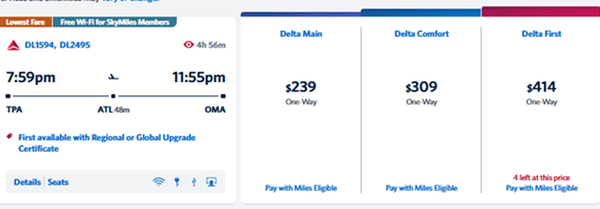
Select the fare as you usually would. On the next screen, you'll get a widget with a dropdown like this:
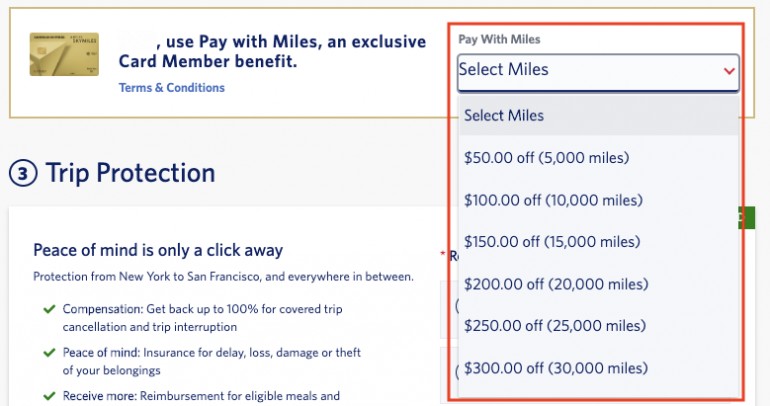
As you can see, you can offset the cost of the cash fare using SkyMiles in 5,000-mile increments.
SkyMiles are always worth 1 cent each when used in this way, which, while not spectacular, isn't far from our estimated value for SkyMiles of 1.2 cents each.
Given how much simpler this option is compared with normal award booking, those with little patience for blackout dates and other award calendar headaches might be willing to forgo potentially higher value from their SkyMiles.
However, it’s probably worth spending a few minutes comparing the value of the fares you find with "Pay With Miles" and normal award bookings (see the calculator below for help figuring this out).
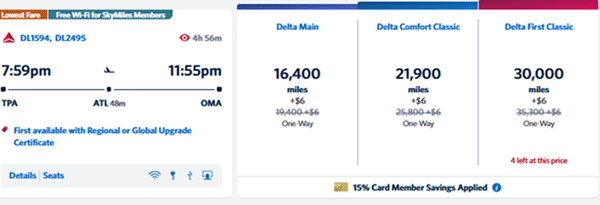
The same flight using just SkyMiles is 16,400 miles, which includes the 15% discount for having a co-branded credit card.
» Learn more: Which Delta Air Lines credit card should you get?
Miles + Cash: How it works
Let’s say you want to use your SkyMiles to book a ticket, but you don’t have enough miles to cover the full cost. You can use the "Miles + Cash" option on most Delta-operated flights to do just that. Search in the Delta booking tool as usual, then select the "Miles + Cash" option under "Show Price In."

Selecting this will switch the prices over to a combination of, well, SkyMiles and cash, like this:
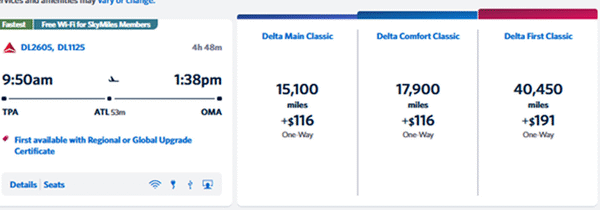
Since Delta is setting both the split between the amount of SkyMiles and cash, as well as the value of the SkyMiles, determining the value of this option requires a little work. For example, the same ticket paying entirely in cash costs $239 in this case (note that the Miles + Cash price above is for a “Main Classic” fare):
Subtracting the cash portion of the Miles + Cash price ($116) from the full cash price ($239) determines how much cash is being offset by miles ($239 - $116 = $123). So $123 is being offset by the 15,100 SkyMiles. That is less than a penny for each SkyMile.
Delta SkyMiles calculator
You can use this Delta SkyMiles to dollars calculator to determine whether this is a good deal or not.
Continuing from the previous section's example, if the value of 15,100 SkyMiles is more than $116, this is not a good deal. If they are roughly the same, it’s a wash.
According to the calculator, the value of 15,100 miles is $181.20, so using Miles + Cash in this case would not be a good deal.
On the flip side, using 16,400 miles to pay for the entire ticket would be a good deal because, according to the calculator, those miles are worth $196.80 and would pay for a ticket valued at $239.
Indeed, for the most part, these Miles + Cash bookings should be considered only as a last-ditch option for burning some extra miles if you don’t have enough for a full ticket.
The bottom line
They may sound similar, but Delta’s "Pay with Miles" and "Miles + Cash" options offer fundamentally different value propositions. Neither offers particularly good bang for your SkyMiles in terms of value, but the "Pay with Miles" benefit for Delta cardholders can make sense in some cases, where the "Miles + Cash" offset rarely does.
How to maximize your rewards
You want a travel credit card that prioritizes what’s important to you. Here are some of the best travel credit cards of 2026:
Flexibility, point transfers and a large bonus: Chase Sapphire Preferred® Card
No annual fee: Wells Fargo Autograph® Card
Flat-rate travel rewards: Capital One Venture Rewards Credit Card
Bonus travel rewards and high-end perks: Chase Sapphire Reserve®
Luxury perks: American Express Platinum Card®
Business travelers: Ink Business Preferred® Credit Card