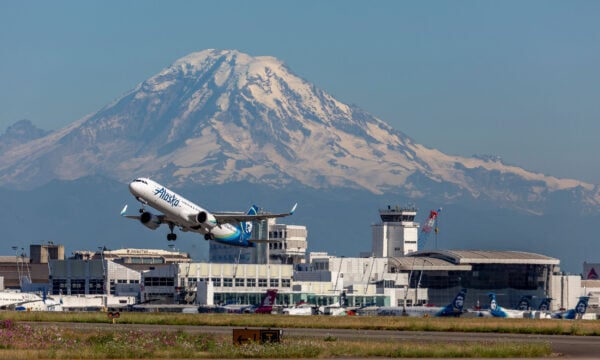
Two major U.S. airlines are planning to merge. In a surprise announcement on Dec. 3, Alaska Airlines revealed it has reached a deal to acquire its smaller competitor, Hawaiian Airlines.
The approximately $1.9 billion deal would see the two airlines join forces under one corporate umbrella. As part of the arrangement, Alaska and Hawaiian Airlines would still operate as separate brands, given their prominence in the nation’s 49th and 50th states.
Customers would earn frequent flyer miles and elite status through one joint loyalty program, and travelers would be able to book itineraries featuring seamless connections between the two airlines and their partners.
If and when this merger comes to fruition, it could mean big changes for passengers, but don’t expect changes right away. Alaska Airlines leaders expect the deal to close in 12 to 18 months — assuming the federal government doesn’t challenge the merger on antitrust grounds.
What’s happening with Alaska Airlines and Hawaiian Airlines?
As part of the agreement, detailed in a press release on Dec. 3, the two airlines will be governed by Alaska’s corporate headquarters in Seattle.
The move would combine Alaska’s network — heavily domestic and West Coast-oriented with flights to small Alaskan towns and cities — with Hawaiian, which currently features a robust schedule of inter-island flights in Hawaii, plus long-haul service to the U.S. mainland, Asia and the South Pacific. Together, the airlines would operate around 1,400 daily flights to 138 destinations with 365 aircraft, Alaska leaders said Sunday.
Both airlines’ corporate boards have already approved the merger, but it’s still subject to regulatory approval.
Will Hawaiian Airlines still exist?
Despite being acquired by Alaska Airlines, Hawaiian Airlines’ name isn’t going anywhere.
Alaska and Hawaiian Airlines would still operate as separate brands — at least on the customer side — flying on planes with their own distinct paint and logos.
At the airport, from the check-in counter to the gate, each airline would remain identified as it is today. More significantly, current leaders of both companies also pledged not to cut essential service, from Alaska’s critical flights to more than a dozen Alaskan communities without roads to Hawaiian’s network of flights to each of the state’s major islands.
“This is a responsibility we take seriously, just like we do today in the state of Alaska,” Alaska CEO Ben Minicucci said on a conference call with analysts Sunday.
What the changes will mean for customers
The merger will bring changes for passengers, but company leaders acknowledged many details have yet to be ironed out.
A combined network
With the airlines combining their networks, Hawaiian Airlines flyers will be able to book itineraries on flights aboard both Hawaiian and Alaska, and vice versa.
Hawaiian joins Oneworld alliance
Under the arrangement, Hawaiian customers would have full access to airlines in the Oneworld alliance, which Alaska joined in 2021.
This will give Hawaiian Airlines customers access to Alaska’s U.S. codeshare partner, American Airlines.
Other prominent Oneworld partners include British Airways, Qatar Airways, Japan Airlines, Qantas and Finnair.
On Sunday’s call, Alaska chief financial officer Shane Tackett said the partnership will give Hawaiian customers triple the number of options for trips to the mainland U.S., given Alaska’s network and its partnership with American.
Plus, Alaska Airlines loyalists will be able to use Hawaiian's network of transpacific flights to cities like Tokyo, Sydney, Auckland, New Zealand and Seoul, South Korea.
One loyalty program
One of the biggest changes customers will notice is a joint loyalty program.
Speaking at a news conference Sunday in Honolulu, Minicucci said the two airlines will share a single loyalty program for earning and redeeming miles. That means the HawaiianMiles program would end, and customers with elite status would be matched into an equivalent status tier in the combined program.
It’s not yet clear what changes this might mean for Alaska’s existing Mileage Plan loyalty program or co-branded credit cards offered by either airline.
Minicucci likened the future setup to a prominent hotel loyalty program.
“Think of something like Marriott Bonvoy,” he said. “You’re part of Marriott Bonvoy, but you can stay in different hotels, right? Under this ‘house of brands.’ So that’s how we’re thinking about it.”
Though a unique setup in the U.S., there are examples in Europe of major corporations serving as parent companies for multiple airline brands. Notably, International Airlines Group (IAG) owns British Airways, Aer Lingus, Iberia and other airline brands — many of which share Avios as a common loyalty currency.
Concerns for consumers
Could the merger drive fares up? That’s what airfare experts fear.
“Competition between airlines is the single biggest cause of cheap flights,” Scott Keyes, founder of Going.com, said in a statement. “A merger between these two airlines … would result not in more cheap flights for consumers, but fewer.”
For their part, Alaska Airlines leaders argue the merger is pro-competitive, allowing Alaska customers access to Hawaiian Airlines’ transpacific network, and giving Hawaiian flyers more access to the mainland U.S. and Alaska’s 29 partner carriers.
At the news conference, Minicucci said Alaska and Hawaiian currently only fly a dozen of the same routes out of around 1,400 total.
Antitrust concerns
Under the Biden administration, the Department of Justice has been skeptical of airline mergers and their impact on consumers, successfully arguing against JetBlue’s now-defunct Northeast Alliance with American Airlines in court earlier this year on antitrust grounds.
However, antitrust legal expert Florian Ederer, a professor at Boston University’s Questrom School of Business, thinks it’s likely Alaska and Hawaiian’s merger survives a legal challenge.
“It’s not quite as fiercely anti-competitive as some of those other arrangements or mergers,” Ederer says. “Now, that’s not to say there’s no anti-competitive concern. If you look at the market shares of flights from the U.S. mainland to Hawaii, Hawaiian is the largest carrier. And in fourth place is, already, Alaska Airlines.”
The DOJ did not immediately respond to a request for comment.
(Top photo courtesy of Alaska Airlines)
How to maximize your rewards
You want a travel credit card that prioritizes what’s important to you. Here are some of the best travel credit cards of 2026:
Flexibility, point transfers and a large bonus: Chase Sapphire Preferred® Card
No annual fee: Wells Fargo Autograph® Card
Flat-rate travel rewards: Capital One Venture Rewards Credit Card
Bonus travel rewards and high-end perks: Chase Sapphire Reserve®
Luxury perks: American Express Platinum Card®
Business travelers: Ink Business Preferred® Credit Card