The quarterly earnings calendar is one of the most important drumbeats in the investing world — especially for active investors and short-term traders.
But it may be getting a major overhaul soon, courtesy of the White House. On Sep. 15, President Donald Trump posted this message on his social media site, Truth Social:
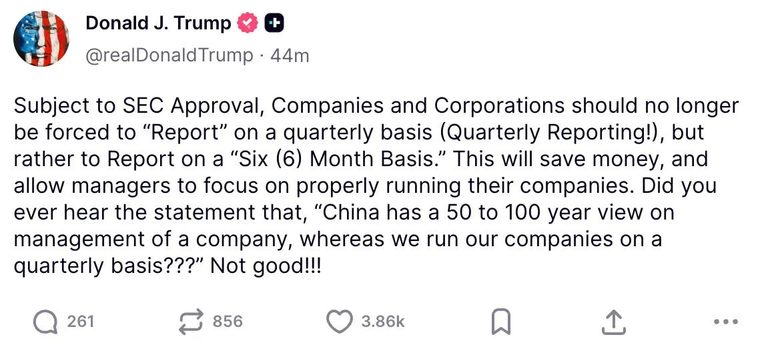
Here’s the scoop on the potential switch to six-month reporting requirements: how likely it is, and how it might affect the markets.
Are earnings reports really going semiannual? When?
President Trump’s call to switch to semiannual reporting is not unprecedented. The European Union made a similar change in 2013, and some prominent Wall Street personalities — including Berkshire Hathaway’s Warren Buffett and J.P. Morgan Chase’s Jamie Dimon — have previously endorsed the idea of relaxing quarterly reporting requirements in some way.
For now, the president has only written a social media post about it, not a legally-binding decree. But the Securities and Exchange Commission (SEC) is already working on it. Last week, SEC chair Paul Atkins said his agency would “fast track” the rule change.
Atkins did not give a complete timeline for the change, but said that he hopes to release a detailed proposal for public comment later this year or early next year. That implies that the change would be implemented, at the earliest, sometime in 2026, assuming it doesn’t hit additional snags.
It’s worth noting that the SEC has explored the idea of switching from quarterly to semiannual earnings reporting requirements before. President Trump tweeted about the idea in 2018, during his first term, prompting the SEC to collect public comments on the idea. The change didn’t move forward in 2018, and only time will tell if this push will end differently.
» MORE: Upcoming Big Tech Earnings
How would the end of quarterly reporting affect stocks?
Earnings reporting requirements help provide investors with important information about company performance. One of the best-known stock valuation metrics, the price-to-earnings (PE) ratio, looks at a company’s stock price divided by its earnings per share over the last twelve months to gauge whether it’s undervalued or overvalued compared to its peers.
Brokerage firms | |
|---|---|




But there’s also some evidence supporting President Trump’s argument that quarterly reports are too frequent, and may create bad incentives for public companies to focus on short-term results at the expense of long-term strategy.
Last week, Srini Krishnamurthy, a finance professor at North Carolina State University’s Poole College of Management, published an analysis of studies on the positive and negative effects of earnings requirements.
One of the studies Krishnamurthy cited is a 2023 paper published in The Accounting Review, an academic journal . It examined the performance of U.S. public companies between 1962 and 2018, and found a strong relationship between companies’ reported results and their share prices, suggesting that frequent reports are a valuable predictor of a stock’s future returns.
However, Krishnamurthy also cited a 2018 study, also published in The Accounting Review, which looked at U.S. public company behavior between 1950 and 1970 — a period when many companies were just starting to report quarterly results . It found that increased reporting frequency was associated with a large decline in long-term investments by the companies.
“There is a tradeoff here, and shifting to semiannual financial reporting would reduce the reporting burden for firms, as well as the incentives for managerial opportunism,” Krishnamurthy wrote in his analysis.
But he also cautioned that ending quarterly reporting could have unintended consequences. “On the flip side, making financial statements less frequently available to investors could make the market less efficient and exacerbate volatility in prices,” Krishnamurthy wrote.
What's next
At this point, it’s uncertain when (or even if) the switch to semiannual reporting would go into effect. Would it improve companies’ long-term planning, reduce transparency and increase volatility for investors, or all of the above? We’ll have to wait and see. In the meantime, most financial advisors suggest long-term investors avoid reacting to short-term noise like earnings anyway. If you have a diversified portfolio, any ripple effect from a policy change like this should be minimal.
Explore more on
Article sources
NerdWallet writers are subject matter authorities who use primary, trustworthy sources to inform their work, including peer-reviewed studies, government websites, academic research and interviews with industry experts. All content is fact-checked for accuracy, timeliness and relevance. You can learn more about NerdWallet's high standards for journalism by reading our editorial guidelines.
- 1.The Accounting Review. Evolution in Value Relevance of Accounting Information . Accessed Oct 2, 2025.
- 2.The Accounting Review. Frequent Financial Reporting and Managerial Myopia . Accessed Oct 2, 2025.