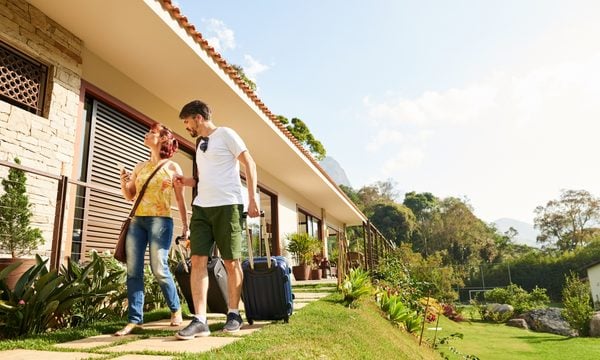






Lodging during your vacations or business trips doesn’t necessarily have to be a standard hotel, bed-and-breakfast or campground. These days, more travelers are turning to Airbnb rentals.
Airbnb stays can sometimes be less expensive than hotels, and typically, you'll have better luck finding options that can sleep more people. Some rentals have washing machines and kitchens to better accommodate extended stays, potentially saving travelers some money.
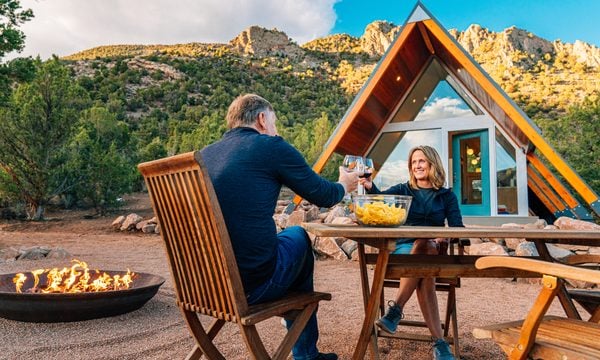
In some less touristy destinations, Airbnb gives you more lodging options (and sometimes the only lodging option). And properties can be delightfully unexpected. There are treehouses, lighthouses and geodesic domes for rent, as well as entire private islands.
But Airbnbs also have challenges. Check-in processes are inconsistent: Some hosts require you to meet them in person to exchange keys, while other units unlock remotely, so you never meet the owner. Policies, for instance, about parties and cancellations, vary by property. There are tons of fees (which, again, vary by property). When you factor everything in, the platform sometimes doesn’t net out to be any cheaper than hotels.
But if the vacation home life is the life for you, here’s what you need to know about renting an Airbnb.
By signing up, you will receive newsletters and promotional content and agree to our Terms of Use and acknowledge the data practices in our Privacy Policy. You may unsubscribe at any time.
How does Airbnb work?
Airbnb launched in 2008 as an online, peer-to-peer home rental service. The idea was born a year prior when its founders were seeking a way to help pay their rent — in this case, renting out a portion of their home to someone else. CEO and co-founder Brian Chesky inflated three air mattresses to make what was the first-ever Airbnb listing, and today, there are millions of listings worldwide.
The premise of Airbnb is simple: A person lists their home for rent, sets available dates and the price, and you can opt to rent it. Some listings give you the entire home to yourself, while others provide private areas within a home (such as a bedroom or an in-law unit). Sometimes, you might even share a room.
Listings vary across pretty much every aspect of your stay, including amenities offered, cancellation policies and the number of guests allowed to stay. But Airbnb’s platform has more than 5 million hosts across 220 countries and regions, so there’s a good chance you’ll find an Airbnb that matches your needs.
According to vacation rental analytics company AirDNA, travelers can expect more rental options in 2026, particularly in coastal areas and suburbs near major cities, as more professionally managed properties come online.
How to make an account on Airbnb
To get started on Airbnb, you’ll need to create an online account, which usually entails more than just a name and email address if you want to book a stay. You’ll typically have to upload your government ID, which Airbnb requires for security (after all, you’re staying in someone else’s house, and sometimes even with them or other guests present).
Accepted forms of identification include a driver’s license, passport, identity card or visa. Airbnb says it does not share your ID with anyone else who uses Airbnb, including hosts.

How to book an Airbnb
Finding your rental
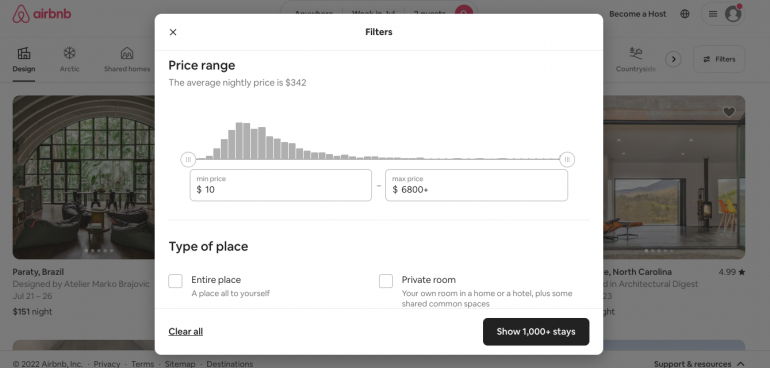
Booking an Airbnb is fairly straightforward. The website offers robust filters, so you can narrow down rentals based on available dates and number of guests, and other features like whether the rental offers amenities like cribs, accessible showers or free parking.
You can also explore places to stay based on what you’re looking for, whether it’s a tiny home, a camper, a windmill, a cabin near a national park or a luxury rental. Airbnb also offers “OMG!” listings, highlighting weird and whimsical stays.
Most listings include multiple photos, detailed descriptions and reviews to give you a solid idea of what you’re in for. If there aren’t many high-quality photos, or there are no reviews, be cautious. It could simply be a brand-new listing and just fine, but it might also be a warning sign.
Read the descriptions carefully, as they typically detail important information such as pet rules, noise rules and limits on guests. Some owners also require you to sign separate contracts or rental agreements outside of the standard Airbnb contracts, which will typically be spelled out in the description as well. Airbnb has features that let you message the host before booking if you’re unsure about something.
If you're planning a longer trip, you might want to take advantage of Airbnb's Split Stay feature. Split Stays give guests the opportunity to split a longer trip between two properties. Individually, those properties might not allow for a long enough stay to match your trip needs, but Split Stays (which will appear in location-specific search results as well as certain categories) provides travelers with automated suggestions for coordinating lodging on a longer trip.
When you’ve found your rental of choice, the actual booking process varies. Some homes let you book instantly, while other homes require you to send the owner a request for approval.
Booking and paying for your Airbnb
Once accepted, you’ll be charged for the reservation. If your rental requires an approval request and the owner either declines or doesn’t respond, you won’t be charged.
All payments are handled via Airbnb. Acceptable payment methods in most countries include major credit cards (like Visa, Mastercard and American Express), most debit cards that can be processed as credit cards and other payment services like PayPal, Apple Pay and Google Pay. If you find yourself in a situation where the host bank transfer), it could be a scam.
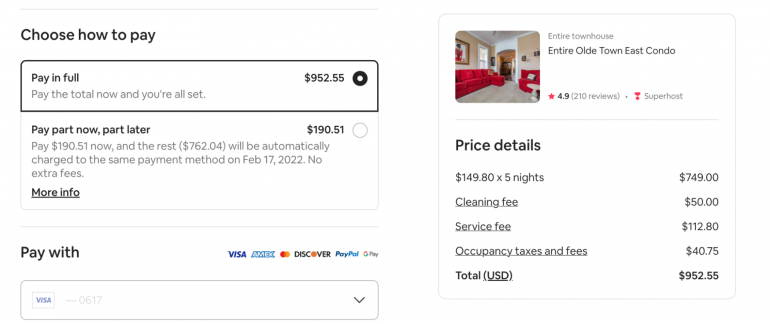
The actual time you need to pay varies depending on location and length of stay. Most properties let you pay via a payment plan, where you pay a portion upon confirmation, and the rest is automatically charged upon checkout.
Between acceptance and your trip date, you’ll be able to chat with your host within the Airbnb app or website. You might find that feature handy for coordinating check-in times or simply for finding more details about amenities (for example, you might want to know whether the kitchen is stocked with certain cookware).
Check-in processes vary
Checking into an Airbnb can sometimes be the biggest adventure of your trip. Unlike a hotel where there’s typically someone working at the front desk 24/7 to issue your key, Airbnb check-in policies vary widely by property.
In-person key exchanges: The most conventional method is to meet your host face-to-face, where they’ll likely hand you the keys and show you around the property. Some property tours might last only a couple of minutes but be prepared: Properties with more complicated features, such as guard gates or even an oddly designed shower, can come with a longer tour. Budget enough time between check-in and your next activity just in case.
Be aware that check-in may require some thoughtful coordination if the host isn’t planning on waiting at the property for your arrival. If you’re trying to text a host to meet up in a foreign country, ensure you have adequate international cell phone coverage or access to Wi-Fi so you can actually chat, especially if your transportation is delayed and you’ll have to meet up later than expected.
Other possible check-in methods that might not require you to meet the host include:
A host leaves instructions to enter (e.g., the key is under this flowerpot or the home uses a digital lock).
Keys are left in a numbered lockbox, and the host messages you with the code.
A neighbor, co-host or building doorperson meets you.
Typically, the host will message you with check-in details 48 hours prior to your trip via the Airbnb app or website.
You may have to clean up before checking out of your Airbnb
Just as the check-in process varies by property, the checkout process varies, too. Some hosts have specific cleanup instructions, such as asking you to put used towels and sheets in the laundry room or to start the dishwasher. Other hosts let you leave the house as-is and handle cleanup themselves.
The majority of hosts also charge cleaning fees, which are a one-time charge pocketed by hosts to cover costs such as doing laundry or scrubbing toilets between guest stays. They’re separate from the base price and are in addition to service fees or charges for optional add-ons. The median cleaning fee for one-bedroom homes in the U.S. is $78, according to data provided to NerdWallet by AirDNA.
When you’re searching for a listing, Airbnb will list the total stay price with fees included, which can help avoid a surprise at checkout. However, keep in mind that taxes are excluded in the initial upfront price.
The process for locking up will also vary. If you met your host in person for check-in, you might also meet them to check out. Other hosts might ask you to lock the door behind you and throw the key through a slot in the door, or return it to the lockbox you initially got it from.
Your host will likely share the specific checkout details either before or upon arrival.
Is Airbnb safe?
Airbnb has safety measures in place, but the company isn’t immune from challenges that come from a service where you enter a stranger's home.
Safety measures between guests and hosts
Airbnb conducts background checks on guests and hosts. It uses machine learning to analyze data with the intent to spot suspicious activity such as fraudulent listings. And because Airbnb acts as the intermediary in handling the transaction, your account and payments are more secure than if you were to directly pay the host.
In response to privacy concerns, Airbnb in 2024 implemented a ban on indoor security cameras and provided more comprehensive guidelines on the use of outdoor security cameras.
Still, as is the case with all types of lodging, safety issues haven’t been eliminated. Some guests have complained about inappropriate and dangerous behavior from hosts. High-profile incidents — like the deadly shooting in 2019 at a Northern California Airbnb — also raise questions about the platform’s safety, although such events are rare.
Safety measures pertaining to property condition
Airbnb has taken some steps to ensure properties are physically safe. It provides smoke and carbon monoxide alarms to hosts at no cost, and you can filter listings by homes that have them.
However, Airbnb doesn’t necessarily inspect properties for other important safety features that you might expect, such as having at least two exits out of every room, or whether appliances and heating systems are up to code.
And unlike most hotels, most Airbnbs lack features that can keep you safe, including a safe (which you might want to use to stash valuables like jewelry or passports). It also doesn’t offer 24/7 lobby staffing, which could be helpful if you need support from a fellow human in an emergency. Airbnb does, however, offer a 24-hour safety line you can access through the app through its AirCover program, which launched in 2021.
Through AirCover, Airbnb will offer you a refund or switch you to a similar property if your host cancels before you check in; you can’t reach your host when there’s an issue; or the listing is significantly different from reality and your host is unable to fix the problem. However, Airbnb says similar properties are “based on availability at comparable pricing,” so you might end up in a tough spot if you’re at your destination and can’t find a reasonable alternative.
Safety measures to protect hosts
Speaking of AirCover, it's there to protect hosts too. AirCover includes guest identity verification and $3 million in damage protection to better protect hosts from issues caused by guests.
Safety issues can happen at any form of lodging, and Airbnb is generally considered safe. Just be aware that problems can arise, so be aware of scams, unethical practices and physical issues with properties.
How to save money on Airbnb bookings
Since Airbnb prices are set by the hosts, the conventional tricks for saving money on hotels don’t always apply. But there are a few ways to save money on Airbnb rentals, including earning and redeeming credit card points and airline miles on Airbnb stays.
Book a longer stay
Many properties offer discounted rates for longer stays (typically a week or more). Some offer even deeper discounts for stays of a month or more.
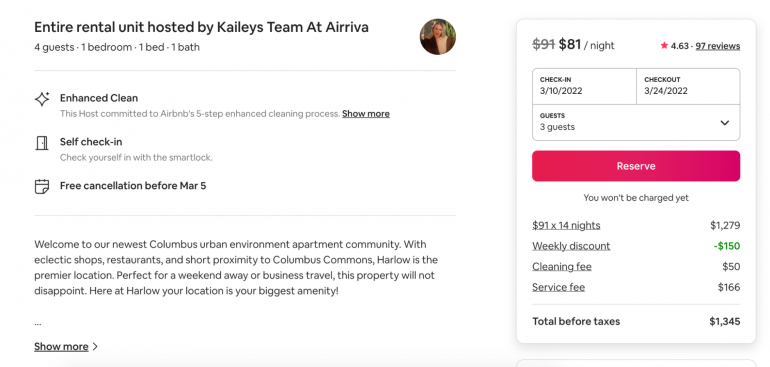
Rather than taking two separate four-day vacations this year, you might consider booking one, eight-day vacation in the same location. You’ll likely save money on not just your Airbnb, but other costs like airfare — and you’ll only have to pack once.
The nightly rate for a 30-night stay was 43% cheaper per night than a one-night stay, according to AirDNA data provided to NerdWallet looking at one-bedroom units in major U.S. cities.
Median price per night in major U.S. metros (1 bedroom) | Percent cheaper per night versus 1-night stay | |
|---|---|---|
1-night stay | $164. | N/A. |
7-night stay | $134. | 18%. |
30-night stay | $94. | 43%. |
» Learn more: Why it's worth booking Airbnb for a week or longer
Split it with friends or family
Airbnbs are particularly cost-effective for large groups, where you can split the cost of one unit across several people.
Unlike hotels, where each room has a set price, Airbnbs allow you to get a bigger unit where a three-bedroom apartment might not necessarily be triple the price of a one-bedroom.
NerdWallet used AirDNA data to compare the price per head at Airbnbs with a maximum capacity of two people versus six people (assuming two adults per room).
The median per-person rate for six was 38% cheaper than for two.
Median nightly rate, per person | |
|---|---|
Small Airbnb (fits 2 adults) | $78. |
Large Airbnb (fits 6 adults) | $50. |
Book close-in stays (and refundable backups)
Using AirDNA data, NerdWallet compared prices (excluding fees) of Airbnbs booked three days out, four weeks out and 47 weeks out.
It turns out that booking an Airbnb three days in advance yields the lowest median price — $130 for a one-bedroom unit. This is roughly $20 cheaper than booking it a month out, and about $50 cheaper than booking it almost a year in advance.
However, close-in bookings are not for the faint of heart. If you want to wait for a last-minute booking, you might want to consider booking a stay with a flexible cancellation policy at a price you’d be happy with. Flexible policies allow you to cancel at least 24 hours in advance and get a full refund.
Use HotelTonight when you’re not staying at Airbnbs
When you book a hotel stay on HotelTonight, a booking platform that offers last-minute hotel deals, you can earn 10% back in Airbnb credit on the booking price (excluding taxes and fees).
To take advantage of this perk, you’ll need to link your HotelTonight and Airbnb accounts. Airbnb, which owns HotelTonight, allows you to stack the credits you earn. You’ll just need to make sure to spend them before they expire a year from your HotelTonight stay completion.
Redeem travel statement credits for Airbnbs
Some credit cards offer travel statement credits, and those that do typically tend to cover Airbnb stays. In fact, the Chase Sapphire Reserve® offers a statement credit that can be used to offset Airbnb purchases.
Purchase discounted gift cards
Airbnb sells gift cards on its own site, but major retailers that sell gift cards, such as Target, Sam’s Club and Best Buy, often can get you a better deal.
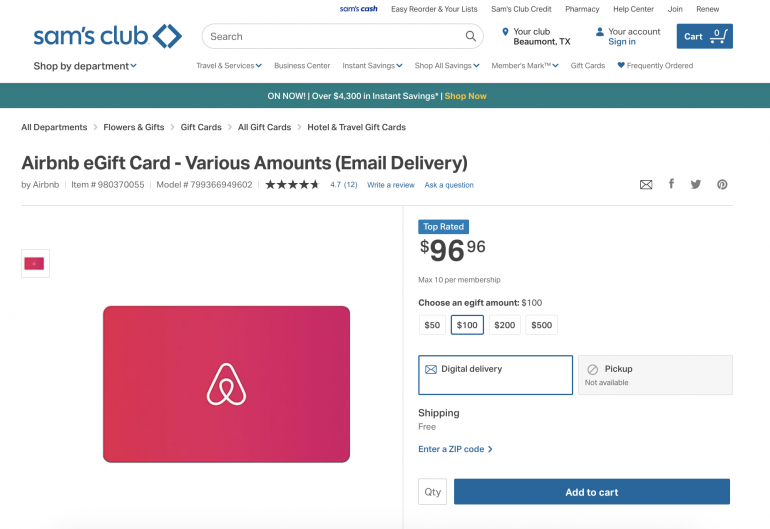
These stores frequently run promotions where they’ll sell you Airbnb gift cards at a lower cost than the gift card’s value. During certain times of year, you might find them sold at a 10% discount, though sometimes the discounts aren’t quite as deep.
Holding certain memberships or credit cards might qualify you for additional discounts. For example, if you purchase an Airbnb gift card from Target and pay with your Target Circle™ Credit Card, you’ll get an automatic 5% discount at checkout (so you’d only pay $95 for a $100 gift card).
Earn points by paying with a travel rewards credit card
This tip won’t necessarily save you money upfront, but it’ll earn you valuable travel currency on the other end. Most credit cards that offer you bonus points on travel classify purchases made through home-sharing platforms like Airbnb in the same way as hotels.
So if you’ve got a travel rewards credit card, use it. And if you don’t have one yet, consider applying for one. While premium travel credit cards can offer big rewards rates for your travel spending, there are plenty of travel credit cards with no annual fee.
Top cards for booking Airbnb stays



Annual fee
Earn rates
1.5 points per $1 spent.
3 points per $1 spent on travel purchases booked through Bank of America.
• 5 miles per $1 on hotels, vacation rentals and rental cars booked through Capital One Travel.
• 2 miles per $1 on all other purchases.
• 10 miles per $1 on hotels and rental cars through Capital One Travel.
• 5 miles per $1 on flights and vacation rentals through Capital One Travel.
• 2 miles per $1 on everything else.
• 5 miles per $1 on hotels, vacation rentals and car rentals booked through Capital One Travel.
• 1.25 miles per $1 on all purchases.
Still not sure?
Earn airline miles, too
Your Airbnb stays are an easy way to rack up Delta SkyMiles, which you can accumulate and redeem for free flights. Once enrolled in the program, you’ll earn 1 mile for every dollar spent on qualifying Airbnb reservations, excluding taxes and fees. You can also earn 3 miles per dollar spent on qualifying Airbnb services and experiences. To earn SkyMiles, you'll need to activate the partnership through the dedicated Airbnb and Delta booking page.
NerdWallet values Delta miles at 1.2 cents each, so this isn’t necessarily going to make you rich. But it’s an easy way to accumulate some extra Delta miles with minimal effort.
» Learn more: How to earn or redeem points on Airbnb stays
Travel when no one wants to
Your Airbnb host is likely aware of the principles of supply and demand, and will set rates for specific nights accordingly. A property in New York City with a view of the Times Square Ball will likely be more expensive on Dec. 31 than any other cold winter day.
If you can be flexible, search for the same property across various weekends versus weekdays to spot lower rates. Meanwhile, consider whether you really need to travel during that long weekend when everyone else is off of work and school. Shoulder season also tends to be an excellent time to travel.
Consider Airbnb alternatives
Airbnb's reign over the vacation rental kingdom is undeniable. But between questionable cleaning fees, quirky cancellation policies, and the occasional horror story, even its most loyal users might sometimes look elsewhere.
Whether you just want to comparison shop or you'd rather swear off Airbnb entirely, there's no shortage of Airbnb alternatives. One of its biggest competitors is Vrbo (consider it the Lyft to Airbnb's Uber). It offers a better browsing experience plus the ability to earn rewards through the One Key Rewards program.
You might also consider Vacasa, which stands out as a full-service vacation rental management company. That means homeowners partnering with Vacasa to have their properties professionally managed (and generally means an overall more polished vacation rental experience while still getting the unique, hometown feel of renting a home from its actual owner).
Photo courtesy of Airbnb.
How to maximize your rewards
You want a travel credit card that prioritizes what’s important to you. Here are some of the best travel credit cards of 2026:
Flexibility, point transfers and a large bonus: Chase Sapphire Preferred® Card
No annual fee: Wells Fargo Autograph® Card
Flat-rate travel rewards: Capital One Venture Rewards Credit Card
Bonus travel rewards and high-end perks: Chase Sapphire Reserve®
Luxury perks: American Express Platinum Card®
Business travelers: Ink Business Preferred® Credit Card