





Unlike regular savings accounts, certificates of deposit typically have one deposit: the first time you add money. The right amount for a CD depends on your money goals and situation, so let’s dive into a few rules of thumb that may help.
Nerdy Takeaways
CDs are for a portion of your existing savings that excludes your emergency fund and long-term investments.
Factor in a CD’s minimum deposit requirement (typically $1,000) and the FDIC-insured maximum ($250,000). Your amount in CDs should result in a worthwhile return.
Money in CDs should make up a small percentage of your total savings.
Big picture: CDs are for a small portion of your money
CDs work as an add-on savings strategy, where you can put savings earmarked for a big near-future purchase, such as a car or home down payment. CDs don’t replace your regular savings account or main retirement account. When you put an upfront sum into a CD, it’s locked in for a fixed time period, typically up to five years, and withdrawing early usually results in a penalty. The main advantage CDs have is a guaranteed rate, as opposed to a regular savings account, where rates may fluctuate without warning.
» COMPARE: Best CD rates
CDs fall into the cash part of your portfolio, meaning your overall collection of assets that generally includes stocks, bonds and cash. Money in CDs is intended to be safe and used for goals within five years.
Financial experts generally recommend that long-term investors only put a small percentage of their overall portfolio, such as 5% or 10%, into cash investments. Cash investments include CDs and Treasury bills and notes, so the amount in just CDs might be smaller. Investing plans and risk tolerance help determine the right mix of stocks, bonds and cash for a portfolio, but generally, cash’s role increases closer to and during retirement.

Flowchart summary of a multi-step approach
A good rule of thumb is to have an emergency fund in a high-yield savings account before you consider a CD. And that might be a good starting point to know when to choose a CD in general. Other factors include rates and the possibility of a withdrawal before a CD term ends. Read past the flowchart for more details.
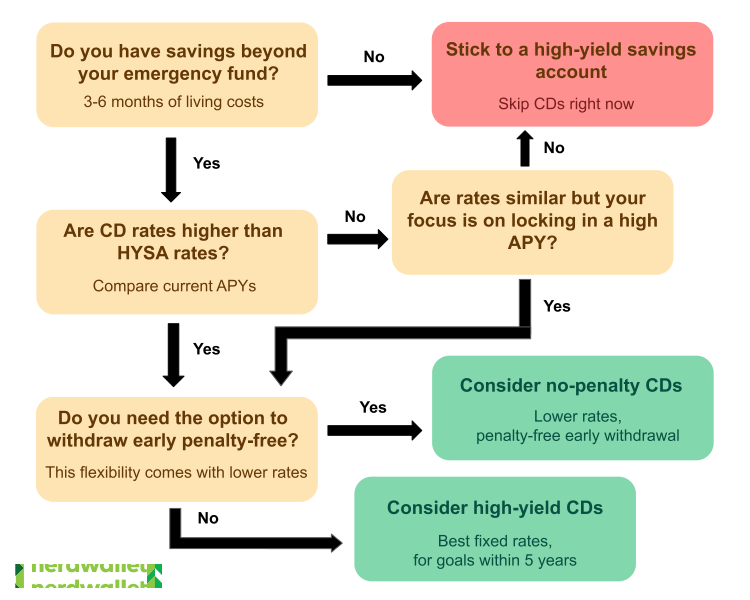
Multi-step approach: Narrow down amount for CDs and check rates
1. Start with other savings to see what’s left for CDs
Look at all of your savings and prioritize short- and long-term savings goals first. Here’s a quick breakdown of two standard goals:
Keep three to six months of living costs in a regular savings account. This range is a standard guideline for an emergency fund in case of sudden job loss or other economic hardship. For your everyday and emergency savings, a high-yield savings account is your best bet to get competitive returns and ongoing access to your money.
For retirement savings, aim to invest 10% to 15% of your income each year. Investing vehicles include an individual retirement account or an employer-sponsored account such as a 401(k) or 403(b). Money is often invested in some combination of stocks and bonds, which typically have higher average returns than CDs.
What’s left could be eligible for CDs — but CDs should match up with your goals too. CDs tend to be most beneficial for locking up savings dedicated to a big purchase within five years, such as a car or down payment on a house. Or for preserving some savings near or in retirement. But weigh the pros and cons of other places to earn returns on your extra savings. See more about when CDs are worthwhile.
2. Determine the payoff: When is money better for a CD than a HYSA?
Use a CD calculator to estimate how much interest you’d earn from a CD and a HYSA. Compare different rates but keep the same amount of money and time period. In reality, the savings rate likely won’t stay the same, and you’d probably add money to your savings account over time. But for this calculation, the goal is only to see if a CD’s return is worthwhile.
If returns are comparable or a savings account comes out ahead, skip CDs. The exception is if locking in a rate is your priority.
If a CD comes out ahead, confirm it aligns with your short-term goals and consider what else to look for in a CD.
You can get penalty-free access to your funds before a term ends through a no-penalty CD, but the trade-off is settling for a lower rate. If you withdraw early from any other CD, the penalty is some or all of the interest earned. Learn more about CD penalties.
If you’re looking at long-term CDs, it’s harder to compare with savings account rates. You earn more CD interest from a longer period of compounding, and the rate environment years from now is harder to predict.
Don’t settle for a CD’s minimum deposit requirement
Treat the minimum opening deposit as a barrier to entry, one to heed but not necessarily to stick to as the recommended amount. A CD’s typical minimum deposit is $1,000, according to NerdWallet data of 50 financial institutions. However, CDs with the most competitive rates tend to have minimums within a range from $0 to $10,000. There are jumbo CDs with minimums traditionally around $100,000, though NerdWallet has found that these CDs rarely have the best rates in the industry.




Member FDIC

4.20%
6 months
Member FDIC

4.40%
13 months

4.40%
9 months


Heed (or prepare for) a CD’s federally insured maximum
As with other bank accounts, a CD is federally insured for up to $250,000 per single account owner (and double that for joint account owners) at banks and credit unions that are members of their respective insurer: Banks are insured by the Federal Deposit Insurance Corp., and credit unions are insured by the National Credit Union Administration.
Federal deposit insurance protects your money up to $250,000 if a bank collapses. A bank may allow you to deposit more than that limit if you have more, but you incur more risks. The $250,000 cap includes all accounts you have at the same bank, such as CDs, checking and savings accounts. And the limit includes interest, so a $250,000 CD deposit would have no interest insured.
Want to see best CDs by term?
View a curated list of our picks based on competitive rates and terms.
Beyond FDIC limits: 4 tips to keep your CD funds insured
Open CDs at different banks or credit unions. This approach might take more work, but you can utilize CDs at different rates and terms. A CD ladder is a common way to spread your funds across multiple CDs of different lengths, such as one-year, two-year and three-year terms, or longer. Each time a CD matures, you decide whether to reinvest in another CD or put the funds elsewhere.
Open CDs in different ownership categories. For example, you could have one CD in your name, another in a joint account with someone else, and yet another as a trust with beneficiaries.
Opt for a brokered CD. This is a CD offered by a brokerage or investment firm. This type of CD can be more involved since you’ll need to open a brokerage account and know some basic investing vocabulary. A brokerage account can hold CDs from multiple banks, which allows for FDIC insurance above $250,000.
Get more FDIC insurance at a bank using a deposit service called CDARS. More than 3,000 financial institutions, including national and community banks and brokerages, provide their customers with FDIC insurance above federal limits through the financial firm IntraFi’s network. IntraFi’s CDARS service lets you have multiple millions of dollars in CDs at one institution, and those funds are managed behind the scenes at multiple banks to federally insure the full amount. CDARS stands for Certificate of Deposit Account Registry Service.
» Want more tips? Here’s our guide to insuring over $250,000