







Bench is an online bookkeeping service. It’s also a bit of an outsourcing cautionary tale for business owners.
Search for Bench online, and you’ll likely come across messages about the company shutting down. It did so in December 2024, albeit briefly. Bench resumed services in January 2025 under a new owner, Employer.com. (You may now see it branded as “Bench by Employer.com” or “Bench MainStreet.” “MainStreet” is another Employer.com company.)
In its initial form, Bench solely used proprietary accounting software. That meant customers couldn’t easily swap Bench out for other providers. When the company declared bankruptcy and paused operations, it left those business owners locked out and in a lurch.
Fortunately, Bench restarted with the same team and mission. And now, bookkeeping can also take place in QuickBooks Online. You may pay more for that, but it will be far easier to break ties with Bench if you don’t like it.
I'd likely consider alternatives to Bench for QuickBooks accounting (more on this below). But it may work for micro-businesses. That's because:
It's cheaper than competitors. Bench offers a $199/month plan for businesses with less than $250,000.
That plan uses modified cash-basis accounting. This is a simpler way to record transactions, which is best only if your finances are also simple.
Bench lacks back-office add-ons. Smaller operators are less likely to need to outsource services Bench doesn't support, like payroll.
It's worth noting this plan relies on Bench's technology. This might be a non-starter if you have years of data in other accounting software. It's less of a concern if you're a smaller business that just wants to get organized. (And you wouldn't mind avoiding a separate software subscription fee.)
Bench has had largely positive online reviews since its acquisition, including for its bookkeepers. That’s key. Any online bookkeeping service is only as good as the individual handling your books. Make sure yours understands your business, and check their work for accuracy.
💻 Author's note
Bench touts “simple, transparent pricing” on its website. I had some questions about that, as well as other product details. I reached out to “media” email addresses for Bench and MainStreet in November 2026. I did not get a response.
I did end up on Bench’s marketing list somehow. That led to multiple messages in a short span:

If Bench responds to my questions, I’ll update this review accordingly. Otherwise, I’d recommend paying close attention to any contract you’re considering with Bench.

NerdWallet Small Business helps you get your business in shape for taxes, loans, and growth. Stop worrying about accounting and speak with a real, human expert from our partner, Xendoo.
on Xendoo's website
Bench bookkeeping pricing
Bench’s bookkeeping rates start at $199/month. That price is available to businesses with less than $250,000 in annual revenue. If you’re above that total, Bench charges $399/month. These rates require you to use Bench’s software.
Bench positions these costs as flat, which is different from other services. Competitors like Bookkeeper360 and Pilot have nearly identical monthly prices ($400 and $399, respectively). But those are “starting at” rates that can change based on your business financials.
Bench’s approach appears more straightforward. However, its terms of use page says Bench can charge overage fees, “in the event that Customer’s Service Time exceeds the Service Time Allocation during any billing period.” It’s unclear which plans or services this applies to.
Here are Bench’s overage rates:
1 to 10 hours over allocation: $215/hour.
11 to 25 hours over allocation: $220/hour.
26+ hours over allocation: $245/hour.
For annual plans, Bench includes catch-up services for free. That’s a real savings. Bookkeeper360 charges at least $1,000 for these services, for instance. For Pilot, they equal one month’s bookkeeping fee. It’s unclear if or how Bench handles catch-up services for monthly customers.
In addition to prior bookkeeping, Bench’s annual plans come with a 20% discount. At its more expensive tier, that’d drop your all-in price from $4,788 to $3,830. Even with those savings, make sure you like Bench before committing. Fees are non-refundable, and contracts auto-renew.
Bench pricing for QuickBooks bookkeeping
Bench has a separate page on its website for QuickBooks Online bookkeeping. These rates are different from the ones above. All plans also include a $1,200 onboarding fee.
Complexity 1: $399/month.
Complexity 2: $699/month.
Complexity 3: $999/month.
At Complexity 2 and 3, you can opt for accrual-basis accounting. You’ll also get more transactions, as well as additional services. Complexity 3 includes custom POS and inventory systems, for instance. Annual discounts are available.
This service appears to be new, or at least its positioning is. When I initially emailed Bench, it advertised hourly bookkeeping rates for QuickBooks. That real estate now belongs to these dedicated plans. Here’s a comparison:
NerdWallet Small Business helps you get your business in shape for taxes, loans, and growth. Stop worrying about accounting and speak with a real, human expert from our partner, Xendoo.
on Xendoo's website
Bench add-on services
Bench aims for simplicity with its add-ons. In addition to bookkeeping, you can get tax filing and advisory services. That’s it.
Other online bookkeepers reach further. Bookkeeper360 can provide a fractional CFO. Pilot leans into startup services, like stock distribution. Bookkeeper.com supports payroll.
Bench sticks to its accounting roots. That’s not a problem, necessarily. But if you’re looking to offload more back-office tasks, Bench won’t be for you.
Bench tax services cost the following:
$300/month (full-service tax support).
$649/month (full-service tax support plus bookkeeping).
$1,200/year (tax services for returning customers).
Bench advertises these as monthly prices. But its website says these rates require a 12-month commitment. It’s unclear what the benefit is for monthly payments if they require a yearlong commitment. Annual plans seem like a better deal. Bench offers a 20% discount for those.
Where Bench stands out
Competitive pricing
Compared with other bookkeeping services, Bench is relatively affordable — especially for smaller businesses. My colleague Hillary Crawford examined the cost of bookkeeping in 2026. She estimated business owners should expect to pay around $300/month. Bench is below that ($199/month) if your annual revenue is less than $250,000.
Not all bookkeeping services use annual revenue to determine your fees. Bookkeeper.com is one that does. Its fees are $499/month if your revenue is less than $500,000. That’s far more than Bench charges smaller businesses. And even if you pass Bench’s $250,000 threshold, you’d still pay less ($399/month) than with Bookkeeper.com.
Just be aware that these rates require you to use Bench's software.
Unlimited customer support
Bench pairs you with a dedicated bookkeeper if you use its software. You get unlimited access to them via phone, message or video call. Online services often have unlimited support with multiple ways to contact your bookkeeper. But Bench’s video call aspect is somewhat unique. It’s a nice value-add if you find it easier to communicate “face-to-face.”
Contact channels are murkier if you opt for QuickBooks bookkeeping. Bench advertises a one-on-one monthly review. Complexity 3 gets more than one of these. Its website doesn’t use similar “unlimited” access language, though.
Catch-up bookkeeping available
Bookkeeping is an easy task to fall behind on. Bench’s prior-year bookkeeping services may be a fit if you’re really far behind.
The company advertises support for cleaning up multiple years of your books. Pricing is custom based on how much work Bench needs to do. However, its site states the cost will be a flat fee.
Bench also includes clean-up services for free if you agree to an annual contract. It’s unclear how the company handles these costs with month-to-month billing, though.
Where Bench falls short
Unclear public details
Transparency isn’t a hallmark of online bookkeeping services. Even given that low bar, Bench’s website still raises many questions.
Bench’s “about” page focuses almost entirely on the company’s brief shutdown. That’s perhaps to counter online perceptions about the brand. But it’d be nice to see more details about Employer.com, the Bench team or the company’s location and contact information.
In fact, the “contact” link on the site takes you to a calendar to schedule a consultation. There’s no phone number, email or other way to get in touch. Will your bookkeeper be based in the U.S.? Other services emphasize this. Bench doesn’t mention it.
Bookkeeper360 is generally more transparent overall. Its pricing is hazier than Bench’s (though I have questions about Bench’s “service time” language). But Bookkeeper360 lets you know what you’re getting for your money:
Dedicated U.S.-based bookkeeper.
Accrual or cash accounting.
Monthly profit and loss and balance sheet statements.
A general overview of its monthly services — transaction categorization, bank and credit card reconciliation, etc.
Bench has an FAQ with some of these details. It says it primarily uses cash-basis accounting. You get monthly P&L and balance sheets too. But this page also includes outdated information.
For instance, it refers to a “Bookkeeping Grow” plan. “Bookkeeping Light” has seemingly replaced this tier. It also mentions downloading an Excel file to export your data. Other parts of the site say Bench works in the software you already use — including those that refer to Bench’s proprietary technology.
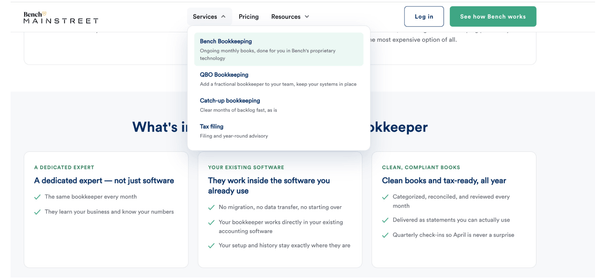
Given the contradictions, it’s hard to vet this information. That said, I do trust those other pages more than the FAQ. That’s because Bench doesn’t link to this resource via the site’s header or footer. This makes me wonder if the page is live, but forgotten.
An inconsistent or outdated website doesn’t make Bench a bad product. (I'm sure NerdWallet has its dusty corners too.) But fair or not, it’s a tough look given Bench’s history and ownership change.
Software compatibility
Bench still appears to use proprietary software for some customers. As many found out when Bench temporarily shut down, this approach can lead to headaches. If you want to switch providers, you need to download Excel files of historical data and upload them elsewhere.
The company can also work with your existing QuickBooks Online account. Relying on QuickBooks is more sustainable, but it’s still a limitation.
QuickBooks is the industry standard for accounting software. Bench isn’t the only online service that sticks to it. Pilot bookkeeping does as well. However, Pilot’s team will at least help you transition from Xero to QuickBooks as part of its onboarding process, if you use the former.
Xendoo is a better choice if you want to stick to Xero. It supports that software and QuickBooks. Xendoo may be more expensive than Bench (plans start at $395/month), but keep in mind that using QuickBooks means paying for QuickBooks. It’s a more expensive option than Xero, with QuickBooks Online monthly prices ranging from $38 to $340. Xero’s most expensive plan tops out at $97/month.
What small-business owners think of Bench
I used an AI tool that NerdWallet built to assess chatter about Bench from Reddit over the past year. There wasn’t much. Most threads about the company point to its abrupt closure in December 2024, with Redditors seeking alternatives.
It’s possible customers left Bench at that point. But the new leadership may have steadied the ship. Bench’s website implies it has more than 35,000 business owners as customers.
Many recent reviews from Trustpilot are from people who say they’ve worked with Bench for years. And on that platform overall, Bench has received lots of organic five-star reviews (see chart below) in the past year, especially after year-end close.
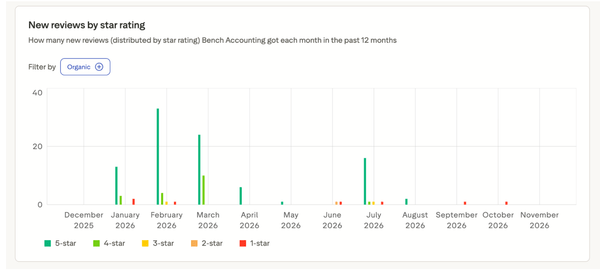
Per Trustpilot, organic reviews are those that don’t rely on the platform’s invitation methods. These reviews often cite individual bookkeepers by name, a good sign for the company.
Bench has less traction on other platforms. The company has two profiles on G2 (one for Bench by MainStreet, and one for just Bench). Neither has had a review since 2024, as of this writing. Bench does have 300-plus reviews on Capterra. However, only one is from 2026.
NerdWallet lead writer Hillary Crawford contributed to this article.