We believe everyone should be able to make financial decisions with confidence. While we don't cover every company or financial product on the market, we work hard to share a wide range of offers and objective editorial perspectives.
So how do we make money? Our partners compensate us for advertisements that appear on our site. This compensation helps us provide tools and services - like free credit score access and monitoring. With the exception of mortgage, home equity and other home-lending products or services, partner compensation is one of several factors that may affect which products we highlight and where they appear on our site. Other factors include your credit profile, product availability and proprietary website methodologies.
However, these factors do not influence our editors' opinions or ratings, which are based on independent research and analysis. Our partners cannot pay us to guarantee favorable reviews. Here is a list of our partners.
Is My Credit Frozen? What to Do If You’re Not Sure
A credit freeze will block approval of a new loan or credit card until you lift it. Here's how to find out whether you have a security freeze in place and how to manage it at each bureau.
Amanda Barroso, Ph.D., is a writer and content strategist helping consumers navigate budgeting, credit building and credit scoring. Before joining NerdWallet, Amanda wrote about demographic trends at the Pew Research Center and earned a Ph.D. from The Ohio State University.
Her work has been featured by the Associated Press, Washington Post and Yahoo Finance.
Bev O'Shea is a former NerdWallet authority on consumer credit, scams and identity theft. She holds a bachelor's degree in journalism from Auburn University and a master's in education from Georgia State University. Before coming to NerdWallet, she worked for daily newspapers, MSN Money and Credit.com. Her work has appeared in The New York Times, The Washington Post, the Los Angeles Times, MarketWatch, USA Today, MSN Money and elsewhere. Twitter: @BeverlyOShea.
Laura McMullen assigns and edits content related to personal loans and student loans. She previously edited money news content. Before then, Laura was a senior writer at NerdWallet and covered saving, making and budgeting money; she also contributed to the "Millennial Money" column for The Associated Press. Before joining NerdWallet in 2015, Laura worked for U.S. News & World Report, where she wrote and edited content related to careers, wellness and education and also contributed to the company's rankings projects. Before working at U.S. News & World Report, Laura interned at Vice Media and studied journalism, history and Arabic at Ohio University. Laura lives in Washington, D.C.
Published in
Updated
How is this page expert verified?
NerdWallet's content is fact-checked for accuracy, timeliness and relevance. It undergoes a thorough review process involving writers and editors to ensure the information is as clear and complete as possible.
If you apply for a loan or a credit card, forgetting your credit is frozen, your application likely won’t be approved. That’s because a credit freeze blocks anyone from accessing your credit reports, and a potential lender is unlikely to extend credit without a credit check. That means the freeze is doing its job.
Some good news: The failed application won’t hurt your credit — there was no hard inquiry on your credit because your file couldn’t be accessed. You'll just need to unfreeze and apply again.
Here’s how to find out at each credit bureau whether your credit is already frozen.
Equifax
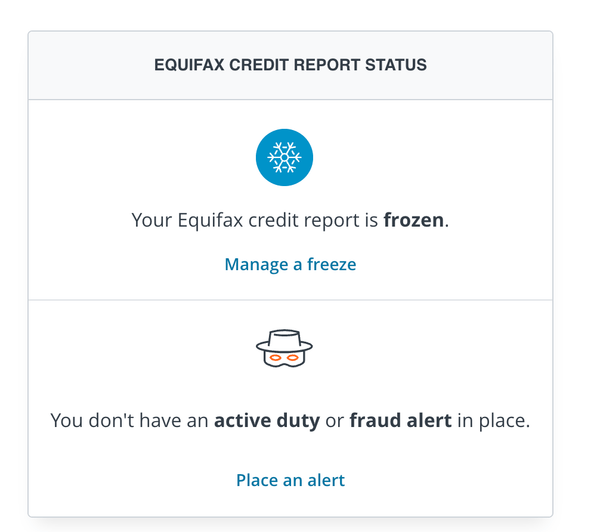
The easiest way to check if you have a credit freeze in place is to log into your myEquifax account. When you log in at myEquifax.com, you can view your freeze status.
If you don’t have an account, or simply would rather use the phone, call 888-298-0045 and follow the prompts to verify your identity. If your credit report is not frozen, you will only hear options for freezing it. If it is frozen, you will hear only options for unfreezing.
Meet MoneyNerd, your shortcut to smart money moves
NerdWallet's twice-weekly newsletter offers practical, no-fluff guidance to help you spend smarter, save more, and make confident money decisions. Delivered free to your inbox.
If you already have a TransUnion account, the fastest way to check is online at the TransUnion website. You’ll need your username and password. After you log in, click on the “Credit Freeze” tile to see whether your account is frozen.
You can also call 800-916-8800. You’ll go through a verification process before you can get the information. Be prepared to provide information like your date of birth, address and Social Security number.
You can go online to Experian’s “Security Freeze Center” page, which looks like this:
You can also call 888-397-3742 and follow the prompts. You will be asked for your Social Security number. That, plus the number you are calling from, will be used to identify you and you'll be given the option to unfreeze if your account is frozen, or to freeze if the account is not frozen.
What are my options for unfreezing credit?What are my options for unfreezing credit?
You have two options for thawing your credit. You can choose to lift the freeze for a specified time, and it will automatically be reinstated at the end of the period. This is a hassle-free way to make sure your credit stays safe when you’re making a purchase that requires a credit check. You can also manually add the freeze back when your purchase is complete. You can also unfreeze permanently, but that leaves you vulnerable to criminals opening accounts in your name.
How long should I lift the freeze?How long should I lift the freeze?
For a credit card or loan application, unfreezing your credit for a week or two should suffice. For a mortgage application, keep your credit thawed through your closing date.
How do I refreeze my credit?How do I refreeze my credit?
If you lifted the freeze temporarily, your security freeze will be automatically applied at the end of the time period you selected. If you permanently lifted the freeze, you can refreeze just as you would if you were freezing your credit for the first time.
Can I get approved with a freeze in place?Can I get approved with a freeze in place?
In general, you will not get approved for credit or loans with a freeze in place. Creditors routinely check your credit before making a decision on an application. If they can’t see it, they won't approve you.
There are a few exceptions: You might slide through if you don’t have your credit frozen at all three bureaus, and the creditor checks the one where your credit is not frozen, or if you apply for a “no credit-check” product.
What if my mortgage closing is late and my credit refroze?What if my mortgage closing is late and my credit refroze?
Most mortgage lenders recheck your credit just before closing. If your temporary thaw expires before then, you can unfreeze your credit and set a new date for the freeze to be reinstated.