


We believe everyone should be able to make financial decisions with
confidence. While we don't cover every company or financial product on
the market, we work hard to share a wide range of offers and objective
editorial perspectives.
So how do we make money? Our partners compensate us for advertisements that
appear on our site. This compensation helps us provide tools and services -
like free credit score access and monitoring. With the exception of
mortgage, home equity and other home-lending products or services, partner
compensation is one of several factors that may affect which products we
highlight and where they appear on our site. Other factors include your
credit profile, product availability and proprietary website methodologies.
However, these factors do not influence our editors' opinions or ratings, which are based on independent research and analysis. Our partners cannot
pay us to guarantee favorable reviews. Here is a list of our partners.
3 Money Habits to Carry Forward From the Pandemic Era
According to a new survey, 78% of Americans report that the pandemic spurred them to take financial action.
Erin El Issa writes data-driven studies across personal finance topics. She loves numbers and aims to demystify data sets to help consumers improve their financial lives. Before becoming a Nerd in 2014, she worked as a tax accountant and freelance personal finance writer. Erin's work has been cited by The New York Times, CNBC, The Guardian, the "Today" show, Forbes and elsewhere. In her spare time, Erin reads and crochets voraciously and tries in vain to keep up with her two kids. She is based in Ann Arbor, Michigan.
Carolyn is a former banking editor and copy editor for NerdWallet. She has worked in newsrooms around the country as a reporter and editor. Her interests include personal finance, sci-fi novels and ridiculous Broadway musicals.
Updated
How is this page expert verified?
NerdWallet's content is fact-checked for accuracy, timeliness and
relevance. It undergoes a thorough review process involving
writers and editors to ensure the information is as clear and
complete as possible.
This page includes information about these cards, currently unavailable on
NerdWallet. The information has been collected by NerdWallet and has not
been provided or reviewed by the card issuer.
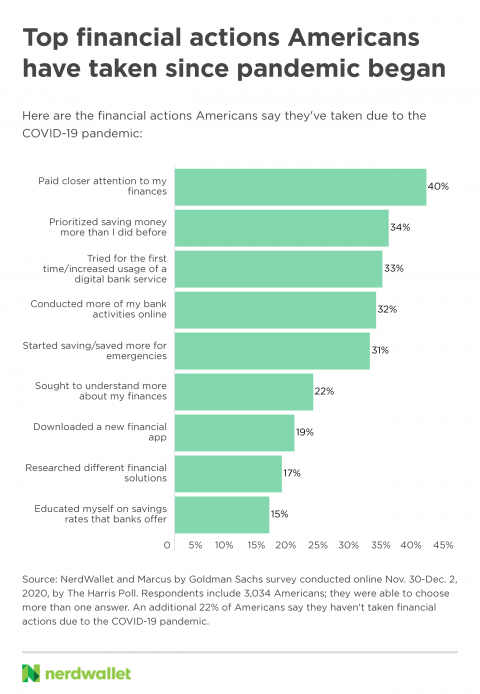
After a year of financial precariousness for so many, those who have the means may be setting 2021 money resolutions to get back on track. According to a new survey commissioned by NerdWallet and Marcus by Goldman Sachs and conducted online by The Harris Poll among over 3,000 U.S. adults, close to 4 in 5 Americans (78%) report that the pandemic spurred them to take financial action.
Here's how you can use these money moves to jump-start your 2021 goals.
1. Pay closer attention to finances
Two in 5 Americans (40%) say they’ve paid closer attention to their finances due to the pandemic — a good habit for everyone to get into, regardless of income. An eye-opening way to get started is to track every dollar you spend for one to three months. Once you’ve got a number, you can determine if that’s how much you want to be spending. Maybe you're spending exactly how you like on exactly what you like, but for many of us, budgeting can be the key to aligning our spending habits with our priorities.
Not sure where to start? The 50/30/20 budget is a smart and simple way to allocate your income to your expenses: 50% of your take-home pay for needs, 30% for wants and the final 20% for savings and debt repayment. This approach may not work for everyone — for instance, those in areas with a high cost of living may struggle to use only half of their income on needs — but it’s a good goal to work toward.
Annual Percentage Yield (APY) is accurate as of June 17th, 2025. Start earning 2.50% APY, then qualify to earn 5.00% APY on your balance up to $5,000.00 and 2.50% APY on balances over $5,000 next month by 1) Receiving direct deposit(s) totaling $1,000 or more; and 2) Ending the month with a positive balance in all your Varo Accounts. No fees, no minimums required. Rates subject to change at any time.
This offer is only valid for a new Premium Savings Account (“PSA”). The Promotional Annual Percentage Yield (“Promotional APY”) will be automatically applied to the account, and will remain effective for 180 days (the “Promotion Period”), after which it will automatically revert to the Standard Annual Percentage Yield (“Standard APY”) without requiring any action from you. Accounts must be opened by 5/20/26 to qualify for the Promotional APY. No minimum balance required, and the offer may be withdrawn at any time. Excludes non-U.S. residents, and residents of any jurisdiction where this offer is not valid. Other restrictions may apply. Please visit etrade.com/premiumsavings for more information.
These cash accounts combine services and features similar to checking, savings and/or investment accounts in one product. Cash management accounts are typically offered by non-bank financial institutions.
The Base Annual Percentage Yield (APY) is 3.30%, from program banks, is as of 1/30/26, is variable and is subject to change. If you are eligible for the overall boosted rate of 4.05% offered in connection with this promo, your boosted rate is also subject to change if the base rate decreases during the three-month promotional period. This limited-time promo offers eligible new Wealthfront clients a 0.75% APY increase over the variable base APY for 3 months on up to $150k in their Cash Accounts. Cash Account offered by Wealthfront Brokerage LLC, Member FINRA/SIPC, and is not a bank. Base APY (is representative, subject to change, requires no minimum) is paid from our Program Banks. Individual experiences and outcomes will differ.
Cash Reserve offered by Betterment LLC and requires a Betterment Securities brokerage account. Betterment is not a bank. Learn More (https://www.betterment.com/cash-portfolio). Annual percentage yield (variable) is 3.25% as of 12/12/25, plus a 0.65% boost (“APY Boost”) for new clients with a qualifying deposit. $10 min deposit for base APY. Terms apply (betterment.com/boost); if the base APY changes, the Boosted APY will change. FDIC insurance provided by Program Banks (https://www.betterment.com/cash-portfolio), subject to certain conditions.
CDs (certificates of deposit) are a type of savings account with a fixed rate and term, and usually have higher interest rates than regular savings accounts.
All Bread Savings APYs are accurate as of 04/09/2026. APYs are subject to change at any time without notice. Offers apply to personal accounts only. Fees may reduce earnings. To open a CD, a minimum of $1,500 is required and must be deposited in a single transaction. A penalty will be imposed for early withdrawals on CDs. At maturity, your CD will automatically renew and earn the base interest rate in effect at that time. Rates are compared against competitor rates published by NerdWallet.com and the institutions themselves as of 04/09/2026. NerdWallet.com obtains the data from the various banks that it tracks and its accuracy cannot be guaranteed.
Annual Percentage Yield (APY) is subject to change at any time without notice. Offer applies to personal non-IRA accounts only. Fees may reduce earnings. For CD accounts, a penalty may be imposed for early withdrawals. After maturity, if your CD rolls over, you will earn the offered rate of interest in effect at that time. Visit synchrony.com/banking for current rates, terms and account requirements. Member FDIC.
Annual Percentage Yield (APY). APY may change at any time and fees may reduce earnings. Please visit etrade.com/ratesheet for more information. The $15 monthly account fee can be waived when you maintain an average monthly balance of at least $5,000 in the account on or after the end of the second calendar month from opening the account.
The pandemic led 33% of Americans to try a digital banking service for the first time or increase their usage of digital banking services and 32% of Americans to conduct more of their bank activities online. In addition to saving time and energy, banking online allows customers to reduce the risk of exposure to COVID-19 by avoiding physical bank branches.
Online-only banks aren’t the only ones that offer online services. Many brick-and-mortar banks have apps and websites that allow customers to do most, if not all, of their banking from their computer or phone.
Concerned about security? Avoid unsecured Wi-Fi networks when logging in to your bank accounts, use two-factor authentication and make sure the online bank monitors for fraudulent activity.
If you opt to switch to a more tech-savvy bank this year, look for one with low or no fees and high interest rates. As rates are currently near historic lows, you may not find something game-changing; however, past trends indicate that they'll go back up as the economy recovers. Rates offered by online banks in particular tend to be higher than the current national average savings rate. (The Federal Deposit Insurance Corp. defines the "national rate" as a simple average of rates paid by U.S. depository institutions as calculated by the FDIC.)
3. Prioritize savings when you’re able
Over a third of Americans (34%) say they’ve prioritized saving money more than they did before the pandemic, and 31% of Americans say the pandemic caused them to start saving or save more for emergencies since its onset. In fact, according to a recent consumer sentiment survey from Marcus by Goldman Sachs, compared to their current behavior, more than a third (34%) of Americans think they will save more during the next six months.
Whether you have a specific goal, like a down payment on a home or a sturdier emergency fund, or you just want to give yourself options in the future, consistently saving money is a good practice. Not only does it help you reach a goal, but it also means you’re spending less than you make, so you’ll be better able to handle an unexpected hit to your finances.
You can use the 50/30/20 budget to figure out how much money you can allocate toward your goal, taking into account your debt payoff plans. For short- to medium-term savings goals, a savings account could be the ideal place to store your cash. Investing money for shorter-term goals carries much more risk, so while growth will be slower in a savings account, your money will be there when you need it.
If your goal is saving up an emergency fund as a bulwark against financial turmoil down the road, a good strategy is to work toward setting aside three to six months’ worth of expenses. Start small: Aim to save $500 or $1,000 first and then go from there. It may take several years to get up to a half year’s worth of expenses in your account, and that’s OK. Save consistently and consider allocating windfalls — like tax refunds or rebates — toward hitting your emergency fund goal even sooner.
The Consumer Sentiment Survey was conducted by Marcus by Goldman Sachs in December 2020 among 1,502 Americans.