











AI chatbots are finding new professions every day — they’re coders, therapists, boyfriends and now, maybe even financial advisors. According to a new NerdWallet survey, more than a quarter of Americans (26%) say they’ve used an AI chatbot to find answers to personal finance questions. About half of those users (49%) say they asked AI a money question in the past week.
While AI chatbots are a helpful tool for learning more about personal finance, it can be risky to take their advice: Of Americans who have acted on personal finance advice provided by an AI chatbot, about 3 in 10 (29%) say it hurt their financial situation. This isn’t to say that’s always the case: 39% say it helped their financial situation.
Our take? It’s nuanced. AI chatbots aren’t all good or all bad for financial advice. They make financial knowledge more accessible, which could lead a lot more people to make smart money moves. But their overconfidence and lack of discernment could be costing Americans real money by following iffy advice. And finances are one area that most of us can’t afford to get wrong.
The survey, conducted online by The Harris Poll, asked more than 2,000 Americans — among whom 496 have used an AI chatbot for personal finance questions — about their AI usage when it comes to personal finance. We found Americans’ opinions are split on whether AI can give them solid money advice, and some users are doing a little too much oversharing.
Key findings
Some opt for AI because it’s not going to judge. Of Americans who have used an AI chatbot for personal finance questions, 28% cite wanting a non-judgmental response as a reason why and 12% say they were embarrassed to ask a real person.
Half of Americans doubt AI chatbots’ financial savviness. Americans are split on whether they’d trust AI chatbots to give them good personal finance advice — 45% say yes, 55% say no.
Social Security numbers are entering the chat. Around three-quarters of Americans who have used an AI chatbot for personal finance questions (77%) have shared some sort of personal information. While some of this is innocuous, some is definitely not — 9% shared their Social Security number and 10% shared account numbers with a chatbot.
Some are quick on the draw with AI advice. One in five Americans who have followed personal finance advice from an AI chatbot (20%) took action right away — without follow-up questions, additional research or human input.
“When it comes to asking general financial questions, running calculations or getting a second opinion, AI chatbots can provide real value. But they fall short when it comes to customized advice on complex topics that require layers of context,” says Kimberly Palmer, personal finance expert at NerdWallet.
Fast answers, sans judgment
People may turn to AI for personal finance advice for all sorts of reasons. According to the survey, the top reason cited by AI chatbot users is they wanted a quick answer (50%), followed by wanting to avoid searching through multiple websites (35%).
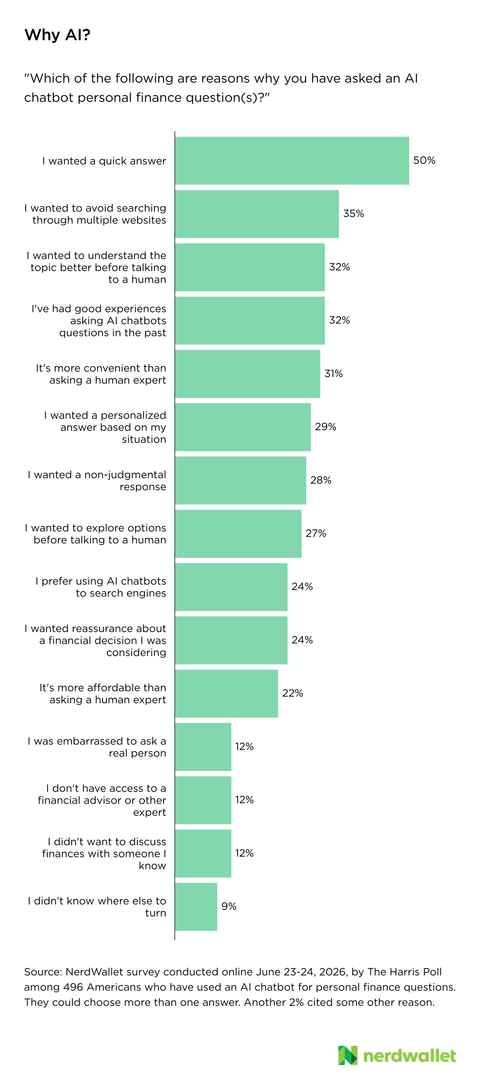
Nearly 3 in 10 Americans who have used AI for personal finance advice (28%) say it’s because they wanted a non-judgmental response and 12% were embarrassed to ask a real person. This may suggest that some people have had bad experiences seeking out money advice in the past. Now, they’re trying to avoid that by forgoing human input.
Some also cited obstacles to human expertise: 22% of Americans who have used AI chatbots for personal finance advice say it’s more affordable than asking a human expert and 12% say they don’t have access to a financial advisor or other expert. For people who can’t afford an advisor or lack access to human help, AI isn’t just a quick answer — it may be the only financial advice they’re getting at all, for better or worse.
Good advice, but not always
A quarter of Americans who have used AI chatbots for personal finance advice (25%) have reported receiving helpful and accurate advice when asking a question, according to the survey.
On the flip side, around 1 in 10 Americans who have asked an AI chatbot personal finance questions (9%) report receiving inaccurate information. This might happen if the chatbot pulls from an inaccurate or outdated source, or if it experiences a hallucination. (A hallucination is information generated by AI that’s incorrect, misleading or fabricated by the chatbot.) Inaccuracies might also happen if the AI chatbot doesn’t have an accurate picture of your situation.
“When I turned to ChatGPT for advice on college savings, I got a helpful chart with suggested monthly targets. What was missing, though, was how to balance these numbers against my other expenses, like retirement,” Palmer says.
Since there’s no one-size-fits-all model for how to save for college, Palmer found the chatbot helpful for general ideas, but less so for making a plan specific to her situation. “A chatbot couldn’t give me answers about how much exactly to save for college. What I really needed was to talk through my priorities with family members and others who understand where I’m coming from,” she adds.
Oversharing personal info is risky business
More than three-quarters of Americans who have used an AI chatbot for personal finance advice (77%) say they’ve shared some sort of personal information with the chatbot, according to the survey. In some cases, this can actually help you get more accurately-tailored advice.
For example, sharing your credit score — which 38% say they’ve done — could help the chatbot direct you to a financial product you’re likely to get approved for. Sharing debt balances and interest rates — which 27% and 34% have shared, respectively — can help the chatbot create a personalized debt payoff plan.
However, oversharing can be a risk. According to the survey, 9% of Americans who have asked an AI chatbot personal finance questions have shared their Social Security number with a chatbot and around the same proportion (10%) have shared account numbers. Some have shared bank or credit card statements (15%) or health insurance documentation (14%), both of which may contain highly sensitive information.
“Just as we wouldn’t post our personal details online, we also don’t want to enter identifying numbers or passwords into a chatbot that could turn around and use that information elsewhere,” Palmer says. Sometimes you can adjust your privacy settings on the chatbot — like opting out of automatic data-sharing and not letting the chatbot use your chats for training purposes — she adds.
Oversharing isn’t the only potential risk with seeking out advice from chatbots. Around 1 in 7 Americans who have asked an AI chatbot personal finance questions (14%) say they followed a link provided by a chatbot that seemed suspicious or misleading. A good rule of thumb is to treat chat links with the same caution you use for links in your work inbox.
Acting too fast can be a costly mistake
More than a quarter of Americans who have used an AI chatbot for personal finance questions (27%) have acted on money advice given to them by a chatbot, according to the survey. That’s not necessarily a bad thing, but it shouldn’t be a first step.
When asked about the most recent time they acted on personal finance advice from an AI chatbot, 20% say they acted on it right away after receiving the advice. Others took at least one other step first:
36% asked the chatbot follow-up questions.
29% did additional research online.
9% talked to a financial advisor about it.
5% talked to another trusted person about it.
Of those who acted on personal finance advice provided by an AI chatbot, results were mixed on how it impacted their finances this most recent time. While nearly 2 in 5 (39%) say it improved their financial situation, another 29% say it hurt their finances and 32% say it had no impact. AI advice can be useful, and it can meaningfully improve your money situation when used correctly. But since that’s not always the case, and the stakes are high, it’s smart to proceed with caution.
Best practices when using AI for personal finance advice
Use AI as a starting point, but verify with a person. About a third of Americans who have used an AI chatbot for personal finance questions (33%) say they trust AI chatbots more for basic personal finance questions than complex ones. For straightforward questions — like “what’s umbrella insurance?” and “how much will my savings grow at X% interest rate with $XX contributed per month?” — an AI chatbot is probably sufficient. It can also be a good tool to start learning about a topic before taking it to the professionals.
But for anything that could truly impact your financial life, verify with a trusted person or source. That could be a financial advisor, a savvy friend or family member, or a reliable financial news source. This isn’t to say you have to accept money advice with a side of judgment — get help from someone with empathy who’s willing to meet you where you’re at in your financial journey.
Do your due diligence before acting. About half of Americans (49%) don’t feel confident evaluating whether personal finance advice from an AI chatbot is accurate. And that’s OK. It’s good to recognize that limitation so you aren’t relying on your own discernment in this area. That’s particularly true for more complex and high-stakes personal finance questions around investing, insurance and taxes.
Share context, but be stingy with sensitive information. Around three-quarters of Americans (76%) say they’re concerned about sharing sensitive personal finance information with an AI chatbot, but many have done it anyway. While it may be useful to share general information for context — like income and debt balances — never share account numbers, your home address and Social Security number for safety.
Stay skeptical. Less than half of Americans (45%) say they’d trust AI chatbots to give them good personal finance advice. The truth is, you can get a lot of good information from chatbots. But since they have a reputation for unearned confidence, ask follow-up questions and push back. AI can be a useful financial tool, but it shouldn’t have the final word on your money decisions.
“Just like you might ask an AI chatbot questions to prepare for a doctor’s appointment, turning to AI for financial questions can build your background knowledge on a topic or help you consider different financial strategies. What it can’t do is make a decision for you or understand the many layers of context that go into your money choices,” Palmer says.
Cite as NerdWallet (2026). “Data: Americans Are Using Chatbots for Financial Advice. Risky or Rewarding?” Retrieved from https://www.nerdwallet.com/finance/studies/using-ai-for-personal-finances
Methodology
The AI Chatbot survey was conducted online by The Harris Poll on behalf of NerdWallet from June 23-24, 2026, among 2,003 U.S. adults ages 18 and older, among whom 496 have used an AI chatbot for personal finance questions. The sampling precision of Harris online polls is measured by using a Bayesian credible interval. For this study, the sample data is accurate to within +/- 2.7 percentage points using a 95% confidence level. This credible interval will be wider among subsets of the surveyed population of interest. For complete survey methodology, including weighting variables and subgroup sample sizes, please contact [email protected].
Disclaimer
NerdWallet disclaims, expressly and impliedly, all warranties of any kind, including those of merchantability and fitness for a particular purpose or whether the article’s information is accurate, reliable or free of errors. Use or reliance on this information is at your own risk, and its completeness and accuracy are not guaranteed. The contents in this article should not be relied upon or associated with the future performance of NerdWallet or any of its affiliates or subsidiaries. Statements that are not historical facts are forward-looking statements that involve risks and uncertainties as indicated by words such as “believes,” “expects,” “estimates,” “may,” “will,” “should” or “anticipates” or similar expressions. These forward-looking statements may materially differ from NerdWallet’s presentation of information to analysts and its actual operational and financial results.