


E*TRADE and Fidelity are legacy brokers whose platforms appeal to both casual and active investors. But no two brokers are exactly the same. Here’s how they compete on user experience, fees, investment selection and more.
How the user experience compares
I’ll be honest: Fidelity is my daily driver when it comes to investing. My 401(k) is through Fidelity, which made setting up an IRA and a brokerage account convenient, as I like seeing all my investments in one place.
However, I went into my research with an open mind. And after lots of hands-on testing, I found that E*TRADE and Fidelity are more similar than I thought, but Fidelity remains king when it comes to ease of use.
I focused my research on the brokers’ mobile apps, where I do most of my trading. The main issue I faced with E*TRADE was figuring out how to even fund my account. I had to navigate to Menu → Pay & Transfer → Transfer Money to get the process started. What should have been a simple task felt buried and overcomplicated.
On the other hand, Fidelity makes things easy: There’s a dollar sign in the bottom navigation bar, where you can transfer money from external accounts, place trades, automate investments and more. It’s all very intuitive.
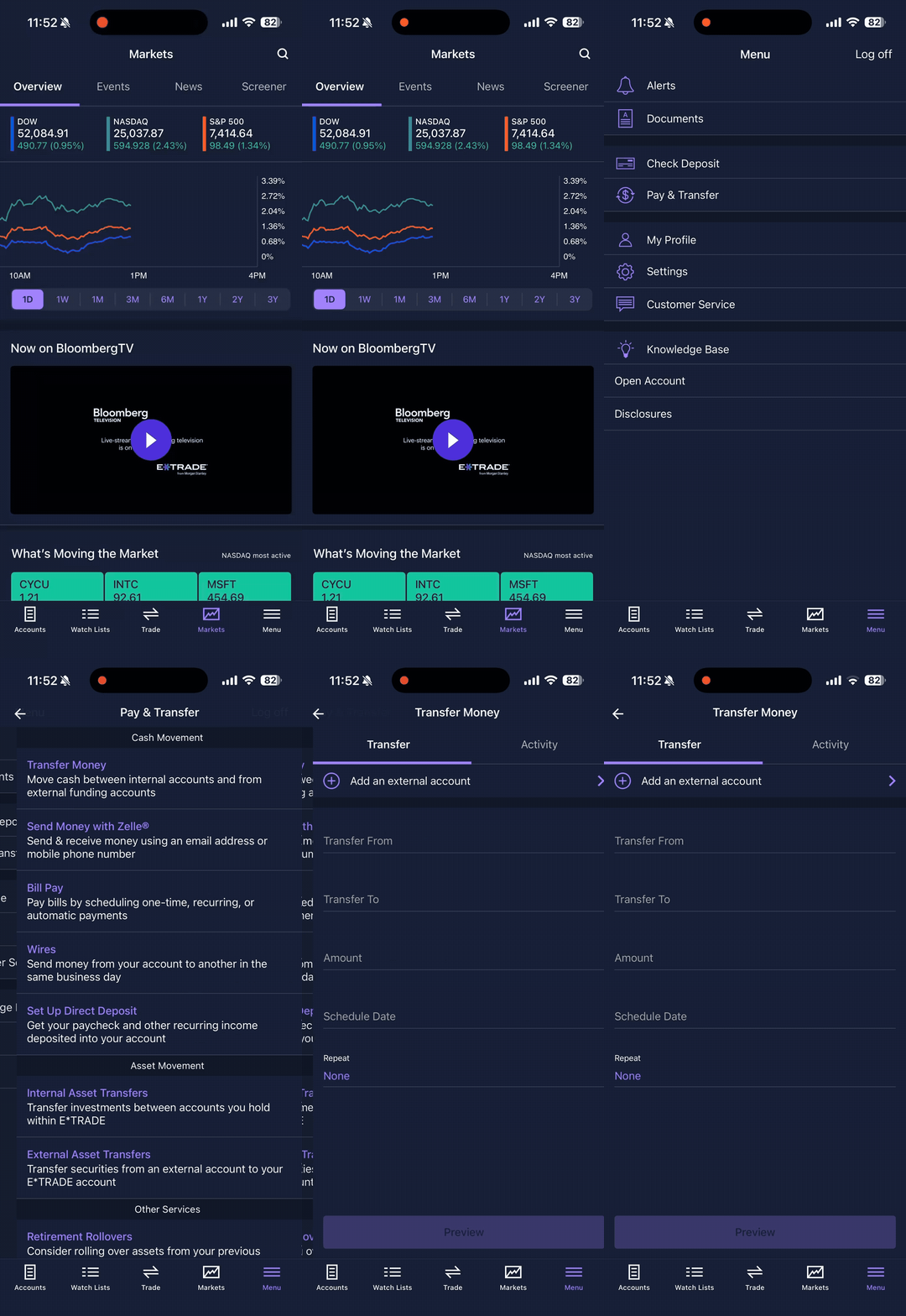
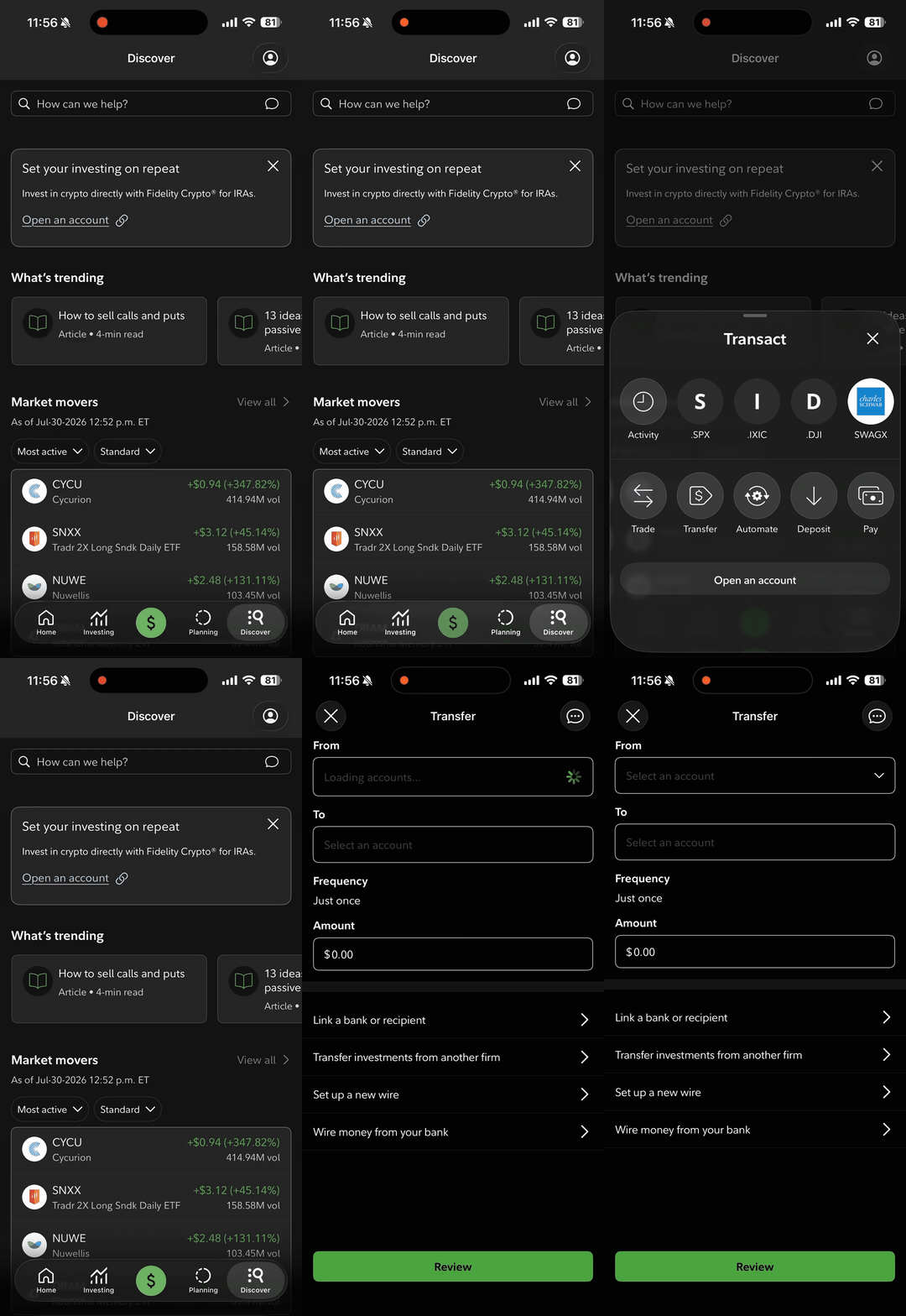
Outside of that, the apps have a similar feel. The home screens show the basics: an overview of how big stock indexes are performing and your overall portfolio balance.
The trading sections of each app are fairly similar, too, but Fidelity has a slight edge over E*TRADE: the design is cleaner, and I found buying fractional shares to be simpler. E*TRADE prompts you to enter a decimal input instead of a simple dollar amount, and while there’s a calculator that does the conversion for you, I still found it to be more steps than necessary.
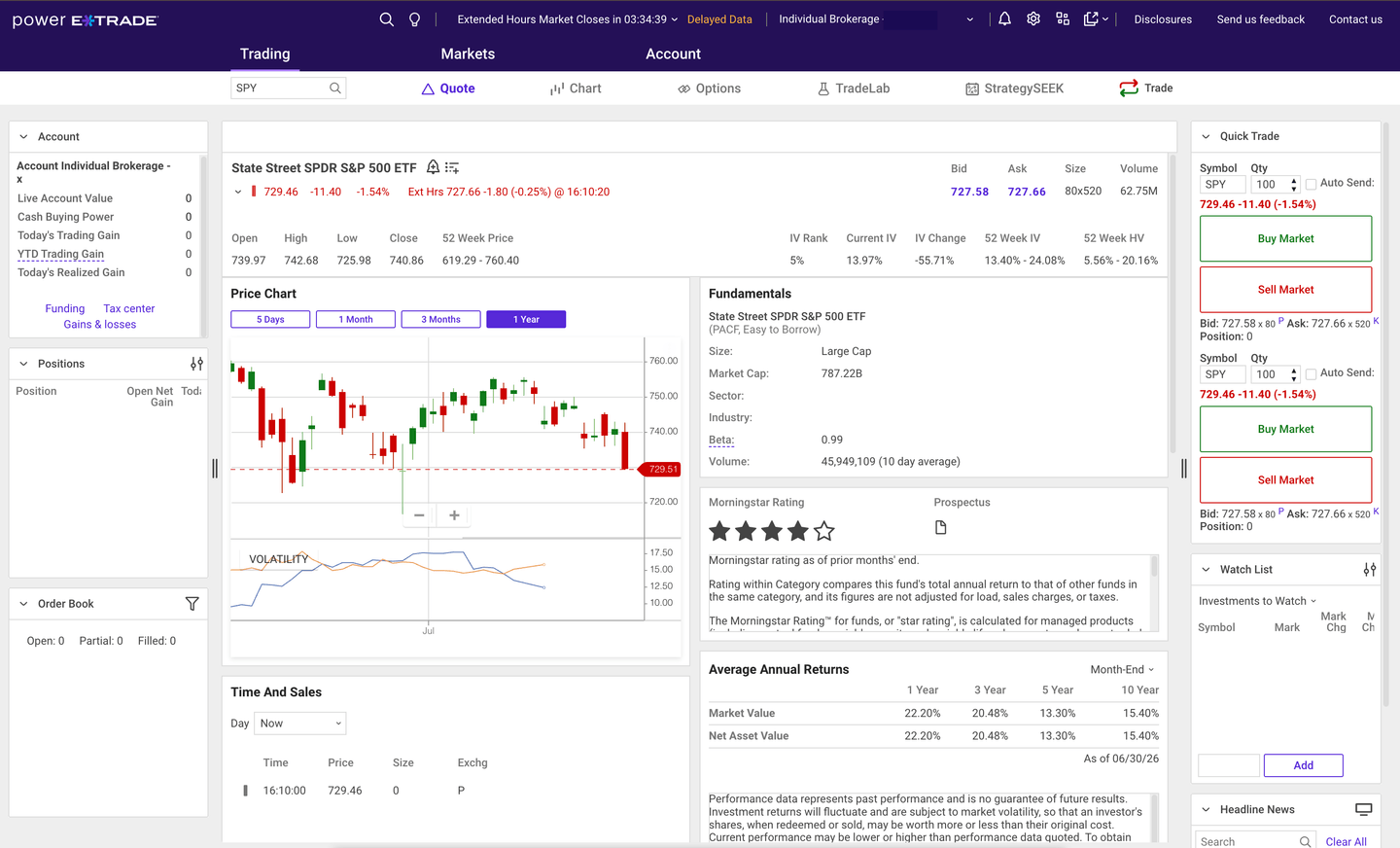
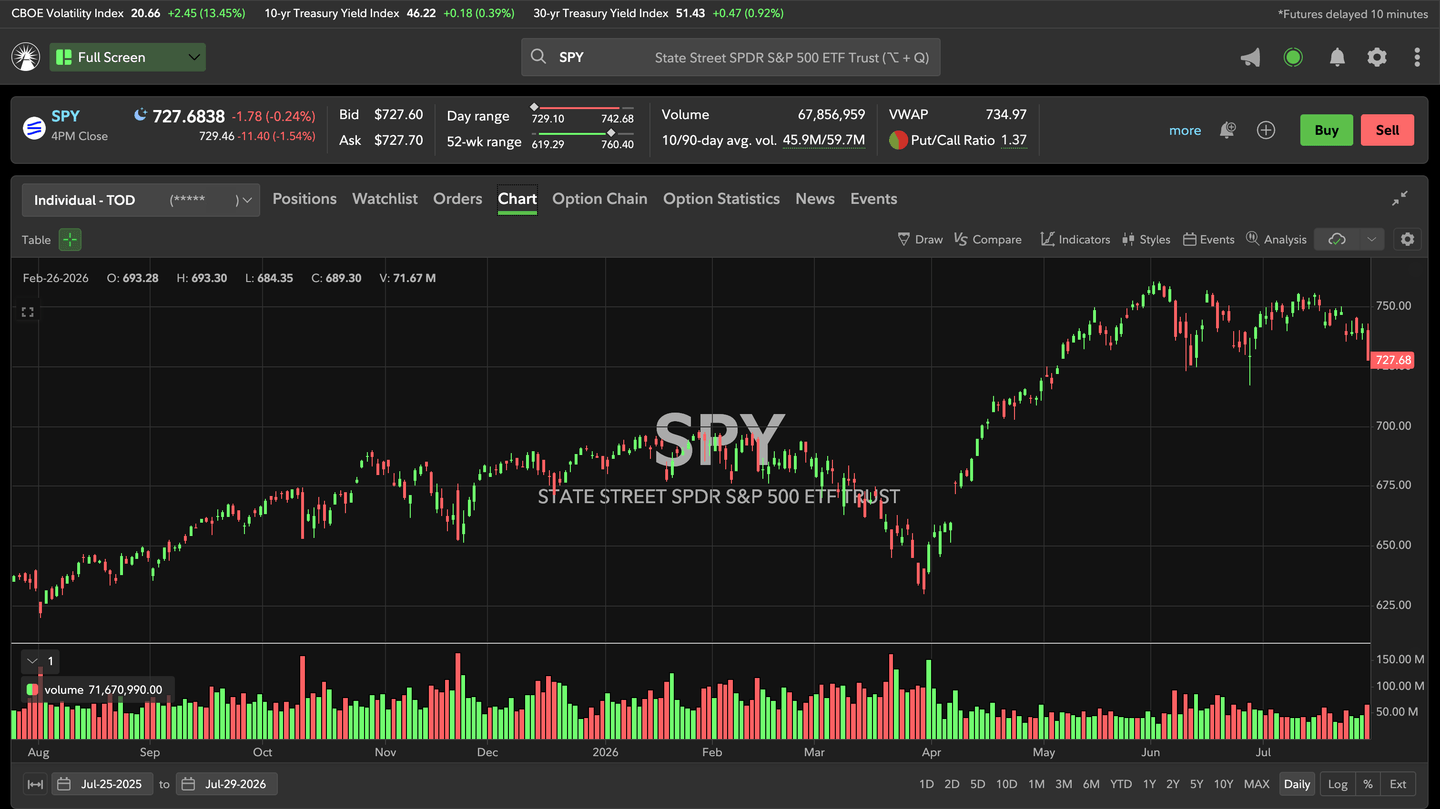
As I mentioned, I tend to stick with the apps, but I did shift over to the browser experience when testing Power E*TRADE and Fidelity Trader+. These are the brokers’ more complex versions of their platforms geared toward active traders.
If active trading is the core of your investing strategy, you may also want to consider a platform like Interactive Brokers, which came out on top when we evaluated brokers for day trading.
Where the brokers differ most
While the user experience isn’t identical, it’s unlikely that anything I’ve written about thus far has been a deal-breaker. So how do the brokers really differ?
Interest rate on uninvested cash: E*TRADE’s 0.01% interest rate on uninvested cash leaves something to be desired, and that rate only ticks up slightly for balances over $500,000. With Fidelity, however, you can have any uninvested cash swept into the broker’s SPAXX fund, which has a yield of over 3% at the time of writing.
Investment selection: E*TRADE offers a wide selection of about 6,000 no-transaction-fee mutual funds. Fidelity only offers about half that number, and mutual funds that do carry a fee will run you about $50. Where Fidelity has an advantage is customizable portfolios — something E*TRADE doesn’t offer.
Paper trading: Paper trading is a simulated investing experience for beginners, where you can learn to trade using fake money. Nearly half of the brokers we review offer this feature, and you may be surprised to learn that Fidelity isn’t among them. Conversely, Power E*TRADE users get up to $100,000 in virtual money to paper trade stocks, ETFs and options.
Fees $0per trade for online U.S. stocks and ETFs | Fees $0per trade. Other fees apply. |
Account minimum $0 | Account minimum $0 |
Promotion Noneno promotion available at this time | Promotion Get up to $1,500when you open and fund an E*TRADE brokerage account. Terms apply. |


More about trading with each broker
Tradable securities: Both brokers offer access to stocks, mutual funds, ETFs, options, bonds and crypto. Where they differ: E*TRADE offers access to futures, while Fidelity offers access to fixed income securities and precious metals.
Research and data: If you’re more than a casual trader, you may want access to as much research as possible. Fidelity takes the cake here, offering data from 19 different providers, compared with E*TRADE’s nine.
Compare fees and other costs
Neither Fidelity nor E*TRADE requires a minimum balance, and their fees are almost identical: they charge no annual, inactivity, closing or online stock trading fees. As of this writing, they also both charge $0.65 per options contract, but E*TRADE’s fee drops to $0.50 per contract if you place at least 30 trades per quarter.
How their customer service stacks up
Fidelity scores 5 stars for its customer support, offering a wide variety of contact methods — phone, email, chat, over social media or at a physical branch — some of which are available around the clock.
E*TRADE doesn’t trail far behind, scoring 4 stars for its customer service. They also offer 24/7 phone support and live chat during the week from 8 a.m. to 8 p.m. EST.
Methodology
How do we review brokers?
All NerdWallet reviews and lists of the best investing products are created by our editorial team of full-time writers and editors, independent of any business relationships. In this case, our investing team's comprehensive review process evaluates and ranks the largest U.S. brokers by assets under management, along with emerging industry players. Our aim is to provide an independent, balanced assessment of brokerages to help arm you with information to make sound, informed judgments on which ones will best meet your needs. Our highest priority is maintaining editorial integrity.
We collect data directly from brokerages through detailed questionnaires and conduct first-hand testing and observation through demonstrations. The questionnaire answers, combined with demonstrations, interviews of personnel at the brokerages and our specialists’ hands-on research, fuel our proprietary assessment process that scores each broker's performance across more than 20 factors. The final output produces star ratings from poor (one star) to excellent (five stars).
For more details about the categories considered when rating brokers and our process, read our full methodology.