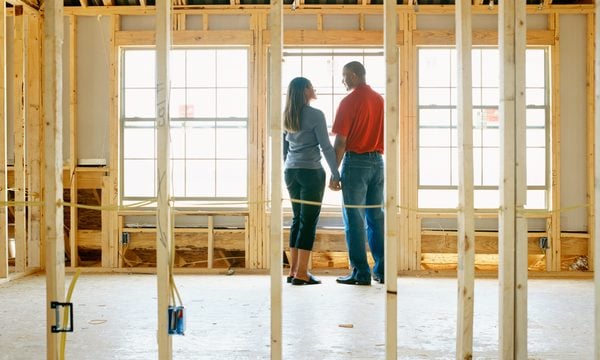



Building a house is a chance to create your ideal home, and a construction loan lays the foundation for making it happen. Here's how the different types of construction loans work, and how to choose a lender before breaking ground.
What is a construction loan?
Construction loans are temporary loans used to cover the cost of building or rehabilitating a house. The lender pays in installments as the work advances.
Once construction is complete, the loan is either converted into a permanent mortgage or paid in full. If the loan doesn’t automatically become a conventional mortgage, you may have to apply for a new loan.
How do construction loans work?
A construction loan can be used to finance a custom home — a house designed and built to your specifications — or to pay for a major renovation.
Construction loans to build a house
Disbursement of a construction loan happens in phases. Instead of transferring a lump sum, lenders pay the builder in installments, called "draws." Each draw coincides with an important phase of the project, such as pouring the foundation, framing and finishing work.
An inspection may be required before each draw is released to the builder, and the amount of that payment is based on the work completed, as noted in the inspection report.
Renovation loans to buy and repair fixer-uppers
The amount you can borrow for a renovation depends on an appraiser’s estimate of value once repairs and upgrades are finished. The lender needs to approve your contractor and renovation plans, and it pays the money in installments.
How is a construction loan different from a traditional mortgage?
Unlike traditional mortgages, a construction loan is a short-term financing solution. The term is usually one year, and you’ll only pay interest during construction. This differs from a traditional mortgage, where you make payments toward principal and interest right away.
Depending on the type of construction loan you get, you may need to put 20% down at closing, while conventional mortgage borrowers are only required to put 3% down.
Construction loan types
Construction-to-permanent loans
A construction-to-permanent loan converts to a permanent mortgage when building is complete. Also known as a single- or one-time close construction loan, it's a convenient option because you apply and pay closing costs only once.
Lenders may also offer a "float-down option," which would let you get a lower rate at closing if mortgage rates improved during construction.
Construction-only loans
A construction-only loan pays for the construction of the home and must be paid off when building is complete. The loans require the borrower to qualify, get approved and go through closing twice — once for the construction loan and once for the permanent mortgage.
Construction-only loans offer more flexibility because you can compare lenders to find the best deal on a construction loan and on a mortgage separately. The downside: You pay for two loan closings.
Renovation loans
Renovation loans are different from other kinds of construction loans because instead of building a whole new house, you use the financing to renovate a fixer-upper. With renovation construction loans, the cost of major renovations is wrapped into the mortgage. The loan is based on the home’s value after the renovation is completed.
Here are some low-down-payment renovation mortgage programs to consider:
HomeStyle loans are guaranteed by Fannie Mae, a government-sponsored enterprise, and have a minimum down payment requirement as low as 3%.
CHOICERenovation loans, guaranteed by Freddie Mac, also a government-sponsored enterprise, allow renovation costs up to 75% of the appraised value after the improvements are completed. Can be combined with Freddie Mac’s HomePossible and HomeOne loans, which have a 3% minimum down payment requirement.
FHA 203(k) loans, insured by the Federal Housing Administration, require a down payment as low as 3.5%.
USDA renovation loans, backed by the U.S. Department of Agriculture, are zero-down payment loans for low- to moderate-income borrowers in eligible rural areas. They are available through approved lenders.
The HomeStyle, CHOICERenovation and FHA 203(k) loans can also be used to refinance a current mortgage and include the costs of a remodeling project.
Owner-builder construction loan
An owner-builder loan is for someone who plans to build their own home and act as the general contractor. Borrowers need to have building experience to qualify, and not all construction lenders offer owner-builder loans.
What can you pay for with a construction loan?
Every project is different, but in general, a construction loan pays for:
Land
Plans, permits and fees
Labor and materials
Contingency reserves (in case the project costs more than estimated)
How to get a construction loan
Follow these steps to get a construction loan:
Review your finances
The minimum borrower requirements for a construction loan vary, but they tend to be stricter than for traditional mortgages. For example, HomeStyle borrowers need a minimum credit score of 620, while a credit score of at least 680 is needed to put down less than 25%.
Government-backed construction loan programs allow for smaller down payments — again, FHA 203(k) borrowers need just 3.5% down.
Shop around for lenders
Not every mortgage lender offers construction loans. NerdWallet’s list of the best construction loan lenders can be a great place to start your search.
Apply for prequalification
Before spending a lot of time and money on building plans, make sure to get prequalified.
Prequalification gives an idea of the amount and the terms of a loan that a lender will approve. There's no sense in getting deep into planning the project only to find out you don't qualify for financing.
Hire a builder
A mortgage is usually a transaction between a lender and a borrower, but construction loans add a third party to the mix: the builder. Everything hinges on your contractor’s ability to complete the construction plans on time and within budget, so hire carefully.
Seek preapproval
For preapproval, you'll provide more documentation about your finances, such as W-2 forms, bank statements and tax returns, as well as details about the project.
A lender may request your builder’s work history and proof of insurance, blueprints, specifications, a materials list, a detailed budget and a signed construction contract that includes start and finish dates.
Finalize your loan approval
Choose the lender that offers the lowest rates and fees and best service, and then move forward for final approval. During underwriting, respond quickly to any lender inquiries to keep the process moving smoothly.
NerdWallet writer Isabella Angelos contributed to this story.