Years ago, airline loyalty programs published fixed award charts and members could easily accumulate miles toward a fixed goal — whether that was a free flight to Hawaii or to Europe.
Nowadays, award flight pricing is far less predictable. Every major U.S. airline now prices award flights within a range of published award rates, dynamically based on expected demand or completely based on the cash cost of the flight. A growing number of airlines have even eliminated award charts entirely.
How many miles you need for a free flight is going to depend on the airline and which aspects it factors into award pricing. Let's dig into each airline's current award pricing policies so you can know how many miles you may need for your next award flight.
If you're looking for info on a specific airline, feel free to jump ahead:
» Learn more: An overview of airline award charts

By signing up, you will receive newsletters and promotional content and agree to our Terms of Use and acknowledge the data practices in our Privacy Policy. You may unsubscribe at any time.
American Airlines
American Airlines is one of the few U.S. airline loyalty programs that still publishes an award chart. However, American rarely sticks to these published award rates. Instead, it has implemented a dynamic award pricing system through the use of Web Special awards.
If your dates are flexible and you don't mind making a stop, you can currently book an American Airlines award flight for as few as 6,000 AAdvantage miles each way. However, if you want to fly nonstop, be prepared to pay a lot more miles.
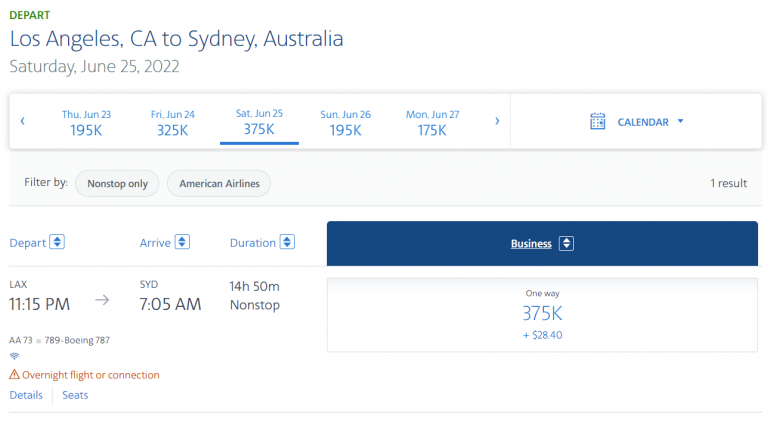
Award prices can climb way off the award chart to book a business or first class award on a popular international route. For example, American's award chart prices business class awards between the U.S. and the South Pacific between 80,000 and 195,000 miles. However, American Airlines currently charges as much as 375,000 miles each way to book a nonstop business class award from Los Angeles to Sydney:
» Learn more: The complete guide to redeeming American Airlines miles
Delta Air Lines
Back in 2015, Delta Air Lines eliminated all of its award charts. Now, how many miles you need for a free flight on Delta depends completely on what Delta wants to charge.
For routes where Delta wants to compete, you can find surprisingly low award rates. For example, flights between Seattle and San Francisco cost as few as 2,500 SkyMiles each way. Even first class awards from Seattle to Cancun can price as low as 10,000 SkyMiles one-way.
» Learn more: Your guide to earning Delta Air Lines SkyMiles
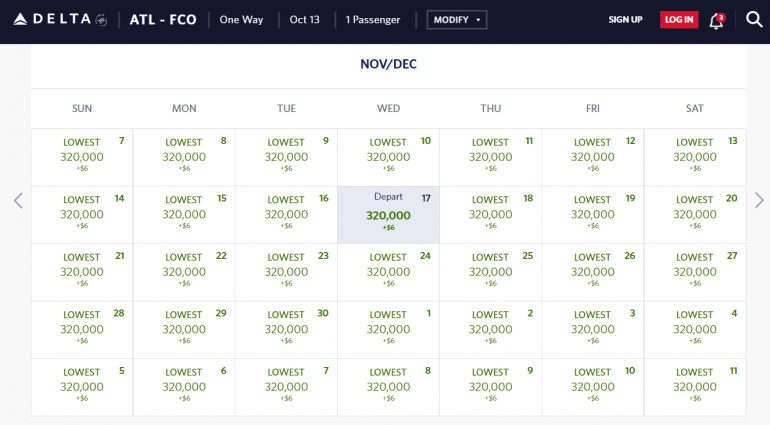
As with American, award rates can quickly climb into the six digits, especially for nonstop and premium cabin awards. For example, Delta regularly charges 320,000 SkyMiles one-way to book a nonstop flight between Atlanta and Rome in Delta One business class.
United Airlines
Like Delta, United Airlines no longer publishes an award chart. However, United generally offers much more predictable award pricing, for better and worse.
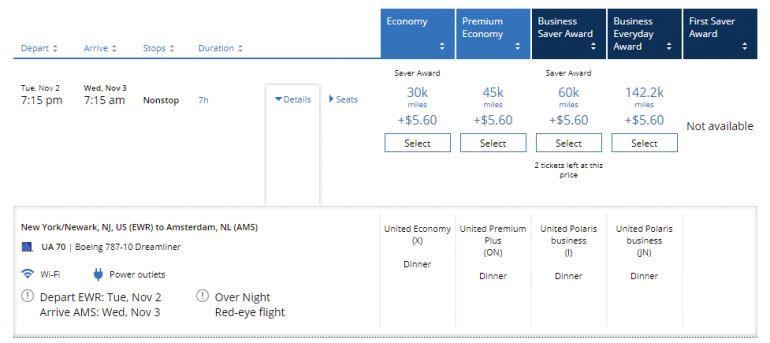
United award prices generally mirror the old award chart. For example, United award flights to Europe generally cost 30,000 miles each way in economy, 45,000 miles in premium economy or 60,000 miles in business class:
However, now that United doesn't publish an award chart, the airline is free to offer much-cheaper awards. For example, as of the time of writing, you can book an award between Newark and West Palm Beach for just 5,000 miles each way or fly from Los Angeles and Honolulu, Hawaii for just 9,500 miles each way.
» Learn more: The complete guide to United MileagePlus
However, you'll want to book in advance. United generally charges a mileage surcharge for awards booked within 21 days of departure. Last-minute awards booked within 7 days of departure can price even higher.
Southwest Airlines
Southwest uses a fare-based award pricing model. To calculate how many points you need for a free flight on Southwest, multiply the base fare for a cash flight by 81-83 points.
For example, a $39 one-way intra-Hawaii fare with a base fare of $27 requires just 2,240 points plus a $5.60 security fee. But, if you can find a flight with lower base fare, it would require even fewer points to book.
» Learn more: Your guide to booking award flights on Southwest
The downside with this fare-based pricing model is that there's no cap on how high award prices can go. For better or worse, there aren't "sweet spots" of the Southwest program. Your Rapid Rewards points have a fairly set value.
Alaska Airlines and Hawaiian Airlines (Atmos Rewards)
Compared to other U.S.-based mileage programs, how many miles you need for a free flight on Alaska Airlines and Hawaiian Airlines is a bit more predictable. The two programs share a joint loyalty program, Atmos Rewards, which uses an award chart that lists minimum award prices.
For domestic flights and flights to Canada, Mexico and the Caribbean, Atmos Rewards' award pricing depends on how far and in which cabin you fly. However, within each distance band, award prices can vary significantly.
Award flights under 700 miles in distance start at just 5,000 points each way.
Coast-to-coast award flights price as low as 12,500 Atmos points each way in economy or 30,000 miles in first class.
For flights to Hawaii, Atmos prices them starting at 15,000 points, and first class awards start from 40,000 points each way.
JetBlue Airways
JetBlue uses variable award pricing that's tied to the cash price of the ticket. As with Southwest, that means that there's no limit to how cheap JetBlue award flights can go. We've even seen JetBlue price awards as low as 400 TrueBlue points one-way during a recent flash sale. However, you'll typically need to pay at least 2,800 points for the cheapest fares.
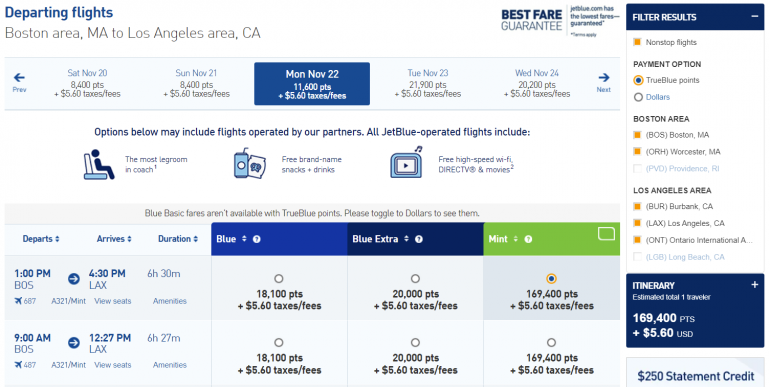
The downside of revenue-based pricing is that awards are very expensive when cash prices are very expensive. For example, during high-demand times, JetBlue's Mint business class can cost over 169,000 TrueBlue points each way.
How to maximize your rewards
You want a travel credit card that prioritizes what’s important to you. Here are some of the best travel credit cards of 2026:
Flexibility, point transfers and a large bonus: Chase Sapphire Preferred® Card
No annual fee: Wells Fargo Autograph® Card
Flat-rate travel rewards: Capital One Venture Rewards Credit Card
Bonus travel rewards and high-end perks: Chase Sapphire Reserve®
Luxury perks: American Express Platinum Card®
Business travelers: Ink Business Preferred® Credit Card