








A certificate of deposit, or CD, is a type of savings account that locks up your money for a period of several months or years. Rates on CDs can be higher than what regular savings accounts offer.
You’d want to consider a CD if you want to boost your return for a few short-term savings goals — and you don’t need to withdraw early.
Overview of how CDs work:
FDIC-insured funds: CDs are federally insured bank accounts, so your money is safe (up to FDIC limits) even if a bank goes bankrupt.
Fixed rate: A CD’s unique advantage is its fixed rate, especially to lock in high yields. A regular savings account rate is subject to change at will.
Fixed term: CD terms typically range from three months to five years, so be sure you can commit to a CD.
Early withdrawal penalty: If you withdraw early, there’s nearly always a penalty that can wipe some or all of the interest earned.
» COMPARE: See the best CD rates
When CDs work best: Certain short-term savings goals
CDs are supplemental savings accounts for money you won’t need for a predetermined period. In fact, you can’t add money to a CD over time; the full amount intended for a CD is required when you open it. And you can’t withdraw early without paying a penalty (with one exception explained later).
Three notable use cases for CDs, in order of most to least helpful, include:
Locking up savings for a big, near-future purchase. You want to set aside a lump sum you’ve already saved for a big purchase within five years, such as a car or down payment on a house. Other goals could be a wedding, a child’s education, or a move to a new city.
Getting guaranteed returns without market risk. CDs’ fixed rates mean you can estimate your full return ahead of time and not worry about its value fluctuating like a stock does. Ideally, your rate can beat inflation. Preserving funds near or in retirement can make CDs appealing.
Keeping a big sum at a distance. A CD can work as a short-term cash storage unit, especially for an inheritance or other type of windfall. The goal is to separate the funds from your everyday savings so you’re not tempted to spend it.
What CDs aren’t for: Cash access or long-term growth
CDs don’t offer access to your cash, so they aren’t the place for your everyday or emergency funds. If you’re building (or rebuilding) your savings, a regular savings account is the clear option. See the best high-yield savings accounts.
CDs don’t outperform long-term investments. The highest CD rates in the past decade occurred between late 2023 and early 2024 when one-year CDs were around 5.50% and five-year CDs were around 4.50%, according to NerdWallet data. But that’s at their peak. In contrast, the S&P 500 Index’s average stock market return is closer to 10% a year. Inflation cuts into returns for both CDs and the stock market, but long-term market returns have tax advantages. CD interest is taxed as ordinary income.
High CD rates remain
The Fed raised its benchmark rate in September for the first time since 2023, but CD rates had already been climbing for months. More increases have followed so it’s worth watching CD rates.
Tips for choosing the amount in CDs: Find the sweet spot
Unlike regular savings accounts, the first deposit you make into a CD is typically the only time you add money. You need to make it count.
Go beyond a CD’s minimum. The typical minimum deposit for a CD is $1,000, but CDs with the most competitive yields tend to have minimums from $0 to $10,000.
Estimate your return to know if it’s worth it. Use a CD calculator and plug in the deposit amount, rate, and term. How much interest is locking up your money worth to you? For example, a one-year CD with $1,000 at a 4% rate earns $40, so that might be hard to justify. But $10,000 in that scenario earns $400.
Don’t focus on rate tiers at a bank. Some providers offer higher rates when your deposit meets a certain amount, such as $10,000 or $100,000. If you belong to a bank with CD rate tiers, make sure it’s a good deal and avoid putting in more money than you mean to.
Heed FDIC limits. All your money at a bank is federally insured up to $250,000 for single account owners, and double that for joint accounts. Consider multiple CDs or brokered CDs (explained below) if you want to keep all your funds insured.
» Learn more: How much money should you put into CDs?
Tips for picking a CD term and rate: Narrow down, compare
Once you’re looking at CDs, narrow down the CD term and then compare by rate.
Start comparing CDs by common terms. It’s easier to see a good deal when you can scan a list of rates for the same term. No math required. The most common terms, in order, are one-year, three-year, two-year, six-month, and five-year CDs, according to a NerdWallet analysis of 50 CD providers in June 2026.
Skip CD terms longer than five years. Six-year, seven-year and 10-year terms are rare, and their rates don’t tend to be better than shorter terms. Plus, CDs are meant for goals within five years.
Factor in the current trend: Short-term CDs have the highest yields. NerdWallet traces this trend’s beginning to November 2022, and it upends the traditional way CD rates work. Banks typically reward customers with higher rates on longer terms. But some economic factors, such as the anticipated direction of the Fed’s rate, play a big role in how banks determine CD rates.
Be careful with CDs shorter than one year: They don’t get a “full” return. Banks use annual percentage yields, or APYs, to describe interest rates for savings accounts and CDs. This is a good thing: APY is a standardized way to see what you’d earn for one year, including compound interest. But a CD shorter than one year doesn’t have an annual return.
» Learn more: How to choose between short-term and long-term CDs
Why is it called a “CD?”
If the name confuses you, here’s some context: CDs are old-school financial accounts. A certificate of deposit historically referred to a paper document that showed proof that funds were held in a bank at a certain rate. These days, you don’t receive a paper certificate when you open a CD, but the name hasn’t changed.






Member FDIC

4.20%
6 months
Member FDIC

4.40%
13 months

4.40%
9 months


Be ready for when a CD matures — or the penalty
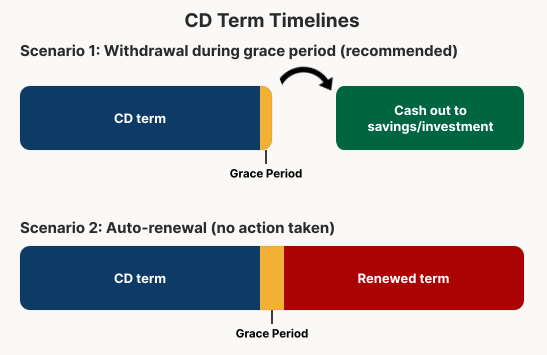
When a CD ends, there’s a grace period of about a week for you to withdraw the original amount plus your earnings. Withdrawing your funds outside a grace period triggers an early withdrawal penalty, which can be worth several months’ to a year’s worth of interest, or more.
During the grace period, it’s usually best to transfer funds to a savings or investment account, even if you plan to open a new CD. Many banks have CDs automatically renew, and that might mean you’re settling for a lower rate than you can get elsewhere.
Helpful strategy: CD ladders mix cash access and high rates
Two big stressors about CDs are having good timing on rates and sacrificing access to your money. A CD ladder is a savings strategy that can address both issues: You open several CDs with staggered terms, such as one-year, two-year, and three-year CDs, and distribute your money equally into them. As each CD matures, you reinvest the money into a long-term CD, which means more chances of catching high rates. Or you can withdraw, giving you more access to cash than a single long-term CD has.
How different types of CDs benefit you
For high rates:
High-yield CDs have competitive rates several times higher than national averages. Technically, “high-yield CD” is a marketing term for a standard CD with a high rate, but you can’t get high-yield CDs everywhere. Usually online banks and some credit unions offer them, and you may have to give up access to branches for high rates.
Promotional CDs can have top rates on unconventional term lengths. You can find stellar yields if you’re comfortable going beyond the most common terms such as one-year, three-year, and five-year CDs. Watch out for their maturity policies since they may auto-renew into lower-rate CDs by default.
For flexibility:
No-penalty CDs give you a free withdrawal at the cost of a lower rate. You can typically redeem a no-penalty CD anytime after the first few days. But their rates aren’t the best out there.
Bump-up CDs and step-up CDs give you rate increases during a CD term. A bump-up CD lets you request one if the bank has raised rates since you opened that CD. A step-up CD has one or more scheduled rate increases, but generally step-up CDs have lackluster rates.
Other options to know:
IRA CDs are a limited retirement option for the risk-averse bank customer. You get the tax benefits of an individual retirement account plus the fixed rate of a CD. Some banks offer them, but your investment options are more limited than IRAs at brokerages.
Jumbo CDs might have better rates than other CDs at the same bank, but they have steep minimum deposit requirements, traditionally $100,000. They don’t often have best-in-market rates.
Brokered CDs are convenient, high-value options for investors at brokerage firms. Folks get these bank-issued CDs alongside various investments in a brokerage account. Brokered CDs can be sold early, so they work slightly more like bonds than CDs at banks and credit unions. But they are FDIC-insured.
Share certificates are CDs at credit unions and rates can be as strong as bank CDs. This name reflects that credit unions are not-for-profit organizations where customer deposits count as shares of ownership.