Quick answer: Your credit report lists detailed information about your credit history, while your credit score is a number used by lenders to determine how likely it is you’ll pay back what you owe. Your score is calculated using data from your credit reports, which is one reason why it fluctuates as new information is reported.
Your credit score does not appear on your credit reports.
A helpful analogy: Think transcript vs. GPA
The difference between a credit score and a credit report is that your credit report lists detailed information about your credit history. Your credit score is all of that report's data calculated into a simple number representing your creditworthiness.
Scores and reports get confused so often that it helps to have something concrete to compare them to. Let’s use school as our analogy:
Credit report = your transcript (the full, detailed record of your academic career)
Credit score = your GPA (the single number everyone actually asks about)
Hang onto that comparison as we go section by section.
Meet MoneyNerd, your shortcut to smart money moves
NerdWallet's twice-weekly newsletter offers practical, no-fluff guidance to help you spend smarter, save more, and make confident money decisions. Delivered free to your inbox.
Credit score vs. credit report: what's the actual difference?
Think of your credit reports like a school transcript, which lists every class you’ve taken, every grade and how many years you’ve been enrolled. It can be long, and no one really wants to read the whole thing every time they want to know if you’re a good student.
Your credit score is like your GPA, or grade point average. All your grades are simplified into one number. This way, a college admissions officer can look at a GPA and get the gist of your academic performance, without reading the pages (and pages) of transcripts.
The same is true with lenders. When you apply for a mortgage, credit card or loan, they don’t want to review your lengthy credit report. Instead, they want a single number that quickly tells them how reliably you’ll pay back money you’ve borrowed. That’s your credit score.
Why do you have multiple credit scores?
Let’s go back to the transcript/GPA analogy. Your GPA might look different depending on who is calculating it (weighted vs. unweighted GPA), or if you took AP classes, etc. But, that number is still pulled from that underlying transcript.
In the same way, your multiple credit scores are based on who is calculating them (FICO or VantageScore) and which scoring model they’re using (FICO 8 and VantageScore 3.0 are popular, but there’s many more models to choose from).
Even though the core information they’re using to calculate those scores comes from the same credit reports, the results can differ.
What is a credit score? (Think: your GPA)
A credit score is a number that lenders use to measure how safe or risky you are as a customer. The most common score is FICO, which comes in different versions (some built specifically for auto loans or credit cards). VantageScore is FICO’s competitor.
» NEXT: You can check your VantageScore for free, every week, at NerdWallet.
The 5 factors that make up your score
Every credit score is calculated using information from your credit reports.
There are important factors to consider when managing your credit score. Think of these like the “subjects” that make up your grade in a class:
Payment history: Your history of paying back what you owe and any derogatory marks for paying late or defaulting (Did you turn things in on time? Are there missing assignments?)
Credit utilization: How much of your available credit are you using at a given time? The goal is to keep this below 30%. (Are you maxed out on your course load, or do you have room to spare?)
Hard inquiries: How often you’ve applied for new credit. Ideally, space applications out every six months to keep your score healthy. (Asking one teacher for a deadline extension is normal, but asking every teacher for an extension in the same week might look concerning to others.)
Age of credit: How long you’ve had credit accounts open. A longer credit history shows lenders you can manage credit over time. (Are you a senior with years on record, or did you just start kindergarten with a blank slate?).
Credit mix: The types of credit you have. With a mix, you’re showing you can handle a credit card, where the payment is different each month, alongside an auto loan, where the payments are fixed. (Are you doing things outside of your classwork, like after-school clubs, sports or working a part-time job?)
» MORE: What is a good credit score?
Why a 700 FICO score isn’t a 700 VantageScore
Credit scores range from 300 to 850, but they will fluctuate depending on your account activity.
Both FICO and VantageScore have different ranges to help you better understand the power of your score. And even though both companies use the same factors to calculate your score (like payment history and credit utilization), a 700 FICO score means something different than a 700 VantageScore.
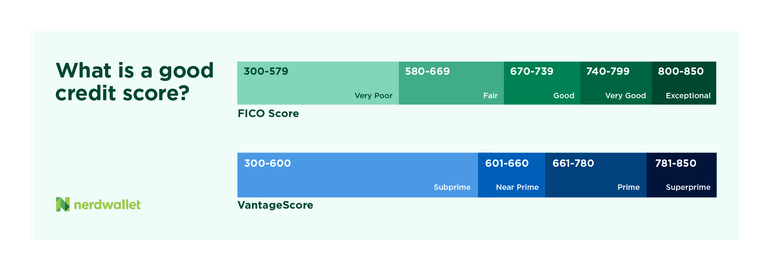
Both models use credit bureau data to assess risk, but the key distinction is how that information is interpreted and weighted, according to FICO.
Those differences can cause meaningful variations in scores that can lead to materially different outcomes for the same consumer, a FICO spokesperson told NerdWallet.
Lenders check your score when you apply for a credit card or a loan, so it’s worth knowing your FICO and VantageScore before they do — especially if you are building your credit.
What is a credit report? (Think: your transcript)
A credit report is like your full transcript. It contains every account you’ve opened, every payment you’ve made, and it records how carefully you’ve managed your debts.
Unlike a GPA, which can be found on most transcripts, your credit score isn’t listed anywhere in your credit reports compiled by Equifax, Experian and TransUnion.
Think of the three major credit bureaus as the transcript offices. They each keep a copy of your file. They might not match exactly — but that’s only because lenders don’t always report to all three.
New to credit? You probably don't have a credit report yet — just like a kid who hasn’t started school doesn’t have a transcript. It’s important to establish a credit history so you can qualify for loans, credit cards, rentals, insurance policies and jobs.
How to request your credit reports in Spanish
You can request your credit report in Spanish directly from each of the three major credit bureaus:
TransUnion: Call 800-916-8800.
Equifax: Visit the link or call 888-378-4329.
Experian: Click on the link or call 888-397-3742.
Usted puede solicitar una copia de su informe crediticio (gratis y en español) de cada una de las tres principales agencias de crédito:
TransUnion: Llame al 800-916-8800.
Equifax: Visite el enlace o llame al 888-378-4329.
Experian: Haga clic en el enlace o llame al 888-397-3742.
Spotting (and fixing) mistakes on your report
Like any record, credit reports get typos — just like transcripts do. Maybe a payment gets marked “missed” that you know you made, an account shows up that you’ve never opened, a debt gets listed twice or an old negative mark lingers longer than it should.
Just like you wouldn’t let a wrong grade sit on your transcript, it’s worth disputing and correcting credit report errors right away. The fastest way to dispute is online, but you can also do it by phone or mail. Use our guide to simplify the process.
Everyone is entitled to free credit reports from each of the three credit-reporting companies. Get a free weekly credit report from NerdWallet