At its September 2026 meeting, the Federal Reserve announced a Fed rate increase of 0.25 percentage points. This is the sixth announcement of 2026 and the first increase since 2023. The target range is now between 3.75% and 4.0%.
As a result, the prime rate increases to 7%. Business owners will likely see slightly higher loan rates.
How much do you need?
How does the Fed rate impact business loans?
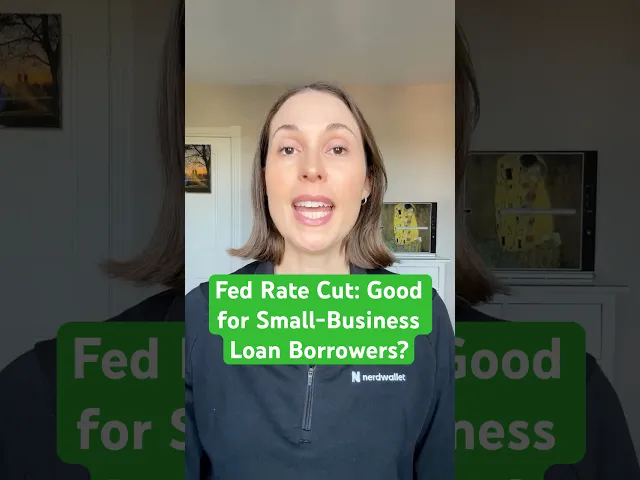
The federal funds rate, also known as the Fed rate, helps shape the prime rate — the benchmark lenders use to determine what they charge borrowers. When the Fed rate drops, the prime rate usually falls too, which often makes business loans less expensive.
Here's what you tend to see when the Fed cuts rates:
Lower costs on variable-rate loans
If you have a variable-rate business loan that’s based on the prime rate — such as an SBA 7(a) loan — Fed rate cuts will lower your interest costs and monthly payments.
For example, say you have a $250,000 SBA 7(a) loan with an interest rate of 13% and a 10-year repayment term. Your monthly payment would be about $3,733, with roughly $197,933 paid in interest over the life of the loan.
With a 0.25% rate reduction, bringing the interest rate to 12.75%, your monthly payment would drop to approximately $3,696. That’s about $193,520 in total interest — saving you nearly $4,500 over the lifetime of the loan.
Loan repayment comparison:
Interest rate | Monthly payment | Total interest paid |
13% | $3,733 | $197,933 |
12.75% | $3,696 | $193,520 |
Difference | $37 less per month | $4,413 saved |
Business owners may also see lower rates on business credit cards and lines of credit, both of which often have variable rates. Rates on Wells Fargo’s BusinessLine® line of credit, for instance, decrease when the prime rate is lowered.
Reduced rates on new fixed-rate loans
Business owners with existing fixed-rate loans don’t see any changes when the Fed cuts rates. New borrowers, however, may find that lenders offer lower rates on upcoming fixed-rate loans. As a result, getting a loan then may be more affordable than it had been in recent months.
Refinancing may offer savings
If you have a high-rate loan that you want to refinance, it can be a good time to do so when the Fed cuts rates. Although a Fed rate cut doesn't guarantee that you’ll save money, you may be able to secure a loan with a lower rate — especially if your qualifications have improved. If your business loan profile is stronger (longer time in business, better credit score or higher revenue), refinancing can help you access more favorable terms.

What business owners should keep in mind
Here are a few things to keep in mind if you're evaluating your financing options in light of a Fed rate cut:
Lenders may not lower rates immediately. Even when the Federal Reserve cuts rates, lenders may not lower their business loan rates right away. Banks and other lenders often wait to see how the market responds before adjusting rates, so you may need to shop around or wait a little longer to see changes in borrowing costs. (SBA 7(a) lenders are the exception to this, as they are required to adjust their rates in tandem with the prime rate.)
Borrowing costs depend on a variety of factors. Not all borrowers will benefit from a Fed rate cut. Although overall rates may be lower, the rate you receive on a loan will depend on your qualifications, as well as your loan type and lender. Stronger credentials will give you access to the most competitive rates.
It may still be difficult to access bank financing. With ongoing economic uncertainty, banks continue to have tight credit standards for small-business owners. This can make it hard to qualify for the lower rates you want. If you can’t get a bank loan, consider working with a local community lender, which may be more flexible, while still offering competitive rates and terms.

Article sources
- 1.U.S. Federal Reserve. Federal Reserve issues FOMC statement. Accessed Sep 16, 2026.