





What is a self-directed IRA?
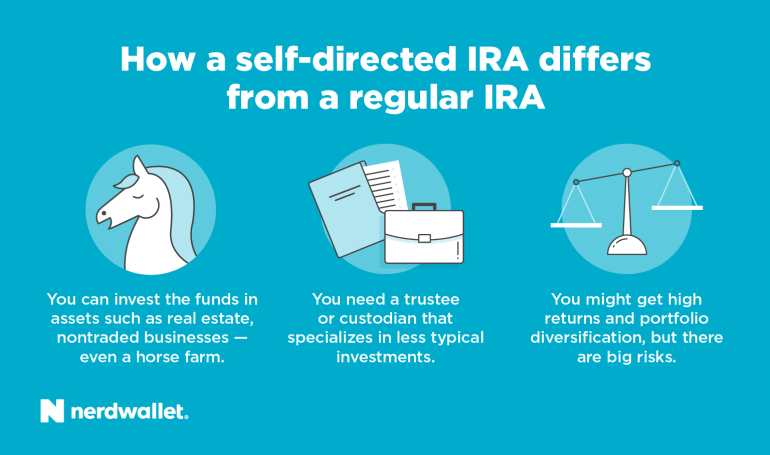
A self-directed IRA (SDIRA) is a type of IRA that holds alternative investments not typically found in conventional IRAs. Besides bonds, stocks, and mutual funds, SDIRA investment options could include real estate, precious metals, cryptocurrency and more.
SDIRAs are bound by the usual IRA rules, including annual IRA contribution limits and withdrawal rules. They also come in two forms: the traditional IRA, which takes tax-deductible contributions, or the Roth IRA, which allows tax-free distributions in retirement.
A SDIRA is considered “self-directed” because although a custodian or trustee administers the account, the account holder directly manages the investments and assumes all risk.
AD
How does your
net worth stack up?
See where you stand compared to households like yours, and get steps you could take to grow from here.

NWWP is an SEC-registered investment adviser. Registration does not imply skill or training. Calculator by NerdWallet, Inc., an affiliate, for informational purposes only.
Self-directed IRA rules
Self-directed IRAs offer more flexibility in investment selection than traditional or Roth IRAs. But there are a significant number of rules that govern them. This includes the “no self-dealing” rule, which prohibits you from borrowing money from your IRA, selling property to it, and other interactions.
Another SDIRA rule prohibits entering into deals with specific relatives, including parents and children. See IRS Publication 560 for more details.
» MORE: How alternative assets work
How to open a self-directed IRA
To open a self-directed IRA, the IRS requires you to go through a custodian who will hold the account. Custodians of SDIRAs are often financial institutions or trust companies. Their role is to ensure the account owners follow IRA rules, such as the annual contribution limit and reporting to the IRS.
When selecting a custodian for your SDIRA, consider their fee structure, the types of investments they handle and whether they’re approved by the IRS.
After choosing your custodian, you can open your account and fund it like any IRA. Custodians won’t offer financial guidance or investing advice, so you’ll be on your own when it comes to due diligence and selecting investments.
Best self-directed IRAs
There are a lot of self-directed IRAs out there, so we compared them to help you find the best option for yourself. We looked at factors including minimum balance, available investments, first-year fees, customer service hours and IRS audit protection.
Some self-directed IRAs allow you to invest in anything permissible by the IRS, which includes just about everything from real estate to commodities to startups. Other self-directed IRAs restrict your options.
To score these self-directed IRAs on their fees, we calculated what you would have to pay in your first year — but keep in mind that you may also have to pay some fees on an ongoing basis.
🤓 Nerdy Tip
Most self-directed IRAs have much higher fees than their non-self-directed counterparts. If you have your heart set on a self-directed IRA, prepare to pay at least a set-up fee and an annual fee. » MORE: How to invest $100,000
Standout feature: Lowest fees 🤑
Pros
No account minimum
Low first-year fee
Cons
No audit protection
The Entrust Group has the lowest fees of the self-directed IRA providers we reviewed. The first-year fee is $249 for accounts with a single asset. But fees increase for accounts with two or more assets or total asset value of more than $50,000.
The Entrust Group doesn’t offer audit protection and has slightly worse customer service options than other providers we reviewed. But they have several educational resources and are audited by external auditors.
If fees are the most important factor for you, The Entrust Group may be your best bet among these SDIRAs.
Standout feature: Audit protection 🎉
Pros
No account minimum
Audit protection
Cons
High first-year fee
IRA Financial is one of the only self-directed IRAs we reviewed that offers free audit protection. That means if the IRS audits your IRA, IRA Financial will help you through the process for no extra cost.
IRA Financial scores well in every category. They also offer prohibited transaction reviews to help you understand what you can't invest in, as well as investment guidance and educational resources through podcasts, blog posts and videos.
However, IRA Financial's first-year fee is high among this group, at $495.
Standout feature: Advisor access 👩💼
Pros
No account minimum
Access to advisors for financial, legal or tax advice
Audit protection
Cons
High first-year fees
Directed IRA may not be right for everyone due to its higher fees. Its first-year fee is among the highest at $595. That includes an annual account fee, as well as an application fee and a one-time asset processing fee. But if you want access to financial advisors, lawyers or tax professionals, they can help with that. Directed IRA also has annual audits by outside auditors.
» MORE: How private equity works
Compare more self-directed IRAs
Here's a list of all the self-directed IRAs we reviewed. These self-directed IRAs also have checkbook-control IRA options ("checkbook IRAs"), which are IRAs that you can write checks from.
| Minimum balance | First-year fees | Available investments | |
|---|---|---|---|
| The Entrust Group | $0 | $249 | Any |
| IRA Financial | $0 | $495 | Any |
| Directed IRA | $0 | $595 | Any |
| uDirect IRA | $500 | $325 | Any |
| Rocket Dollar | $0 | $720 | Restricted |
| Madison Trust Company | $500 | $490 | Restricted |
Advantages of a self-directed IRA
For experienced investors, SDIRAs offer three distinct advantages.
- Diversification. Investors can build a portfolio of investments to their specifications, investing in things that conventional retirement accounts don't typically offer.
- Potential for higher returns. For an investor well-versed in a specific industry or asset type, investing in a SDIRA could allow them to take advantage of those potential returns in a retirement account.
- Tax breaks. Investors can choose their SDIRA investments and build a portfolio to their specifications while still receiving the tax breaks found in traditional or Roth IRAs.
Risks of self-directed IRAs
The potential benefits are well and good — but it’s also important to consider the risks:
- Self-directed due diligence. In a SDIRA, custodians and trustees only manage the account. They provide no financial guidance or recommendations. Instead, it’s up to the account holder to do their own due diligence. That includes evaluating future revenue and expenses for their investments, verifying the accuracy of financial information and more.
- Fees. SDIRA fees vary by custodian and type of investment; they are also dependent on actions the account holder takes.
- Lack of liquidity. Self-directed IRAs allow you to invest in a wide variety of investments, but those assets are often illiquid. That means if you run into an unexpected emergency, you might be hard-pressed to get money out of your IRA. You’ll need to find a buyer for the investment. This can also be an issue for owners of traditional self-directed IRAs when required minimum distributions come due at age 73.
- Lack of transparency. It can be hard to determine the monetary worth of an investment. The U.S. Securities and Exchange Commission (SEC) warns investors that self-directed IRA promoters sometimes list the purchase price, or the purchase price plus expected returns, as the valuation. But that figure isn't the actual amount you'll get for the asset. "If possible, take steps to independently verify information — such as prices and asset values — provided in account statements," the agency says.
- Higher potential for fraud. Fraudsters have used self-directed IRAs as a way to add a stamp of legitimacy to their schemes. One common ruse is to say the IRA custodian has vetted or approved of the underlying investment, when, as the SEC notes, custodians generally don’t evaluate “the quality or legitimacy of any investment in the self-directed IRA or its promoters.”
- Concentrated portfolios. Proponents of self-directed IRAs say their ability to invest outside the mainstream improves their diversification. But a self-directed IRA can lack diversity like any other retirement account.
AD
How does your
net worth stack up?
See where you stand compared to households like yours, and get steps you could take to grow from here.
NWWP is an SEC-registered investment adviser. Registration does not imply skill or training. Calculator by NerdWallet, Inc., an affiliate, for informational purposes only.
How do I know if my IRA is self-directed?
Unless you opened up your IRA with a specific self-directed IRA provider, it is unlikely to be self-directed. Some popular brokerages offer IRAs with expanded access to investments, such as crypto. But they may not include the full lineup of self-directed assets. If you're not sure if you have a self-directed IRA, check your account details or contact your IRA provider. You can also check out the assets you can invest in from your IRA to see what flexibility you have.
Can I invest in real estate through a self-directed IRA?
Yes, you can invest in real estate through a self-directed IRA.
How much money can you put in a self-directed IRA?
Self-directed IRAs have the same contribution limits as regular IRAs, which is $7,500 for 2026 ($8,600 if aged 50 and older).
» MORE: How to invest $100,000
The bottom line
Self-directed IRAs offer more variety in investment options while still providing the tax benefits of an IRA. But account holders must select and manage investments on their own. That makes self-directed IRAs best for experienced investors. You need financial experience and knowledge to take on the risk.
For most other retirement savers, the range of assets available through a traditional IRA — stocks, bonds, CDs, ETFs, mutual funds and real estate investment trusts (REITs) — provide more than enough investment diversity.
Traditional IRAs also can be quick and easy to open and provide the same tax benefits as a self-directed IRA. And they may be more accessible at various financial institutions.
» Check out our list of top picks for best IRA accounts.


AD Advertisement
Get matched to a financial advisor for free with NerdWallet Advisors Match. Match With an Advisor for free

AD Advertisement
Get matched to a financial advisor for free with NerdWallet Advisors Match. Get Matched for Free
AD Advertisement Explore more on
Article sources
NerdWallet writers are subject matter authorities who use primary,
trustworthy sources to inform their work, including peer-reviewed
studies, government websites, academic research and interviews with
industry experts. All content is fact-checked for accuracy, timeliness
and relevance. You can learn more about NerdWallet's high
standards for journalism by reading our
editorial guidelines.
- 1. FINRA. Investor Alert: Self-Directed IRAs and the Risk of Fraud. Accessed Sep 9, 2025.
- 2. Investor.gov. Investor Alert: Self-Directed IRAs and the Risk of Fraud. Accessed Sep 10, 2025.
- 3. IRS.gov. Retirement plans FAQs regarding IRAs. Accessed Sep 10, 2025.