As two of the largest U.S.-based carriers, Delta Air Lines and United Airlines have many similarities, but there are a few things that set them apart. The main differences between United and Delta are:
Delta charges lower carry-on bag fees on basic economy tickets.
United is a member of Star Alliance (the largest network with 26 airlines), while Delta is part of SkyTeam (a smaller alliance with 18 airlines).
Delta’s most expensive credit card provides limited Sky Club lounge access and unlimited entry to American Express Centurion Lounges (no complimentary guests), while United’s most expensive card grants unlimited entry with guest access but only to United Club lounges.
So, which is better for your individual travel needs, preferences and budget?
Where they’re based and where they fly
Winner for most options: United
Delta
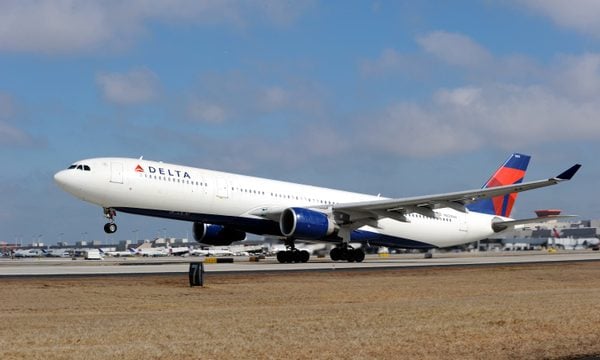
Delta Air Lines passengers can fly to more than 300 destinations on six continents. As a SkyTeam member, the airline partners with 17 other global carriers. SkyTeam member airlines cover 945 destinations in 145 countries.
Delta U.S. hubs:
Atlanta.
Boston.
Detroit.
Los Angeles.
Minneapolis.
New York (JFK and LaGuardia).
Salt Lake City.
Seattle.
Delta’s key international markets:
Amsterdam.
London-Heathrow.
Mexico City.
Paris-Charles de Gaulle.
Seoul.
Tokyo.
United
Star Alliance member United Airlines covers more than 380 destinations across six continents: 231 U.S. cities and 153 international destinations.
Star Alliance is the world’s largest alliance and includes 26 carriers serving more than 1,150 airports, which gives you a lot of global connection options for a vacation.
United U.S. hubs:
Chicago.
Denver.
Guam.
Houston-Intercontinental.
Los Angeles.
Newark.
San Francisco.
Washington-Dulles.
United’s key international markets:
Frankfurt.
London-Heathrow.
Sao Paulo.
Tokyo (Haneda and Narita).

By signing up, you will receive newsletters and promotional content and agree to our Terms of Use and acknowledge the data practices in our Privacy Policy. You may unsubscribe at any time.
Reliability
Winner for reliability: Delta
Delays and other operational issues can affect your travel day significantly. While no airline is immune to disruptions, it helps to know which airline is more reliable in terms of flight cancellations, on-time arrival and baggage handling.
We’ve compiled operational data for Delta and United between July 2024 and June 2025 and have concluded the following:
Airline | On-Time | Cancellation % | Mishandled luggage % |
|---|---|---|---|
Delta | 80.27%. | 1.37%. | 0.46%. |
United | 78.84%. | 1.34%. | 0.69%. |
Delta beats United in on-time performance and mishandled baggage, while United has a slightly lower flight cancellation rate. When it comes to reliability, we’re going with Delta on this one.
» Learn more: Which airline is the most reliable?
Fees
Winner for lowest fees: Delta
Fees have become an integral part of air travel, but the amounts vary across the industry.
For this section, we’ve compiled a few different data points: the cost of a checked bag on a domestic itinerary, the cost of a carry-on bag when flying basic economy on domestic itineraries and the average seat selection cost.
So, which is better: Delta or United?
Airline | One checked bag (domestic) | One carry-on bag in basic economy (domestic) | Average seat selection |
|---|---|---|---|
Delta | $45. | $0. | $24.99. |
United | $45 (if added 24 hours before departure), $50 otherwise. | Not allowed. | $58.49. |
Delta wins this round with the lowest fees across the board. Checked baggage fees are the same whether you pay in advance, at check-in or at the airport, while United charges more if you wait to check your bag.
On basic economy tickets, Delta also allows one carry-on bag that will fit in an overhead bin for free whereas United does not (more on this below). In addition, United’s average seat selection fees are more than twice as high as Delta’s.
» Learn more: Which airlines have the best (and worst) fees?
Basic economy
Winner for best basic economy tickets: tie
When pitting Delta versus United, it’s important to compare their basic economy fare policies and decide whether saving a few bucks is worth it.
Airline | Markup | Free overhead carry-on | Earning redeemable miles | Elite status qualification rate | Elite upgrades | Boarding group |
|---|---|---|---|---|---|---|
Delta | $50. | Yes. | No. | 0%. | Not eligible. | Zone 8 (final boarding group). |
United | $9 - $50. | No, fee is $45, unless the passenger is flying to select international destinations, has elite status or certain United credit cards. | No, unless you hold elite status or certain United cards. | 100% of Premier Qualifying Points and 0 Premier Qualifying Flights. | Not eligible. | Group 6 (final boarding group). |
Delta’s basic economy tickets don’t earn redeemable miles or elite status credits, and there may be a higher price difference between basic economy and main cabin fares. Plus, Delta flyers are not permitted entry to Delta Sky Clubs when traveling on a basic fare.
United, on the other hand, allows travelers to earn redeemable miles and Premier Qualifying Points on basic economy fares, though these flights do not count toward elite qualifying flight segments. You'll also earn 3 fewer miles per dollar on United basic economy fares.
The carrier also doesn’t include a free carry-on when traveling in basic economy unless you’re a MileagePlus Premier member, hold a qualifying United credit card or are flying on select international routes. If you make it to the gate with a carry-on bag and it doesn’t fit underneath the seat, you’ll have to pay $65 to check it.
Overall, neither airline has a clear advantage when it comes to basic economy. Delta offers a free carry-on, while United provides more earning potential and, in some cases, a lower markup, making the better option dependent on what matters most to you.
» Learn more: Basic economy vs. main cabin
Loyalty programs
Winner for the best loyalty program: tie
Achieving Delta’s elite status may be more straightforward for some travelers. United, however, offers more ways to earn elite status but generally requires meeting higher thresholds. Overall, neither loyalty program is objectively easier, and the better choice depends on how you plan to qualify for elite status.
» Learn more: Best airline rewards programs
Delta SkyMiles
Earning miles
With Delta, you earn redeemable miles based on the cost of your ticket and not the distance you travel, at least on Delta-marketed flights. The miles are multiplied for every dollar spent toward base fare cost. In other words, taxes and fees don’t count.
Here's how many miles you typically earn when you fly Delta and credit your flights to Delta SkyMiles:
Elite status level | SkyMiles you earn |
|---|---|
General member | 5 miles per $1. |
Silver Medallion | 7 miles per $1. |
Gold Medallion | 8 miles per $1. |
Platinum Medallion | 9 miles per $1. |
Diamond Medallion | 11 miles per $1. |
However, you may earn additional or fewer miles based on the travel experience you purchase: Basic, Classic or Extra. For example, Delta Main Basic is basic economy and earns zero miles, while Delta Main Extra is a refundable fare that allows you to earn more miles. Read more about Delta's fare classes.
When you purchase any Extra fare, you will earn 2 additional miles per $1. When you purchase a Comfort Basic fare, you will earn 3 fewer miles per $1.
When you fly other SkyTeam partners and credit your flight to Delta SkyMiles, you earn miles based on a percentage of distance flown based on the ticket’s fare class.
As per NerdWallet’s valuations, Delta SkyMiles are worth about 1.2 cents each.
Delta doesn’t publish award charts and instead prices out its flights based on demand. In other words, you can’t always get an outsized value for your SkyMiles when mileage rates for a ticket more or less correlate with its cash rates.
A good way to redeem Delta SkyMiles is by booking one of the occasional SkyMiles Deals. This limited-time sale on award flights can get you to your destination for as few as 6,200 SkyMiles each way. Not all redemption rates will be as low, but it’s a good place to start looking for your next vacation destination.
» Learn more: Best ways to earn Delta SkyMiles
Earning elite status
The only way to earn Delta Medallion elite status in the SkyMiles program is by earning Medallion Qualification Dollars (MQDs).
Elite status level | MQDs required to earn |
|---|---|
Silver Medallion | $5,000. |
Gold Medallion | $10,000. |
Platinum Medallion | $15,000. |
Diamond Medallion | $28,000. |
You’ll earn 1 MQD per dollar spent on airfare on Delta- and partner-operated flights and Delta Vacations. You can also earn MQDs with a Delta SkyMiles credit card:
1 MQD for every $20 spent with the Delta SkyMiles® Platinum American Express Card and the Delta SkyMiles® Platinum Business American Express Card.
1 MQD for every $10 spent with the Delta SkyMiles® Reserve American Express Card and the Delta SkyMiles® Reserve Business American Express Card. Terms apply.
» Learn more: Delta SkyMiles value calculator
United MileagePlus
Earning miles
United offers a more convoluted points-earning structure. Program members earn redeemable miles based on their elite level, how much they spend with the airline, whether they hold a United credit card and whether they're flying in basic economy.
Here is how many miles you will earn based on your elite status level:
Status | Earn rate without a United card | Earn rate with a United card |
|---|---|---|
General member (no elite status) | 3 miles per dollar. | 6 miles per dollar. |
Premier Silver | 5 miles per dollar. | 8 miles per dollar. |
Premier Gold | 6 miles per dollar. | 9 miles per dollar. |
Premier Platinum | 7 miles per dollar. | 10 miles per dollar. |
Premier 1K | 9 miles per dollar. | 12 miles per dollar. |
If you hold an eligible United credit card, you will earn an additional 3 miles per $1, regardless of whether you purchased your ticket with the card. Basic economy flyers will earn 3 fewer miles per $1. That means a Premier 1K member could earn 17 miles per $1 if they had a United card and were flying in standard economy.
Star Alliance carrier tickets earn redeemable miles calculated by a percentage of the total distance flown and the fare class in which you booked your ticket.
Based on NerdWallet’s recent valuations, United miles are worth 1.2 cents apiece — the same as Delta SkyMiles.
» Learn more: Easy ways to earn more United miles
Earning elite status
MileagePlus members can earn United elite status in the program by earning Premier Qualifying Flights (PQFs), or flight segments flown, and Premier Qualifying Points (PQPs). You can earn 1 PQP for every dollar spent on airfare, carrier-imposed surcharges, seat purchases, paid upgrades and when purchasing the Premier Accelerator. Members will also earn PQPs for spending on United credit cards and when redeeming miles for award tickets.
To qualify for elite status, you’ll need the following number of PQF and PQP thresholds and fly at least four segments on United or United Express-operated flights.
Elite status level | Requirements to earn |
|---|---|
Premier Silver | 15 PQFs and 5,000 PQPs, or 6,000 PQPs. |
Premier Gold | 30 PQFs and 10,000 PQPs, or 12,000 PQPs. |
Premier Platinum | 45 PQFs and 15,000 PQPs, or 18,000 PQPs. |
Premier 1K | 60 PQFs and 22,000 PQPs, or 28,000 PQPs. |
These requirements highlight how United allows travelers to qualify for elite status either through spending alone or through a combination of spending and flights, which differs from Delta’s approach.
Neither airline’s approach is better; Delta’s Medallion program is based solely on MQDs, which removes flight segment requirements and can make status simpler to earn for travelers who qualify through spending.
United Premier status, however, requires meeting PQP thresholds that are mostly higher but offers additional ways to earn PQPs, which can benefit travelers who can take advantage of those options.
Travel credit card availability
Winner for the best airline credit card: tie
Delta and United offer credit cards with perks like a free checked bag, although Delta's cards offer a second free bag on domestic flights.
Both also offer premium cards with airport lounge membership, but Delta has a slight edge in this regard because its premium card offers access to the Centurion Lounges as well. Terms apply.
For a casual traveler, United℠ Explorer Card (annual fee: $0 intro for the first year, then $150) is slightly better than the Delta SkyMiles® Gold American Express Card (annual fee: $0 intro for the first year, then $150) because it includes two one-time United Club passes. Terms apply.
Overall, both airlines’ card offerings are similar enough to call it a tie in this department. Your pick in the Delta versus United credit card battle largely comes down to which carrier you fly more often and whose credit card perks you’re likely to use.
You don't have to be a travel rewards expert to use credit cards to make travel more affordable. Here are your airline credit card options, broken down by airline.
Delta credit cards
American Express offers several credit cards to Delta flyers. Here’s a closer look at all the options, ranging from those with a $0 annual fee to one with a $650 annual fee.
Delta SkyMiles® Blue American Express Card (Annual fee: $0, see rates and fees )
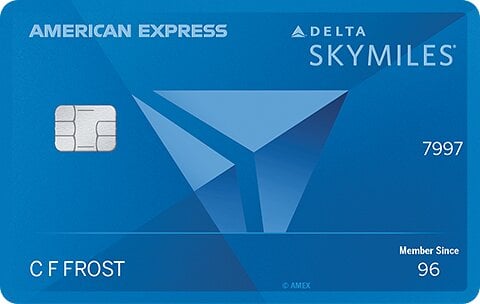
Welcome bonus: Earn 10,000 bonus miles after you spend $1,000 in purchases on your new Card in your first 6 months. Terms Apply.
Earning rates:
2 miles per $1 spent on Delta purchases and at restaurants.
1 mile per $1 spent on all other eligible purchases.
Other benefits:
20% back on in-flight purchases.
Pay with Miles.
No foreign transaction fees.
Travel insurance and purchase protection benefits.
Terms apply.
Delta SkyMiles® Gold American Express Card (Annual fee: $0 intro for the first year, then $150, see rates and fees )
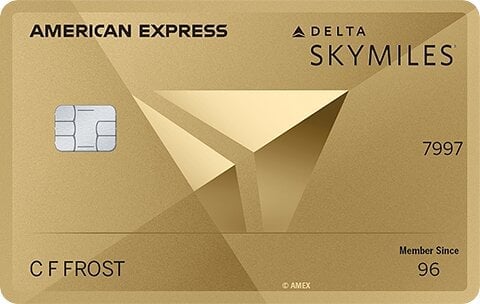
Welcome bonus: As High As 80,000 Bonus Miles + Earn a $250 Statement Credit after you spend $3,000 in purchases on your new Card within the first 6 months of Card Membership. You may not be eligible for the maximum welcome offer amount. Offer ends 11/04/2026. Terms Apply.
Earning rates:
2 miles per $1 spent on Delta purchases, at restaurants and at U.S. supermarkets.
1 mile per $1 spent on all other eligible purchases.
Other benefits:
Free checked bag for up to nine passengers. Second bag free for primary cardholder on domestic flights.
Save 15% when redeeming SkyMiles for Delta flights.
Zone 5 priority boarding.
$200 Delta credit after making $10,000 in purchases.
20% back on in-flight purchases.
Annual $100 Delta Stays credit for hotels and vacation rentals.
Annual $120 rideshare credit ($10 per month).
Travel insurance and purchase protection benefits.
Pay with Miles.
No foreign transaction fees.
Terms apply.
Delta SkyMiles® Platinum American Express Card (Annual fee: $350, see rates and fees )
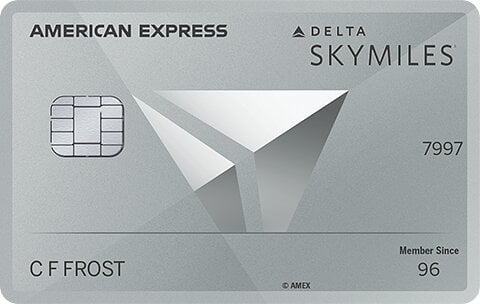
Welcome bonus: As High As 90,000 Bonus Miles + Earn a $300 Statement Credit after you spend $4,000 in purchases on your new Card within the first 6 months of Card Membership. You may not be eligible for the maximum welcome offer amount. Offer ends 11/04/2026. Terms Apply.
Earning rates:
3 miles per $1 spent on Delta purchases and directly at hotels.
2 miles per $1 spent at restaurants and U.S. supermarkets.
1 mile per $1 spent on all other eligible purchases.
Other benefits:
Global Entry / TSA PreCheck enrollment fee credit.
Delta companion certificate (main cabin).
Free checked bag for up to nine passengers. Second bag free for primary cardholder on domestic flights.
Save 15% when redeeming SkyMiles for Delta flights.
Zone 5 priority boarding.
20% back on in-flight purchases.
2,500 MQD deposit each year.
MQD boost of 1 MQD for every $20 spent.
Annual $120 rideshare credit ($10 per month).
Annual $150 Delta Stays credit for hotels and vacation rentals.
An up to $120 Resy credit per year ($10 per month).
Travel insurance, purchase protection and cell phone insurance benefits.
Pay with Miles.
No foreign transaction fees.
Terms apply.
Delta SkyMiles® Reserve American Express Card (Annual fee: $650, see rates and fees )
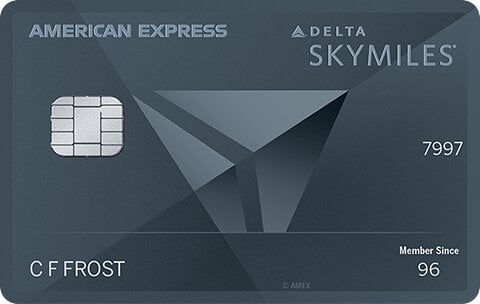
Welcome bonus: Earn two round‑trip Delta Comfort Flight Certificates valid for travel to the U.S. 48, Puerto Rico, or the U.S. Virgin Islands, along with 50,000 Bonus Miles after you spend $10,000 in purchases on your new Card in the first 6 months. A 21+ day advance purchase is required. Taxes and fees up to $80 per person apply. Terms and other restrictions apply. Offer ends 11/4/2026. Terms Apply.
Earning rates:
3 miles per $1 spent on Delta purchases.
1 mile per $1 spent on all other eligible purchases.
Other benefits:
Global Entry / TSA PreCheck enrollment fee credit.
Delta companion certificate (Delta First, Delta Comfort or Delta Main).
Complimentary Delta Sky Club access (up to 15 visits per year).
Complimentary Centurion Lounge access.
Free checked bag for up to nine passengers. Second bag free for primary cardholder on domestic flights.
Save 15% when redeeming SkyMiles for Delta flights.
Zone 5 priority boarding.
20% back on in-flight purchases.
2,500 MQD deposit each year.
MQD boost of 1 MQD for every $10 spent.
Annual $120 rideshare credit ($10 per month).
Annual $240 Resy credit ($20 per month).
Annual $200 Delta Stays credit for hotels and vacation rentals.
Travel insurance, purchase protection and cell phone insurance benefits.
Pay with Miles.
No foreign transaction fees.
Terms apply.
United credit cards
United Gateway℠ Card (Annual fee: $0)
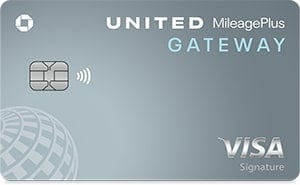
Welcome bonus: Earn 40,000 bonus miles after you spend $1,000 on purchases in the first 3 months your account is open. Plus, earn 10,000 bonus miles when you add an authorized user in the first 3 months your account is open.
Earning rates:
2 miles per $1 spent on United purchases, gas, local transit and commuting.
1 mile per $1 spent on all other purchases.
Other benefits:
25% back on in-flight purchases.
Travel insurance and purchase protection benefits.
No foreign transaction fees.
United℠ Explorer Card (Annual fee: $0 intro for the first year, then $150)
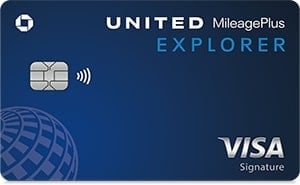
Welcome bonus: Earn 70,000 bonus miles after you spend $3,000 on purchases in the first 3 months your account is open. Plus, earn 10,000 bonus miles when you add an authorized user in the first 3 months your account is open.
Earning rates:
3 miles per $1 spent on United purchases, dining and hotels.
1 mile per $1 spent on all other purchases.
Other benefits:
First checked bag free for up to two passengers.
Priority boarding.
Two one-time United Club passes per year.
Global Entry / TSA PreCheck enrollment fee credit.
Earn 1 PQP for every $20 spent up to 1,000 PQPs per year.
Annual $100 credit toward United Hotels purchases.
Annual $60 rideshare credit ($5 per month).
Annual $120 Instacart credit.
Travel insurance and purchase protection benefits.
25% back on in-flight purchases.
No foreign transaction fees.
United Quest℠ Card (Annual fee: $350)
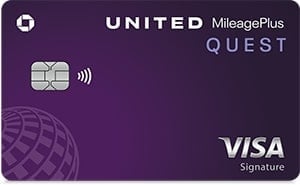
Welcome bonus: Earn 500 Premier qualifying points after your first purchase and 80,000 bonus miles after you spend $4,000 on purchases in the first 3 months your account is open. Plus, earn 10,000 bonus miles when you add an authorized user in the first 3 months your account is open.
Earning rates:
5 miles per $1 spent on Renowned Hotels and Resorts.
4 miles per $1 spent on United purchases.
2 miles per $1 spent on dining, travel and select streaming services.
1 mile per $1 spent on all other purchases.
Other benefits:
$200 in United® TravelBank cash after account opening and annually on your account anniversary.
Annual 10,000-mile award flight discount.
First and second checked bag free for up to two passengers.
Priority boarding.
Global Entry / TSA PreCheck enrollment fee credit.
Earn 1 PQP for every $20 spent up to 18,000 PQPs per year.
1,000 PQP deposit each year.
Annual $150 statement credit for Renowned Hotels and Resorts bookings.
Annual $100 rideshare credit ($8 per month and $12 in December).
Annual $180 Instacart credit ($15 per month).
Travel insurance and purchase protection benefits.
25% back on in-flight purchases.
No foreign transaction fees.
United Club℠ Card (Annual fee: $695)
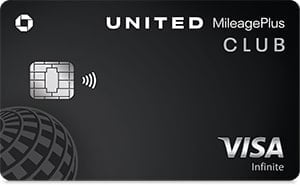
Welcome bonus: Earn 90,000 bonus miles after you spend $5,000 on purchases in the first 3 months from account opening. Plus, earn 10,000 bonus miles when you add an authorized user in the first 3 months your account is open.
Earning rates:
5 miles per $1 spent on Renowned Hotels and Resorts.
5 miles per $1 spent on United purchases.
2 miles per $1 spent on dining and travel.
1 mile per $1 spent on all other purchases.
Other benefits:
United Club membership.
Premier Access at the airport.
Avis President’s Club membership and IHG One Rewards Platinum elite status.
First and second checked bag free for up to two passengers.
Priority boarding.
Global Entry / TSA PreCheck enrollment fee credit.
Earn 1 PQP for every $15 spent up to 28,000 PQPs.
1,500 PQP deposit each year.
Annual $200 statement credit for Renowned Hotels and Resorts bookings.
Annual $150 rideshare credit ($12 per month and $18 in December).
Annual $240 Instacart credit ($20 per month).
Travel insurance and purchase protection benefits.
10% discount on Economy Saver Awards when traveling within the continental U.S. or between the continental U.S. and Canada.
25% back on in-flight purchases.
No foreign transaction fees.
» Learn more: The best airline credit cards right now
If you’re choosing between Delta and United
In the competition of Delta versus United, there isn’t a clear winner. Delta charges lower baggage fees and makes basic economy more tolerable for frugal travelers.
United, meanwhile, offers a larger global route network and more ways to earn elite status.
We recommend looking at which airline serves your home airport as well as the routes you want to fly and make your final decision based on that.
For rates and fees of the Delta SkyMiles® Reserve American Express Card, please visit American Express' rates and fees page.
For rates and fees of the Delta SkyMiles® Platinum American Express Card, please visit American Express' rates and fees page.
For rates and fees of the Delta SkyMiles® Blue American Express Card, please visit American Express' rates and fees page.
For rates and fees of the Delta SkyMiles® Gold American Express Card, please visit American Express' rates and fees page.
How to maximize your rewards
You want a travel credit card that prioritizes what’s important to you. Here are some of the best travel credit cards of 2026:
Flexibility, point transfers and a large bonus: Chase Sapphire Preferred® Card
No annual fee: Wells Fargo Autograph® Card
Flat-rate travel rewards: Capital One Venture Rewards Credit Card
Bonus travel rewards and high-end perks: Chase Sapphire Reserve®
Luxury perks: American Express Platinum Card®
Business travelers: Ink Business Preferred® Credit Card