Imagine you’re booking a pair of award flights: One costs 10,000 miles, and the other costs 25,000 miles. Which one is the better deal?
The cheaper flight seems like the obvious answer at first glance, but it’s really a trick question. The award prices alone aren’t enough to tell you which flight is the better deal, or whether either flight is a good deal to begin with. To determine that, you need to calculate the return you get from booking with miles, also known as the award redemption value.
Learning to calculate award redemption values can help you identify when booking an award is worthwhile, as well as when you’re better off paying cash.

By signing up, you will receive newsletters and promotional content and agree to our Terms of Use and acknowledge the data practices in our Privacy Policy. You may unsubscribe at any time.
How to calculate award redemption values
To calculate award redemption value, you’ll generally need three pieces of information: the award price (in points or miles), the cash price of the same itinerary (in dollars), and the sum of any added costs that result from booking an award (also in dollars). You can then calculate redemption value for a given award in three steps:
Subtract the sum of added award costs from the cash price.
Multiply by 100 (to convert from dollars to cents).
Divide the result by the award price.
The result is the cents per point or mile you get from booking an award, and will usually be a number roughly between zero and five. In some cases the redemption value may be less than zero or greater than five, but double check your work if you get a number far outside that range. For the mathematically inclined, here’s the same process in equation form:
Redemption value = ((cash price in dollars - taxes and fees in dollars)/price in points or miles) x 100
As an example, this three-night stay with flexible cancellation at The Graduate by Hilton in Ann Arbor, Michigan, costs $1,059.43:

Alternatively, you could book the same stay as an award by redeeming 237,000 Hilton Honors points:
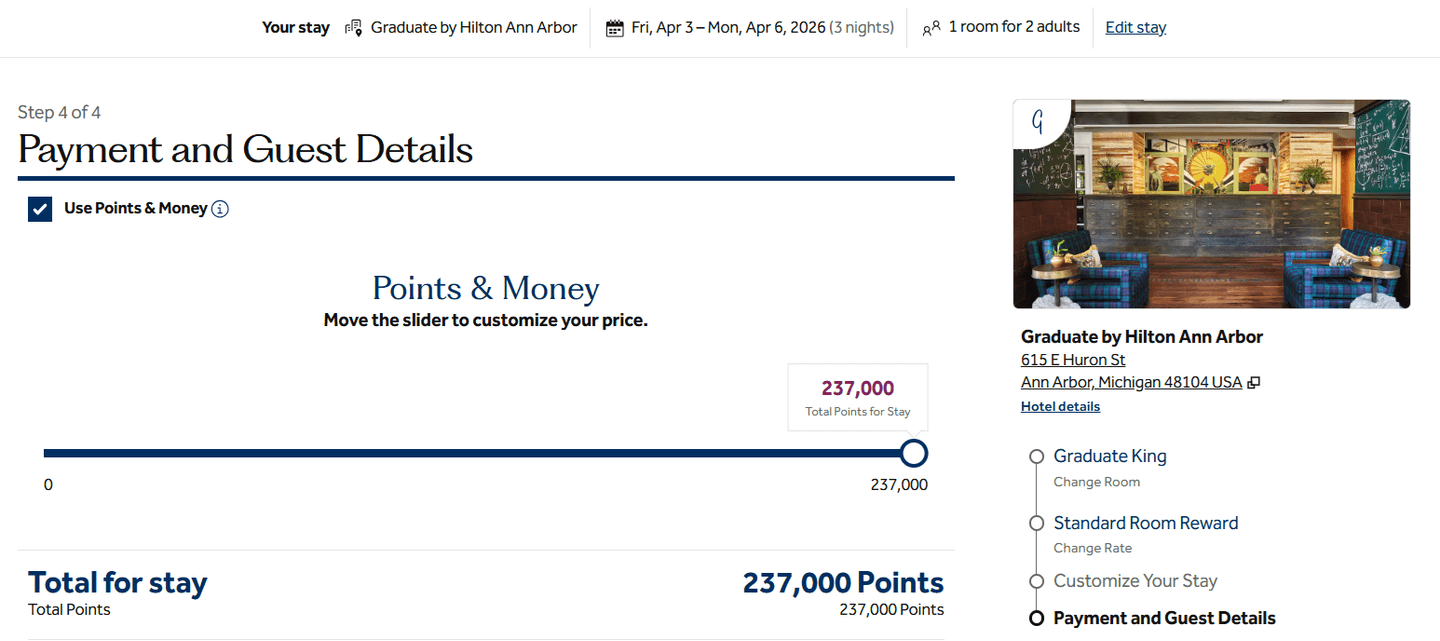
There are no added costs in this example, so to calculate the redemption value, multiply the cash price by 100 to get a total of 105,943 cents. Dividing that number by the award price of 237,000 points yields an award redemption value of approximately 0.45 cent per point.
Accounting for added award costs
To accurately measure redemption value, you have to account for any additional costs you incur when booking an award. These may include mandatory taxes that would normally be folded into the cash rate, but are charged separately on award bookings, such as surcharges and award fees imposed by travel providers or other expenses related to booking award itineraries. Whatever the source, these added costs lower the redemption value of your points and miles.
For example, a Blue Basic fare on this JetBlue Airways flight from New York to Kingston, Jamaica, costs $193:

Alternatively, you could book the same itinerary by redeeming 9,700 TrueBlue points and paying $49.60 in various taxes and fees. These taxes and fees are included in the cash fare, but are charged separately when you pay with points.

To calculate the redemption value in this example, subtract the added cost of award taxes and fees ($49.60) from the cash price ($193) to get $143.40, which represents the net savings you get from booking an award. Multiplying that number by 100 and then dividing by the award price (9,700 points) yields a redemption value of approximately 1.48 cents per point.
Skipping the first step of the calculation can distort the value of award redemptions by making them seem better than they really are. If you ignore the taxes and fees in this example, you end up with a redemption value of 1.99 cents per point.
» Learn more: Airline miles vs. cash calculator
Points + Cash Awards
You can similarly calculate the value of mixed points and cash awards by treating the cash portion like an added cost in the equation above. For example, this one-night stay at the Grand Hyatt Scottsdale in Arizona has a cash rate of $913 (excluding taxes and fees).

Alternatively, you could book the same stay as a World of Hyatt Points + Cash award for 14,500 points and $491 (again excluding taxes and fees).
To calculate the award redemption value in this case, subtract the cash portion of the Points + Cash award ($491) from the cash price ($913) to get $422, which again represents your net savings from booking the award. Multiplying that number by 100 and dividing by the award price (14,500 points) yields a redemption value of approximately 2.91 cents per point.

The opportunity costs of award travel
Booking award travel often means you won’t earn points, miles or elite credits that you would normally earn when paying cash. That diminishes the value of booking awards an added cost. To do that, you’ll have to assess the value of those rewards.
For example, a Choice fare on this Southwest Airlines flight from Nashville to Phoenix costs $191 and earns 978 points.

You could instead book the same fare for 15,000 Rapid Rewards points and $5.60 in fees.

Ignoring rewards earned on the cash fare yields a redemption value of 1.24 cents per point. However, booking with Rapid Rewards means you won’t earn the 978 points offered on the cash fare.
Rapid Rewards points are worth 1.4 cents apiece in NerdWallet’s valuations; on that basis, 978 points are worth $13.66, which can be deducted from the cash price along with the $5.60 security fee. That yields a lower redemption value of 1.11 cents per point.
The same principle applies to elite credits, though their value is more subjective and circumstantial. Missing out on those credits could be a big deal if you’re close to qualifying for elite status, or it could mean very little if you’re unlikely to reach a higher elite tier anyway.
» Learn more: How to use points and miles valuations
Other cost considerations
In addition to costs like taxes and surcharges paid directly at the time of booking an award, you should account for indirect costs that are paid separately but are still necessary to make your itinerary work. For example, if booking a first class award means you have to take a positioning flight or spend an extra night in an airport hotel, those added travel expenses diminish the redemption value.
On the other hand, you should also try to account for any value gained by booking an award. The most common example is a more flexible change or cancellation policy, as many loyalty programs let you modify award bookings at no cost. Other examples include booking an award flight that allows you to add a free stopover and avoiding resort fees at hotels that waive them on award stays.
Finally, while award redemption value generally compares the cash and award prices of the same itinerary, it’s sometimes useful to compare rates between similar (but not identical) itineraries.
For example, if a hotel room costs either $200 or 20,000 points, then booking an award yields a redemption value of 1 cent per point. But if the hotel next door is just as nice and only costs $180 per night, then you’re arguably not getting $200 of value by booking an award. When booking options are comparable, use the cheaper one as the basis for calculating redemption value.
» Learn more: Should I pay for my hotel using cash, points or both?
Why you should calculate award redemption values
The primary reason to calculate redemption value is to determine whether booking an award is a good deal. To that end, you’ll also need some measure of what constitutes a “good” deal, such as NerdWallet’s points and miles valuations.
For example, NerdWallet’s valuations list American Airlines AAdvantage miles at 1.7 cents apiece, so an AAdvantage award with a redemption value around that value indicates a fair or average deal. A much higher redemption value indicates a good or great deal, while a much lower redemption value indicates a bad or terrible deal.
» Learn more: What are travel points worth and why do they matter?
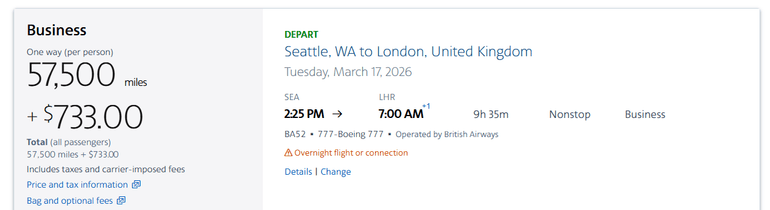
Consider this AAdvantage award from Seattle to London on Oneworld partner British Airways. The one-way cost in Business class is 57,500 miles and $733 in taxes and carrier-imposed fees:
In comparison, the cash price for the same itinerary is $3,028:
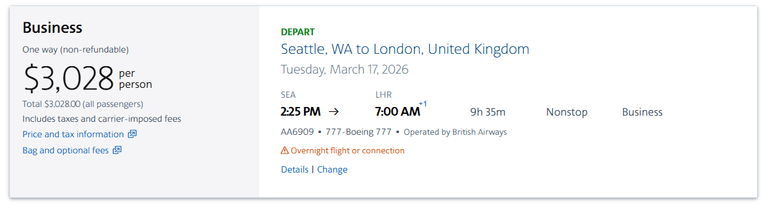
Accounting for award taxes and fees, but excluding opportunity costs and other cost considerations, this award yields a redemption value of 3.99 cents per mile.
This is more than twice NerdWallet’s valuation of AAdvantage miles, indicating that this award is an excellent deal despite the relatively high surcharges.
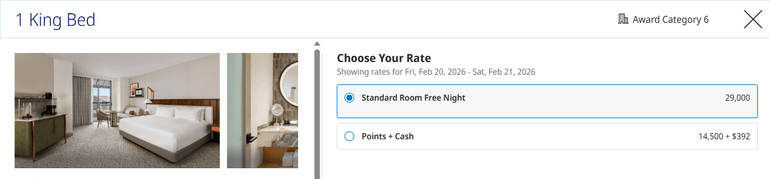
Redemption value is also useful for comparing different award booking options. For example, this World of Hyatt stay could be booked as a Points + Cash award for 14,500 points and $392, as a Standard Room Free Night award for 29,000 points, or at a cash rate of $759.
Running the numbers reveals a redemption value of 2.53 cents per point for the Points + Cash award, and 2.62 cents per point for the Free Night award. Both options are good deals based on NerdWallet’s valuation of 1.8 cents for World of Hyatt points, but the Free Night award is a little better.
Taking the time to do the math on redemption values like these can help you make the most of your points or miles and score the best deals on your travel bookings.
How to maximize your rewards
You want a travel credit card that prioritizes what’s important to you. Here are some of the best travel credit cards of 2026:
Flexibility, point transfers and a large bonus: Chase Sapphire Preferred® Card
No annual fee: Wells Fargo Autograph® Card
Flat-rate travel rewards: Capital One Venture Rewards Credit Card
Bonus travel rewards and high-end perks: Chase Sapphire Reserve®
Luxury perks: American Express Platinum Card®
Business travelers: Ink Business Preferred® Credit Card