Whenever you travel by air within, to or from the U.S., you’re electronically screened using the Transportation Security Administration Secure Flight screening program. While this system is transparent for most passengers, it occasionally misidentifies passengers as high risk.
If you've frequently been stopped for additional security during travel or have been denied travel for security reasons, you may consider applying for a redress control number (better known as redress number) to avoid this in the future.
The redress number meaning is a numeric identifier given to individuals who were falsely identified as posing threats to transportation security or public safety when flying. It aims to streamline TSA checkpoints for these travelers.
Here's how redress numbers for travel work and if applying for one is a smart move for you.
What is a redress number?
The short answer is a redress number is an identifier that allows TSA to match you with the results of your redress case. A redress number is used by the TSA’s Secure Flight program to simplify the watchlist matching process and can prevent future false matches of people who have been misidentified as matching a watchlist in the past.
A redress number is different from a Known Traveler Number, which identifies your membership in Trusted Traveler programs like TSA PreCheck and Global Entry.
» Learn more: Jump to credit cards with free TSA PreCheck
Most travelers won't have a redress number. Only people who have applied for the Department of Homeland Security’s Traveler Redress Inquiry Program, or TRIP, will have one.
Do I need a redress number?
If you've been denied travel or delayed during travel for additional security screening, or if you've had trouble getting through checkpoints at U.S. borders, DHS TRIP may provide relief from security-related travel woes.
Specifically, TSA suggests that you apply for a redress number if you've had issues like being unable to print a boarding pass, being denied or delayed boarding of a plane, being denied or delayed entry into or exit from the U.S. at a border checkpoint, or are frequently referred for additional screening at an airport.
Here is the list of issues that DHS says TRIP can help resolve:
You were unable to print a boarding pass from an airline ticketing kiosk or from the Internet.
You were delayed or denied boarding an aircraft.
The airline ticket agent informed you that the federal government was not authorizing you to travel.
You are repeatedly referred for secondary screening when clearing a U.S. Customs and Border Protection checkpoint or were denied entry into the U.S.
You were told by CBP at a U.S. port of entry that your fingerprints need to be corrected.
You wish to amend a traveler record because of an overstay as a result of not submitting the required I-94 when exiting the U.S.
You believe you were incorrectly denied ESTA authorization.
If you frequently experience issues like these when traveling, you might want to apply for DHS TRIP.
Note that TRIP is meant to resolve security-related issues like watchlist mismatches. It isn't intended to resolve customer-service complaints, address issues related to discrimination, help you find lost or damaged items or provide assistance during security screening.
Further, having a redress number doesn't guarantee that you'll never be selected for additional screening, but it makes additional screening less likely if you've been previously falsely matched to a watchlist.
» Learn more: TSA PreCheck or Global Entry — Which is right for you?

By signing up, you will receive newsletters and promotional content and agree to our Terms of Use and acknowledge the data practices in our Privacy Policy. You may unsubscribe at any time.
How to get a redress number
You can apply for a redress number through the Traveler Redress Inquiry Program portal if you believe that you're being incorrectly stopped or screened when flying.
During the application process, you'll be asked a series of screening questions to determine if obtaining a redress number may help solve your travel issues.
To apply, you'll be required to submit ID documents proving your identity. U.S. citizens should provide a copy of the biographical page of an unexpired U.S. passport or, for those without one, a copy of an unexpired government-issued photo identification.
Non-U.S. citizens must provide a copy of the biographical page of an unexpired passport and/or copies of one of several U.S. government-issued identification documents. Acceptable identification documents include:
Passport.
Passport card.
Driver's license.
Birth certificate (for people younger than 18.)
Military identification card.
Government identification card.
Certificate of citizenship.
Naturalization certificate.
Immigrant/non-immigrant visa.
Alien registration.
Petition or claim receipt.
I-94 admission form.
FAST card.
Border crossing card.
SEVIS card.
After the DHS receives and processes your application, it will send you a resolution letter detailing the outcome of your application. If you feel that your redress request was resolved incorrectly, you should follow the instructions in your resolution letter.
» Learn more: Can Americans travel to Europe?
How do I use a redress number?
Making sure your redress number is attached to your air travel reservations will give you the greatest chance of avoiding security hassles when flying or crossing U.S. borders.
You can attach your redress number to a travel reservation during booking, you can add it to your frequent flyer profile or you can ask an airport agent to add your redress number to your reservation at check-in.
Enter your redress number during booking
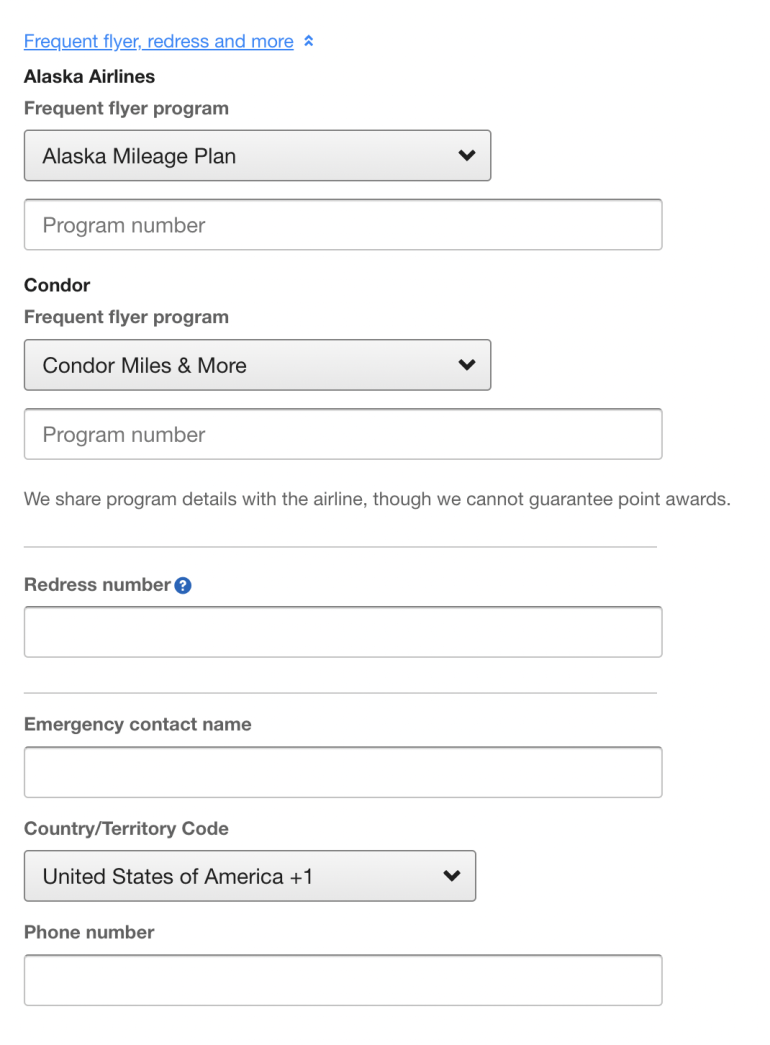
Enter your redress number during the booking process when using most online travel agencies, airline websites or travel agents.
For example, when booking a flight on Expedia, you can enter your redress number after you provide your name, gender and date of birth. Look for the option to expand the “Frequent flyer, redress and more” section of this page.
Other online travel agencies and airline websites will typically have a similar option during their booking process.
Enter your redress number in your frequent flyer profile
If you belong to a frequent flyer program, you can add your redress number to your loyalty member profile. For many travelers, this is the most convenient way to ensure that your redress number is applied automatically to all their reservations. The process will vary by airline, but this can typically be done online, similarly to how you would add a known traveler number.
If you are a Delta Air Lines SkyMiles member, for example, you can add your redress number to the Secure Flight Info section of your profile. On Delta.com, your Secure Flight Information can be found under the Passenger Details section of your profile.
Similarly, Southwest Airlines members can enter their redress number under the “Travel related info” panel in the personal information section of their profile.
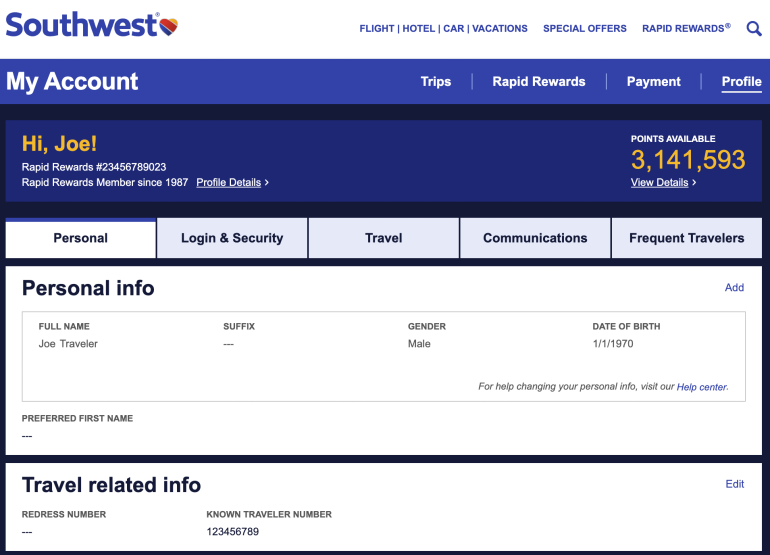
Exactly how to enter your information varies by airline, but the field to enter your redress number can typically be found in the same place where you enter your known traveler information.
» Learn more: The best frequent flyer program and credit card combo
Give your redress number to an airport agent
There may be times when you are unable to add your redress number to your reservation until check-in.
For example, if you book travel as part of a group tour package and your tour provider doesn’t provide your airline confirmation number, or if you booked through an online travel agency and forgot to add your redress number to your reservation, you may show up at the airport without your redress number attached to your reservation.
Most airport ticketing agents should be able to add your redress number to your reservation upon check-in.
Redress numbers for TSA recapped
While a redress number isn't required for travel and not everyone will need one, if you’ve experienced security-related issues while flying, applying for a redress number may be right for you. By adding it to your travel bookings or frequent flyer accounts, you can help TSA identify you to save time and stress.
How to maximize your rewards
You want a travel credit card that prioritizes what’s important to you. Here are some of the best travel credit cards of 2026:
Flexibility, point transfers and a large bonus: Chase Sapphire Preferred® Card
No annual fee: Wells Fargo Autograph® Card
Flat-rate travel rewards: Capital One Venture Rewards Credit Card
Bonus travel rewards and high-end perks: Chase Sapphire Reserve®
Luxury perks: American Express Platinum Card®
Business travelers: Ink Business Preferred® Credit Card