






You’re entitled to free weekly credit reports from Equifax, Experian and TransUnion through AnnualCreditReport.com, the only website authorized by federal law for this purpose.
As of 2026, free weekly access remains permanent. These reports were previously limited to once a year. Request all three at once or stagger them throughout the year to monitor more frequently. Reports don’t include a credit score. Checking your credit does not damage it.
Here’s how to get a free credit report from all three bureaus.
1. Go to the correct site
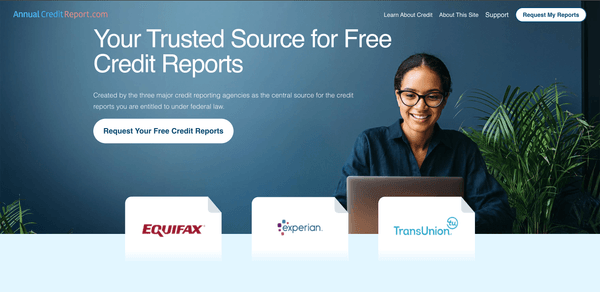
First, make sure you’re on the right site: AnnualCreditReport.com. Some other sites have similar-sounding names.
The one you want looks like this:
2. Enter your personal information
You'll need your name, Social Security number, address and birthdate. This, along with other personal data, will be matched against files for identification.
3. Request a credit report or reports
You can order your reports from one, two or all three of the major credit bureaus: Equifax, Experian and TransUnion.
Question | Answer |
|---|---|
Where do I get my free credit reports online? | AnnualCreditReport.com. |
Which credit bureaus are included? | Equifax, Experian and TransUnion. |
How often can I get them? | Weekly (as of July 2026). |
Do the reports include my credit score? | No. Credit reports don't include credit scores. |
Can I request all three reports at once? | Yes. You can request them together or separately throughout the year. |
Can I request my free reports by phone or mail? | Yes. Call 1-877-322-8228 or mail a request to Annual Credit Report Request Service, P.O. Box 105281, Atlanta, GA 30348-5281. Reports will be mailed within 15 days. |
How to get credit reports in Spanish
· TransUnion: Call 800-916-8800.
· Equifax: Visit the link or call 888-378-4329.
· Experian: Click on the link or call 888-397-3742.
🤓 Consejo Nerdy
Usted puede solicitar una copia de su informe crediticio (gratis y en español) de cada una de las tres principales agencias de crédito:
· TransUnion: Llame al 800-916-8800.
· Equifax: Visite el enlace o llame al 888-378-4329.
· Experian: Haga clic en el enlace o llame al 888-397-3742.
4. Successfully answer security questions
For each report request, you’ll be asked a few questions about your finances that presumably only you can answer — for instance, the approximate amount of your mortgage payment or who holds your auto loan and when you took it out.
Some consumers have reported difficulty using the site, particularly answering security questions about accounts that are several years old. If you can’t recall those details, you can request your reports by mail or phone; this process doesn’t require security questions.
Meet MoneyNerd, your shortcut to smart money moves
NerdWallet's twice-weekly newsletter offers practical, no-fluff guidance to help you spend smarter, save more, and make confident money decisions. Delivered free to your inbox.
5. View your credit report online or get it delivered
You can save reports to your desktop or print them out so you’ll have access later.
If you need to request a report or reports by mail, send a request form to:
Annual Credit Report Request Service
P.O. Box 105281
Atlanta, GA 30348-5281
Your report or reports should be sent within 15 business days.
You can also get your credit reports by calling 877-322-8228. Visually impaired consumers can also call this number to request audio, large-print or Braille reports.

6. Read your reports and fix errors
Read your credit reports, looking for:
Accounts that aren’t yours or you didn’t authorize.
Incorrect, negative information.
Negative information that’s too old to be included. Most negative information, other than one type of bankruptcy, should be excluded after seven years.
These errors have the potential to hurt your credit score, says Chi Chi Wu, a senior attorney with the National Consumer Law Center. You might see other types of errors, such as out-of-date employment information, she says, but those aren’t factored into your score.
If you find errors, dispute them. Typically, the fastest way to file a dispute is online, but you can also call the credit bureaus or send a credit dispute letter by mail. The credit bureaus will investigate and must remove information that they can’t verify.
7. Monitor your credit regularly
Monitoring your scores and reports can tip you off to problems such as an overlooked payment or identity theft. It also lets you track progress on building your credit. NerdWallet offers both a free credit report summary and a free credit score, updated weekly.
Here’s how the information you’ll get from AnnualCreditReport.com differs from what free personal finance sites may provide:
AnnualCreditReport.com provides:
Reports (not scores)
Data from all three major credit bureaus
An extensive history of your credit use
Personal finance websites, including NerdWallet, provide:
Credit scores, sometimes credit report information
Unlimited access
Data from one or two credit bureaus
A recent history of your credit use
Additional information about building and protecting your credit
» Get your free credit score from NerdWallet
Meet MoneyNerd, your shortcut to smart money moves
NerdWallet's twice-weekly newsletter offers practical, no-fluff guidance to help you spend smarter, save more, and make confident money decisions. Delivered free to your inbox.