


I’ll spoil the bottom line early: I’ve had both the Fidelity and Robinhood apps on my phone for years, and they’re each solid choices — but they target different kinds of users.
Fidelity is best for
Long-term investors.
Managing multiple accounts.
Robinhood is best for
Mobile experience.
IRA match.
What it’s like to use Fidelity
Fidelity is the platform I gravitate toward, not because it’s inherently better than Robinhood, but because it aligns more with my personal investing preferences. What I value most is simplicity, which I think is what Fidelity excels at.
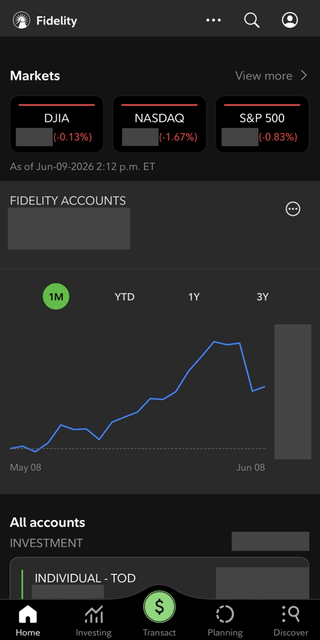
The broker’s mobile app, where I prefer to trade, is super intuitive. The homescreen shows you how your portfolio is performing overall, then breaks down each account below. If you’re like me and your 401(k) is through Fidelity, this is especially helpful. I can see all of my investments in one spot, and it helps me to think of them as a unit.
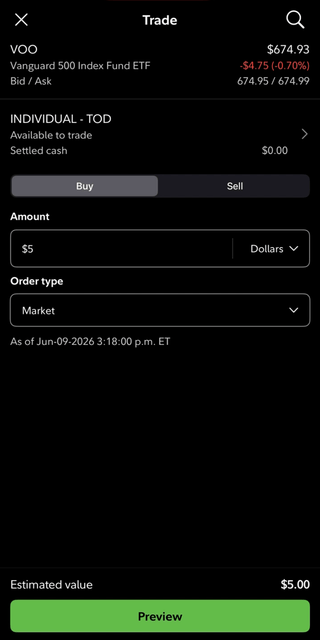
There’s also not much of a learning curve when you’re first getting started. There’s a green “transact” button at the bottom of the app that’s hard to miss. This is where I spend most of my time: You can transfer money from your external bank account, place a trade, automate your investments and more.
👉 All the details you need to know: Fidelity's account minimum, fees and more
Account minimum | $0 |
Stock trading costs | $0* |
Options trades | $0.65 per contract |
Account fees (annual, transfer, closing, inactivity) | Annual fee: $0 Inactivity fee: $0 Closing fee: $0 |
Interest rate on uninvested cash | Rates change frequently. For the current rate, check the 7-day SEC yield for Fidelity's SPAXX money market fund, its default account for idle cash. |
Number of no-transaction-fee mutual funds | 3,220 |
Tradable securities | Stocks, mutual funds, ETFs, options, bonds and fixed income, precious metals, crypto |
Trading platform | Three: Fidelity.com, mobile app, Fidelity Trader+ |
Mobile app | Available for iOS and Android |
Research and data | Several data providers, including Argus, Zacks, CFRA and S&P Global |
Customer support options (includes how easy it is to find key details on the website) | 24/7. Hours vary by contact method, but you can get help via phone, email, chat, over social media or at a physical branch. |
What it’s like to use Robinhood
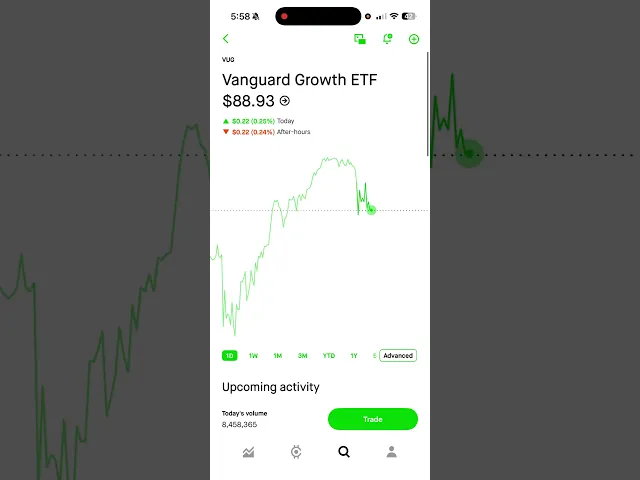
While Fidelity’s app is easier and more intuitive to use than some other legacy brokers, it can’t compete with Robinhood’s sleek design.
The biggest difference I noticed between the two brokers is how much Robinhood’s mobile app caters to investing trends. For example, the homepage features a prediction markets section that, after I showed some interest in and went to exit, Robinhood offered me $1 to stay on and learn more about the concept. On a similar note, the app has a dedicated tab for learning about and buying crypto.
Whether these features bother or entice you will depend on your preferences. While some passive investors may not mind all the extras, I found the app to be geared toward a more adventurous investor than myself.

👉 All the details you need to know: Robinhood's account minimum, fees and more
Account minimum | $0 for brokerage accounts, Robinhood Gold accounts and IRAs. |
Stock trading costs | $0. |
Options trades | $0 for equity options. $0.50 for index options, or $0.35 for Gold accounts. |
Account fees (annual, transfer, closing, inactivity) | No annual or inactivity fees. $100 ACAT outgoing transfer fee. Robinhood Gold costs $5 a month or $50 per year. Matching funds in IRAs may be taken back if money is withdrawn in less than five years. Instant withdrawals cost 1.75% of the amount withdrawn, with a minimum fee of $1 and a maximum of $150. |
Interest rate on uninvested cash | 0.01% for free accounts, 3.6% for Gold accounts |
Tradable securities | Stocks, ETFs, Options, Cryptocurrency, American Depositary Receipts for over 650 global companies, Futures, Fractional shares. Bonds only available in the form of bond ETFs. |
Number of no-transaction-fee mutual funds | Not rated; no mutual funds. |
Trading platform | Robinhood's mobile and web platforms are known for their smooth sign-up, funding and trading processes. The broker now also offers a desktop platform, Robinhood Legend. |
Mobile app | Mobile trading platform includes customizable alerts, news feed, advanced charting and ability to listen live to earnings calls for some companies. Reviews are mostly positive, although the average star rating on both iOS and Android is below the 4.5 star line. |
Research and data | Access to professional research from Morningstar and Level II market data from the Nasdaq Stock Exchange (with Gold subscription). |
Customer support options (includes how easy it is to find key details on the website) | 24/7 chat support. Phone support available from 7:00 a.m. ET to 9:00 p.m. ET, Monday - Friday. Decent suite of educational articles and webinar events, and an easily-navigable website. |
Fees $0per trade for online U.S. stocks and ETFs | Fees $0on trades of stocks, ETFs and their options. Other fees may apply. |
Account minimum $0 | Account minimum $0 |
Promotion Noneno promotion available at this time | Promotion Noneno promotion available at this time |


More about trading with each broker
Platform: Fidelity has three trading platforms: Fidelity.com, a mobile app and Fidelity Trader+. Robinhood has two: its well-known mobile app and a desktop platform called Robinhood Legend.
Tradable securities: Both brokers offer access to stocks, ETFs, options and crypto. Fidelity offers access to mutual funds — including some no-expense-ratio index funds — bonds, fixed income securities and precious metals. Robinhood offers access to American Depositary Receipts for over 650 global companies, futures and bond ETFs.
No-transaction-fee mutual funds: Notably, Robinhood doesn’t offer any mutual funds. Fidelity, on the other hand, offers over 3,220 mutual funds with no transaction fees.
Research and data: Fidelity has a long list of research providers, including Argus, Zacks, CFRA and S&P Global. This could make it a better fit for active traders than Robinhood’s offerings, which include Morningstar and Level II market data from the Nasdaq Stock Exchange (with a Gold subscription).
How fees and other costs compare
Both brokers have no account minimums or stock trading costs, but there are other fees to compare.
Options trading: Fidelity charges $0.65 per contract. Equity options are free with Robinhood, but index options will cost you $0.50 per trade (or $0.35 for Gold accounts).
Account fees: Fidelity and Robinhood both have no annual or inactivity fees. However, Fidelity doesn’t charge any closing fees, while Robinhood charges $100.
Good to know
IRA match: Robinhood’s IRA match is one of the strongest among the brokers we review. It offers a 1% match on IRA contributions for free accounts, and a 3% match for Gold members. Fidelity doesn’t offer a match.
Interest rate on uninvested cash: Some brokers offer programs that sweep your uninvested cash into a low-risk investment (like a money market fund) or an affiliated bank account to earn interest. Fidelity generally offers a competitive rate on uninvested cash to all users, whereas Robinhood’s rates depend on your subscription status. Non-Gold users get a scant 0.01% rate on uninvested cash, while Gold members get a 3.35% rate.
Customer support: Both providers score highly for their customer support options, offering 24/7 access in at least one form. Fidelity has a slight leg up, since you can get help via phone, email, chat, social media or at a physical branch. This is compared with Robinhood’s two forms of communication: chat and phone.
Fees $0per online equity trade | Fees $0per trade. Other fees apply. |
Account minimum $0 | Account minimum $0 |
Promotion Up to $500when you make a qualifying net deposit | Promotion Get up to $1,500when you open and fund an E*TRADE brokerage account. Terms apply. |


Methodology
How do we review brokers?
All NerdWallet reviews and lists of the best investing products are created by our editorial team of full-time writers and editors, independent of any business relationships. In this case, our investing team's comprehensive review process evaluates and ranks the largest U.S. brokers by assets under management, along with emerging industry players. Our aim is to provide an independent, balanced assessment of brokerages to help arm you with information to make sound, informed judgments on which ones will best meet your needs. Our highest priority is maintaining editorial integrity.
We collect data directly from brokerages through detailed questionnaires and conduct first-hand testing and observation through demonstrations. The questionnaire answers, combined with demonstrations, interviews of personnel at the brokerages and our specialists’ hands-on research, fuel our proprietary assessment process that scores each broker's performance across more than 20 factors. The final output produces star ratings from poor (one star) to excellent (five stars).
For more details about the categories considered when rating brokers and our process, read our full methodology.