



At least three days before you're scheduled to close on a mortgage, the lender will provide a Closing Disclosure.
This is a five-page form that spells out the final terms and closing costs of a home loan. If any information looks different from what you expected, contact the lender or settlement agent right away.
Using the Closing Disclosure to understand your mortgage
Because the disclosure document will include most details about your loan, it should be able to answer any lingering questions that you have. If not, your lender should be able to help.
Question | What to look for | Page number |
|---|---|---|
Will any costs change after closing? | “Loan Terms.” This section will specifically highlight whether any amounts can increase after closing, including any prepayment penalties. | 1 |
What will my monthly payment be? | “Projected Payments.” This breaks down the costs of principal, interest and estimated escrow. This section will also show you how this dollar amount might change over time. | 1 |
What closing costs will I be charged? | “Loan Costs” and “Other Costs.” These sections will break out each fee, and note which fees are paid before closing. | 2 |
How much do I owe at closing? | “Calculating Cash to Close.” This section will include anything you’ve already paid, along with what you still owe. It will also record your down payment, any seller credits and adjustments. | 3 |
Does my loan have any unique features I should know about? | “Loan Disclosures.” This section will tell you whether the loan is assumable, has a demand feature (where your lender can require early repayment) or has a negative amortization feature (where the principal balance grows). It will also tell you whether partial payments are allowed, as well as whether you have an escrow account and what the associated costs are. | 4 |
What will I pay over the total life of the loan? | “Loan Calculations.” This section will estimate your total payments, as well as the percentage of your payments that go toward- interest. | 5 |
Page 1
The first page of the Closing Disclosure provides an overall summary of your mortgage including the loan amount, interest rate, estimated monthly payment, closing costs and the amount of cash needed at closing.
This page also includes your personal information, so be sure to verify that your name is spelled correctly and your address is accurate. If there is an error, it's important to let your lender know so it can be corrected.
Page 2
The second page spells out the closing costs in detail. It breaks down where your money is going, including origination charges, which are the loan fees your lender charges for creating and processing your mortgage. It also lists third-party fees such as the cost of the appraisal, title services and inspections.
The “Other Costs” section includes additional expenses such as homeowners insurance and interest, initial escrow deposits for taxes and insurance, and government fees like recording or transfer taxes.
» MORE: Calculate your closing costs
Page 3
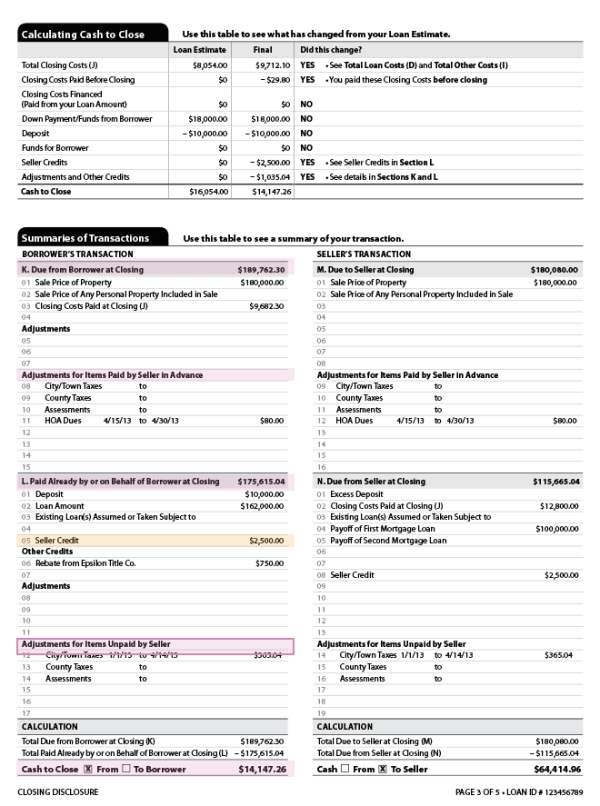
The third page shows the final breakdown of your numbers, including how your cash-to-close is calculated and a summary of the transaction. A comparison table shows the costs as reported by the Loan Estimate vs. the actual charges to be applied at closing. This section clearly shows whether the costs have changed since receiving your Loan Estimate.
At the bottom is the literal bottom line — the total amount you, as the borrower, will owe at closing. The image below is from a sample Closing Disclosure on the Consumer Financial Protection Bureau's website, where you can click through each page of the form for more detail.
Page 4
Page four outlines important loan terms and legal disclosures. It lays out the conditions of your mortgage, including escrow account details, potential late fees or penalties, and whether certain features apply, such as loan assumption or early repayment rules.
The fourth page also explains other terms that affect how your loan works over time and what you’re responsible for as the borrower.
Page 5
The fifth page provides a boiled down summary of the loan calculation along with contract details, and appraisal, refinancing and tax deduction disclosures.
This page is a great resource for who to contact about your loan, how and where to make payments, and includes additional details about your rights and responsibilities after closing.
What can cause a 3-day closing delay?
Any substantial revision to the loan’s terms triggers a new three-day review. Minor changes such as modifications to the escrow or adjustments to prorated payments for taxes, utilities and the like don’t qualify.
These three things can reset the 72-hour clock:
- The APR increases by more than one-eighth of a percentage point for fixed-rate loans or more than one-quarter of a percentage point for adjustable-rate mortgages.
- A prepayment penalty is added to the loan terms.
- The loan product changes, such as moving from a fixed-rate to an adjustable-rate loan or to an interest-only mortgage.
Explore more on