


Self-Directed IRA (SDIRA): How It Works and Where to Open One

Many, or all, of the products featured on this page are from our advertising partners who compensate us when you take certain actions on our website or click to take an action on their website. However, this does not influence our evaluations. Our opinions are our own. Here is a list of our partners and here's how we make money.
The investing information provided on this page is for educational purposes only. NerdWallet, Inc. does not offer advisory or brokerage services, nor does it recommend or advise investors to buy or sell particular stocks, securities or other investments.








What is a self-directed IRA?
See where you stand compared to households like yours, and get steps you could take to grow from here.

Self-directed IRA rules
How to open a self-directed IRA
Best self-directed IRAs
Standout feature: Lowest fees 🤑
Pros
No account minimum
Low first-year fee
Cons
No audit protection
Standout feature: Audit protection 🎉
Pros
No account minimum
Audit protection
Cons
High first-year fee
Standout feature: Advisor access 👩💼
Pros
No account minimum
Access to advisors for financial, legal or tax advice
Audit protection
Cons
High first-year fees
Compare more self-directed IRAs
| Minimum balance | First-year fees | Available investments | |
|---|---|---|---|
| The Entrust Group | $0 | $249 | Any |
| IRA Financial | $0 | $495 | Any |
| Directed IRA | $0 | $595 | Any |
| uDirect IRA | $500 | $325 | Any |
| Rocket Dollar | $0 | $720 | Restricted |
| Madison Trust Company | $500 | $490 | Restricted |
Advantages of a self-directed IRA
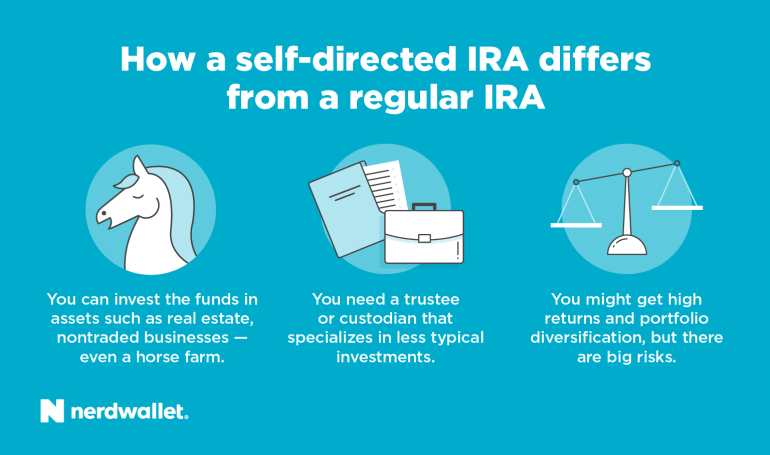
- Diversification. Investors can build a portfolio of investments to their specifications, investing in things that conventional retirement accounts don't typically offer.
- Potential for higher returns. For an investor well-versed in a specific industry or asset type, investing in a SDIRA could allow them to take advantage of those potential returns in a retirement account.
- Tax breaks. Investors can choose their SDIRA investments and build a portfolio to their specifications while still receiving the tax breaks found in traditional or Roth IRAs.
Risks of self-directed IRAs
- Self-directed due diligence. In a SDIRA, custodians and trustees only manage the account. They provide no financial guidance or recommendations. Instead, it’s up to the account holder to do their own due diligence. That includes evaluating future revenue and expenses for their investments, verifying the accuracy of financial information and more .
- Fees. SDIRA fees vary by custodian and type of investment; they are also dependent on actions the account holder takes.
- Lack of liquidity. Self-directed IRAs allow you to invest in a wide variety of investments, but those assets are often illiquid. That means if you run into an unexpected emergency, you might be hard-pressed to get money out of your IRA. You’ll need to find a buyer for the investment. This can also be an issue for owners of traditional self-directed IRAs when required minimum distributions come due at age 73.
- Lack of transparency. It can be hard to determine the monetary worth of an investment. The U.S. Securities and Exchange Commission (SEC) warns investors that self-directed IRA promoters sometimes list the purchase price, or the purchase price plus expected returns, as the valuation. But that figure isn't the actual amount you'll get for the asset. "If possible, take steps to independently verify information — such as prices and asset values — provided in account statements," the agency says .
- Higher potential for fraud. Fraudsters have used self-directed IRAs as a way to add a stamp of legitimacy to their schemes. One common ruse is to say the IRA custodian has vetted or approved of the underlying investment, when, as the SEC notes, custodians generally don’t evaluate “the quality or legitimacy of any investment in the self-directed IRA or its promoters.”
- Concentrated portfolios. Proponents of self-directed IRAs say their ability to invest outside the mainstream improves their diversification. But a self-directed IRA can lack diversity like any other retirement account.
See where you stand compared to households like yours, and get steps you could take to grow from here.
How do I know if my IRA is self-directed?
Can I invest in real estate through a self-directed IRA?
How much money can you put in a self-directed IRA?
The bottom line
Article sources
- 1. FINRA. Investor Alert: Self-Directed IRAs and the Risk of Fraud. Accessed Sep 9, 2025.
- 2. Investor.gov. Investor Alert: Self-Directed IRAs and the Risk of Fraud. Accessed Sep 10, 2025.
- 3. IRS.gov. Retirement plans FAQs regarding IRAs. Accessed Sep 10, 2025.
- What is a self-directed IRA?
- Self-directed IRA rules
- How to open a self-directed IRA
- Best self-directed IRAs
- Compare more self-directed IRAs
- Advantages of a self-directed IRA
- Risks of self-directed IRAs
- How do I know if my IRA is self-directed?
- Can I invest in real estate through a self-directed IRA?
- How much money can you put in a self-directed IRA?
- The bottom line










 AD Advertisement