








Updated on Oct. 19.
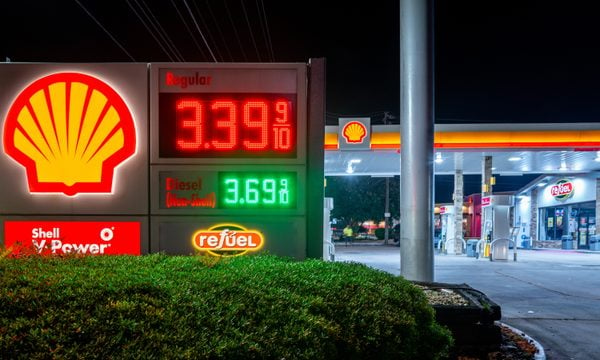
The average regular gas price in the U.S. as of Oct. 19 is $4.2953 per gallon, according to AAA.
One week ago: $4.3556
One month ago: $4.4759
One year ago: $3.0362
Crude oil is trading around $109 a barrel and gas prices remain elevated as hostilities with Iran continue. The U.S. and Iran have continued to exchange strikes and negotiations are stalled. Iran is continuing to block the Strait of Hormuz, while the U.S. maintains economic sanctions and a naval blockade.
Gasoline prices remain below their all-time high and have slightly declined over the last week. Meanwhile, diesel costs hit new records in late September, thanks to the wars in Iran and Ukraine. On Oct. 2, the G7 issued a joint statement that it would be coordinating a release of 100 million barrels of crude oil and diesel over four months to combat rising prices.
The International Energy Agency says oil markets are expected to remain tight into 2027, with diesel shortages and lingering supply disruptions continuing to put pressure on fuel prices well into next year, according to its latest oil market report released on Oct. 14.
On Feb. 28, the first day of the U.S.-Israeli attacks on Iran, the national average price of a gallon of regular gas was just under $3. Any return to pre-war prices could be as far as a year away as global energy supply recovers from what has been a major disruption.
State prices for a gallon of regular gas range from $3.61 in North Carolina to $6.17 in California, according to AAA.
The text and charts below are updated weekly.
What are gas prices like right now?
As of Oct. 19, gas prices sit around $4.2953 a gallon, nearing the 2026 high of $4.50 nationally in June and $1.69 higher since the war began. Gas prices were below $3 in 39 states in February.
Oil prices spiked after the U.S.-Israeli attack on Iran began on Feb. 28, peaking at over $110 per barrel as oil shipments through the Strait of Hormuz were halted because of the war. Gas prices have climbed steadily even as oil prices have gyrated wildly.
Meet MoneyNerd, your shortcut to smart money moves
NerdWallet's twice-weekly newsletter offers practical, no-fluff guidance to help you spend smarter, save more, and make confident money decisions. Delivered free to your inbox.
Gas price inflation, explained
Gas prices surged in 2021 and 2022, largely due to two economic disruptions: pandemic-related supply shocks and then Russia’s invasion of Ukraine. The combination of the two hit energy markets hard and prices never recovered to pre-pandemic levels.
Here’s what happened:
In 2019, before the pandemic, the average per-gallon price of regular gas was $2.601, according to EIA data.
Following Russia’s invasion of Ukraine, the national average increased before peaking at $5.016 per gallon on June 14, 2022, according to AAA.
Until the Iran invasion, gas prices had retreated, Until the Iran invasion, gas prices had retreated, but hadn’t returned to pre-pandemic levels.
Why gas prices remain higher than they used to be
At this time of year, seasonal factors play a considerable role in raising gas prices. A scheduled switch to summer-blend gasoline temporarily elevates prices through the warm months. Inflation, supply-chain disruptions and gas tax hikes can factor into higher prices, as well. But in the end, elevated oil prices are the main culprit.
The cost of oil typically represents more than half of the cost of a gallon of gasoline, according to the U.S. Energy Information Administration (EIA). So, a major reason gas prices have remained so high is that, until recently, oil prices were higher than they were before the pandemic hit in 2020 and Russia invaded Ukraine in 2022. That’s based on the average monthly price of West Texas Intermediate crude, which is used as the benchmark for oil prices in North America.
For much of the year to date fuel costs had been lower than they were a year ago. That has changed dramatically in the last few weeks. Here’s how gas prices compare today:
As of Oct. 19, the average regular gas price in the U.S. is $4.2953 per gallon, according to AAA, which tracks gas prices.
The price is down from $4.3556 a gallon a week ago.
The price is up from $4.4759 per gallon a month ago.
A year ago, the price was $3.0362 per gallon.
Oil prices remain below their June 2022 peak of almost $120 per barrel.
Average gas price per state
The average gas price per state varies widely, with the most expensive state typically costing about $2 more per gallon of regular than the least expensive state.
(Photo by Joe Raedle/Getty Images)