Small manufacturers looking for flexible funding have a new option: MARC (Manufacturers’ Access to Revolving Credit) loans from the U.S. Small Business Administration. MARC loans provide the same large funding amounts, competitive interest rates and long repayment terms as other SBA loans, but stand out by offering term loans and revolving lines of credit.
How much do you need?
Fast facts about the SBA MARC program
Launched on Oct. 1, 2025.
Limited to small manufacturing businesses.
A subset of the SBA 7(a) loan program.
Partially guaranteed by the SBA.
Issued by participating lenders, typically banks and credit unions.
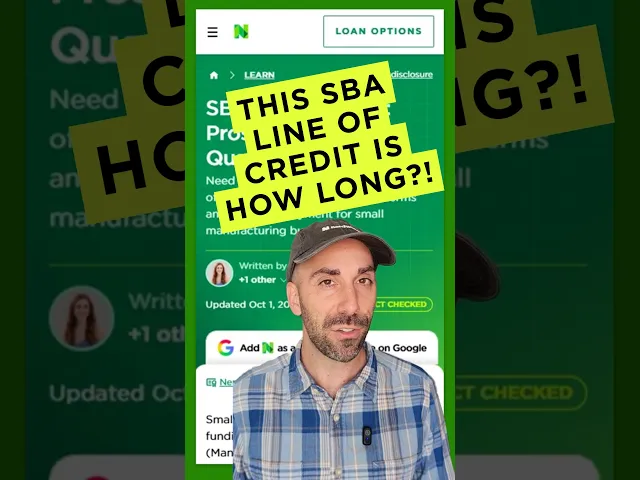
MARC line of credit is the longest working capital financing that the SBA offers.
SBA Manufacturers’ Access to Revolving Credit loan features
SBA MARC loans can be structured as term loans or lines of credit, and can be used for working capital.
Loan amount | Up to $5 million. |
Maximum SBA guarantee | 85% for loans up to $150,000 and 75% for loans greater than $150,000. |
Terms |
|
Interest rates | SBA loan rates can be fixed or variable:
|
Fees |
|
Collateral | At minimum, your lender will place a lien on all of your business assets — with the exception of vehicles and trading assets. |
*Revolving line of credit limits
SBA MARC lines of credit are subject to annual renewal requirements and overall structural limits.
Annual review: Every year, your lender will take another look at your finances — think your cash flow, debt coverage and collateral — to confirm you still qualify. If you meet the requirements, your line of credit will be renewed for another year. If you don’t, your credit line is converted into a standard term loan and you won’t be able to borrow additional funds.
Term-out period: If your credit line lasts longer than one year, it must include a repayment period known as the “term-out period.” After the draw period (when you can borrow money), the term-out period goes into effect. During this time, you aren’t allowed to access any more funds and instead you have to repay what you’ve borrowed. For MARC lines of credit, the term-out period must be at least as long as the draw period.
Because of these rules, SBA MARC lines of credit can only revolve for up to 10 years. After 10 years, any remaining balance is converted into a regular term loan, which can then be repaid over a maximum of 10 more years.
» MORE: Best working capital loans

Pros and cons of SBA MARC loans
Pros
Available as a term loan or line of credit.
Large loan amounts.
Competitive interest rates and terms.
Line of credit has longer repayment terms than other SBA working capital loans.
Government guarantee makes it somewhat easier to qualify compared with conventional business bank loans.
Cons
Slow to fund.
Can only be used for working capital. For example, can't be used for buying equipment or real estate.
Lenders may charge an annual fee for lines of credit.
May not be available from all 7(a) lenders.
🔎 Want to compare a wider range of financing options? Check out our list of the best small business loans.
SBA MARC loan requirements
To qualify for an SBA MARC loan, your business must be in the manufacturing industry. Specifically, your North American Industry Classification System (NAICS) code must start with 31, 32 or 33.
You must also have a debt service coverage ratio equal to or greater than 1.0 based on past financial performance — or if you’re a new business relying on projections — you must reach a ratio of at least 1.0 within two years of loan disbursement. In simple terms, this means your business needs to bring in enough cash to cover at least 100% of your loan payments.
In addition to these MARC-specific rules, you’ll need to meet the standard set of SBA loan requirements, including:
Qualify as a small business, according to SBA size standards.
Be a for-profit business located in the United States or its territories.
Be 100% owned by U.S. citizens, U.S. nationals or unconditional lawful permanent residents.
Prove that the owners have invested in the business, either through money or time.
Demonstrate good credit and the ability to repay the loan.
Be unable to access the financing from non-government sources.
No delinquencies on any existing government loans.
Provide a personal guarantee from anyone who owns 20% or more of the business.
The SBA doesn’t set specific qualifications for credit score, time in business or annual revenue. Instead, your lender will set those requirements. Generally speaking, however, it’s helpful to have good credit, strong revenue and at least two years in business.
Who should get an SBA MARC loan?
SBA MARC loans can be a good option for small manufacturers who want a streamlined application process, higher funding limits and flexibility on their loan type. Beyond this, you should also consider:
Specialized focus. SBA MARC loans are specifically designed to make it easier for small manufacturers to get financing. Because this program has a narrower focus, borrowers may benefit from fewer applications to compete with than in a standard SBA loan program.
Challenges of a new loan option. Since MARC loans are a new addition to the 7(a) program, it may be harder to find lenders that offer them. Processing times could also be slower as lenders learn how to administer the program and work through questions with the SBA.
7(a) guarantee fee waiver for small manufacturers. If you’re a small manufacturer looking for a term loan of $950,000 or less, a standard 7(a) loan will likely be the better choice over a MARC loan. For fiscal year 2026, the SBA is waiving guarantee fees on 7(a) loans of this size for small manufacturers. MARC loans, however, still require borrowers to pay the guarantee fee. For example, on a $500,000 loan with a term longer than 12 months, that waiver translates to a savings of $11,250.
Long repayment terms for line of credit. The MARC line of credit offers the longest terms of any SBA working capital product. You can get a revolving line of credit for up to 10 years, which then converts to a term loan with an additional repayment period of up to 10 more years. That’s a total of 20 years — twice as long as comparable products. In contrast, standard 7(a) loans, Express loans, Express lines of credit and SBA Working CAPLines are all capped at 10 years.
How to apply for an SBA MARC loan
You apply for an SBA MARC loan through a participating SBA lender, like a bank or credit union. If you already have a relationship with a financial institution, start by asking if it offers this type of SBA loan.
What you’ll need to apply:
SBA Form 1919, Borrower Information Form.
SBA Form 912, Statement of Personal History.
Personal financial statement (you can use SBA Form 413).
Business financial statements, such as income statements, balance sheets and cash flow projections.
Business and personal tax returns.
Detailed list of collateral.
Existing debt schedule (if applicable).
Business certificates or licenses.
Loan application history.
Resumes for each business owner.
Business overview and history.
Business lease.
Once you’ve submitted your application, the underwriting, approval and closing processes can take anywhere from 30 to 90 days. SBA preferred lenders may offer faster processing times, as they can approve and issue loans without SBA review.

Alternatives to SBA MARC loans
Not sure if an SBA MARC loan is right for your business? You still have options. Here are a few other types of financing to consider:
SBA Express loans

If your business isn’t in manufacturing or you need financing for more than working capital, an SBA Express loan might be a good fit. Express loans are available to a wide variety of small businesses and can be used for working capital, purchasing equipment or real estate, as well as refinancing debt.
Like SBA MARC loans, Express loans are available as either term loans or lines of credit, with competitive rates and repayment terms. However, the maximum loan amount is capped at $500000.
Express loans can fund faster than other SBA loans, since lenders can issue them without SBA approval (similar to the way preferred lenders operate). Plus, because these loans are a long-standing part of the 7(a) program, you’ll likely find more lenders that offer them as opposed to the new MARC option.
SBA microloans
SBA microloans are aimed at helping businesses that may have a harder time qualifying for other types of financing. That makes them a good option for companies that may not qualify for an SBA MARC loan.
These loans are issued by approved intermediaries, typically nonprofit and community lenders, which tend to have flexible qualification requirements. These lenders may also offer business training, coaching and other educational resources.
The trade-off is that SBA microloans are smaller — they cap out at $50000. Still, they come with competitive rates and repayment terms, making them a strong choice for newer or smaller businesses.
Online loans
If speed is your priority, consider online business loans. Some lenders can issue funding as quickly as the same day you apply.
These lenders also tend to have flexible qualification requirements, making them a good option for startups and borrowers with bad credit. As a result of their speed and flexibility, however, these loans often have higher interest rates and shorter repayment terms.
Article sources
- 1.U.S. Small Business Administration. SOP 50 10, Appendix 13: 7(a) Manufacturers' Access to Revolving Credit (MARC).
- 2.U.S. Small Business Administration. Types of 7(a) loans. Accessed Sep 22, 2026.
- 3.U.S. Small Business Administration. 7(a) Fees Effective October 1, 2025 for Fiscal Year 2026 and 90-Day Rule Clarification. Accessed Sep 22, 2026.